
Running an internet radio station in the US legally comes down to two things: music licensing and business licensing. You do not need an FCC license for internet-only broadcasting, but you do need permission from the copyright holders of every song you stream. This guide walks through exactly what that means, what it costs, and how to set it up the right way in 2026.
I’ve spent the last several years talking to broadcasters, digging into the rates set by SoundExchange, ASCAP, BMI, and SESAC, and watching what happens when station owners skip the paperwork. The good news: staying compliant costs less than most people think, and the process is straightforward once you understand the two separate copyrights involved.
Table of Contents
- What Is an Internet Radio Station and Why Is It Different From Terrestrial Radio?
- The Two Copyrights Every Internet Broadcaster Must Understand
- SoundExchange Licensing: What It Covers and How Much It Costs
- ASCAP, BMI, and SESAC: Performance Rights Organizations Explained
- Business Licensing Requirements for US Internet Radio
- FCC Regulations and Internet Radio: What You Don’t Need
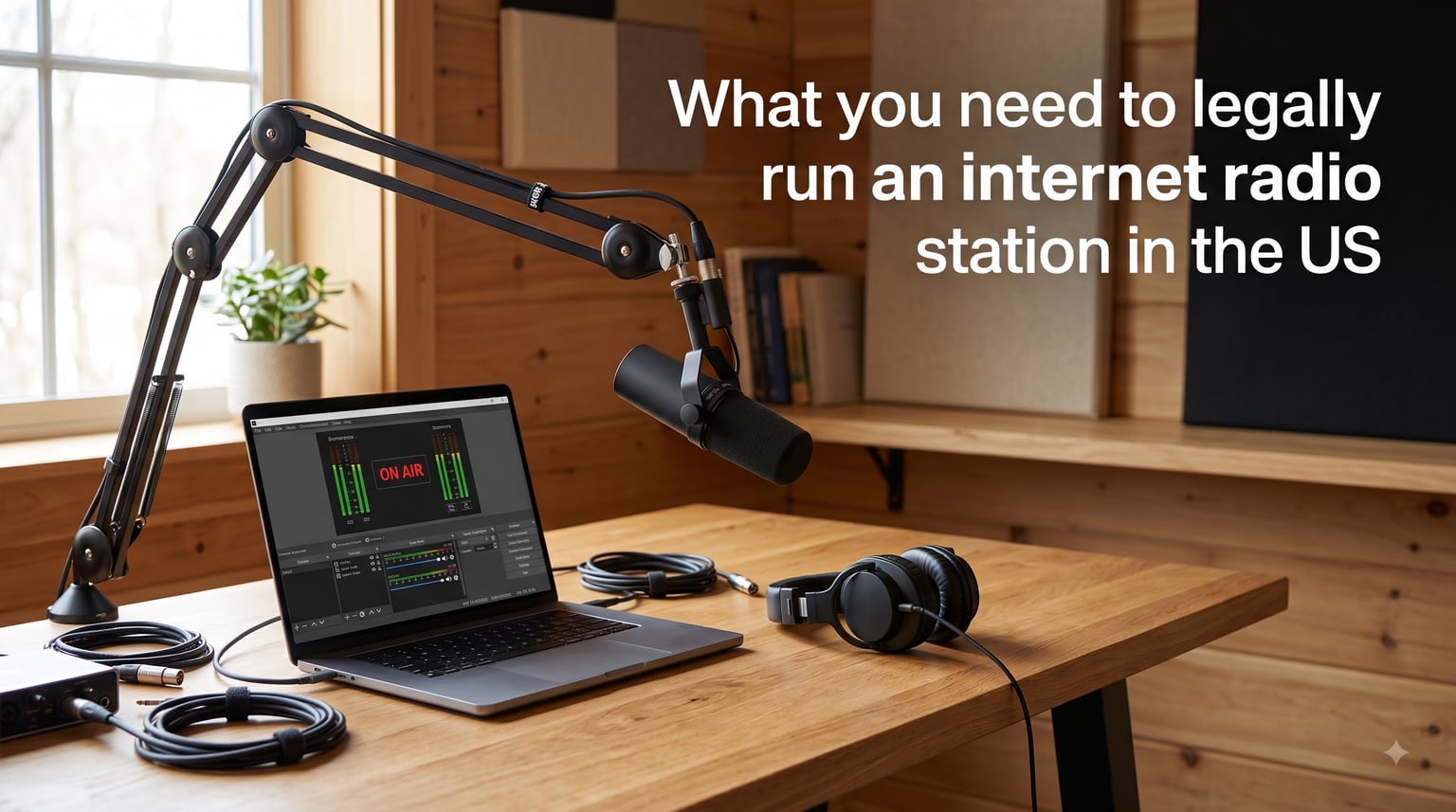
- Equipment and Software Checklist for a Legal Station
- Royalty Calculation: A Real-World Example
- What Happens If You Broadcast Without the Right Licenses
- Cost-Saving Alternatives: Creative Commons and Royalty-Free Music
- Step-by-Step Compliance Checklist
- Frequently Asked Questions
- Final Thoughts on What You Need to Legally Run an Internet Radio Station in the US
What Is an Internet Radio Station and Why Is It Different From Terrestrial Radio?
An internet radio station is an audio broadcasting service that streams over the web rather than over FM or AM airwaves. Listeners tune in through a website, a mobile app, or directories like TuneIn and iHeartRadio. The station sends an encoded audio signal through a hosting platform, and any listener with the stream URL or app can hear the broadcast in real time.
Terrestrial radio stations broadcast over licensed spectrum regulated by the Federal Communications Commission (FCC). They need a specific frequency assignment and pay fees to the FCC. Internet radio stations broadcast as data over the public internet, not over regulated spectrum, which puts them under a different set of rules. The Copyright Act covers them, while the Communications Act primarily does not.
Here’s the part most beginners get wrong: the FCC does not regulate internet-only streaming the way it regulates over-the-air broadcasting. You do not need an FCC construction permit, you do not need a frequency, and you do not file anything with the FCC to start. The licenses you need come from private music rights organizations, not from a federal agency.
That distinction matters because it means your legal checklist looks very different from a traditional radio station’s. You won’t fight for a frequency slot, but you will need to pay royalties to songwriters and recording artists through established collectives. Those are the two pieces of the puzzle we’ll cover next.
The Two Copyrights Every Internet Broadcaster Must Understand
Every commercially released song carries two distinct copyrights, and you need permission from both to legally stream it. Most first-time broadcasters only learn about one of them. Missing the second is the most common reason for DMCA takedowns.
The first copyright covers the composition — the melody, lyrics, and underlying musical work written by the songwriter or composer. This is what ASCAP, BMI, and SESAC represent. Performance rights organizations collect royalties on behalf of songwriters and publishers whenever the composition is performed publicly, including when you stream it.
The second copyright covers the sound recording, also called the master. This is the specific recorded version of the song performed by a particular artist, produced by a particular label. SoundExchange collects royalties on behalf of recording artists and labels for the digital performance of their masters. Without this license, you could pay every songwriter but still owe the performer and label separately.
Most stations focused on commercial hits need both. A station playing only original recordings it owns outright, or only royalty-free and Creative Commons music, can skip one or both. I’ll cover those alternatives later. For the typical scenario where you stream mainstream music from major and indie labels, plan to license both copyrights.
SoundExchange Licensing: What It Covers and How Much It Costs
SoundExchange is the non-profit designated by the US Copyright Office to collect royalties for the digital performance of sound recordings. For internet-only streaming, your license comes through SoundExchange’s statutory webcasting license — a rate set by the Copyright Royalty Board rather than negotiated with every individual label.
The current statutory rate for non-subscription internet radio webcasting is $0.0023 per performance for stations earning under $1.25 million in annual revenue. A performance means each time a single listener hears a single song. If 100 listeners all hear the same track at the same time, that’s 100 performances. The rate covers 100% of the royalty, with SoundExchange distributing roughly 50% to the featured artist, 45% to the rights owner (usually the label), and 5% to session musicians via the AFM and SAG-AFTRA funds.
To register, you fill out SoundExchange’s online application, agree to the royalty terms, and file monthly reports of your total performances. Reporting is mandatory even if your count is zero in a given month. You also pay a $100 annual fee for non-commercial stations, while commercial stations pay a small percentage-based fee on gross revenues.
Here’s a working calculation so the numbers feel less abstract: a station playing 15 songs per hour for 8 hours per day with 100 simultaneous listeners generates 12,000 performances per day. At $0.0023 each, that’s $27.60 in SoundExchange royalties per day, or roughly $828 per month and $10,000 per year. The license itself is the cheaper part — the royalty is the bigger ongoing cost. That is also why royalty-free and Creative Commons strategies appeal to small operators.
ASCAP, BMI, and SESAC: Performance Rights Organizations Explained
PROs collect royalties for the composition side of every song you play. The three major PROs in the US operate as separate collectives, so you need a license from each one if your playlist includes works from all three. Skipping any of them is the most common compliance mistake I see.
ASCAP and BMI are the largest, representing the catalogs of most major publishers and songwriters in the US. SESAC is smaller and represents a more selective roster. Major-label hits usually appear across all three catalogs indirectly, which is why broadcasters pay each PRO individually rather than picking one.
ASCAP’s internet radio license starts at a few hundred dollars per year and scales with station revenue. BMI’s webcasting license is similarly tiered. SESAC’s webcasting license is flat-fee based on gross revenue tiers. None of them charges per-song usage for the typical small broadcaster — you pay a blanket fee that covers the entire represented catalog.
The application is straightforward: fill out the online form, agree to the terms, pay the annual fee, and you get the right to perform any song in that PRO’s catalog. Renew annually. Report your usage if the PRO requires it. The total annual spend for a small station is usually in the high hundreds to low thousands when combining ASCAP, BMI, and SESAC.
Quick Comparison: SoundExchange vs PRO Licenses
SoundExchange covers the sound recording — the artist’s specific recorded performance. PROs cover the composition — the underlying song. Both are required when streaming commercial music. Both charge annually, but SoundExchange royalties scale with audience size while PROs scale primarily with revenue.
Business Licensing Requirements for US Internet Radio
Music licensing is the headline requirement, but your state and local government also want to know you exist. Business licensing is the easier piece of the puzzle, and the part most people forget until a station starts earning revenue.
You generally need a few standard business items regardless of state: a federal Employer Identification Number (EIN) from the IRS if you operate as anything other than a sole proprietor, a registered business entity (LLC, corporation, or sole proprietorship), and any state or local business license your city or county requires. Costs range from $0 in some states to $500+ in others. California, for example, charges an $800 minimum franchise tax for LLCs in their first year, even if you earn nothing.
If you sell advertising or take donations over a threshold your state defines, you’ll register for state sales tax if applicable and report the income. Hobby stations with no revenue may qualify for non-commercial status in some states and avoid parts of this, but the moment you monetize — even modestly — the authorities want a record.
Filing a “Doing Business As” (DBA) name is only required if you operate under a name other than your legal name. Many small stations do file one, since stations like “Coastal Jazz Radio” sound more professional than “Joe Smith’s Stream.”
FCC Regulations and Internet Radio: What You Don’t Need
Internet-only streaming does not require an FCC license. This is the single biggest misconception I hear from new broadcasters, and it’s worth saying clearly: you do not need to apply to the FCC, you don’t get a call sign, and you don’t pay FCC regulatory fees to operate an internet-only station.
The FCC regulates broadcasters because they use public spectrum — a finite resource the government controls. The internet is not licensed spectrum, and the FCC has consistently taken the position that internet-only streaming falls outside its broadcast licensing authority. The agency focuses on terrestrial radio and television, plus newer digital broadcast standards, but not pure streaming.
There is a narrow exception: if you also operate an FM or AM transmitter alongside your stream, the FCC license covers the over-the-air portion, and your internet feed piggybacks on that licensed station. Pure webcasters — the bulk of new stations — stay outside FCC jurisdiction entirely.
Equipment and Software Checklist for a Legal Station
The hardware and software side of an internet radio station is actually the easiest part. Most stations today run on a laptop with an internet connection, a hosting platform, and broadcast software. You can launch for well under $500 if you already own a computer.
Here’s the core stack:
- Broadcast computer: Any modern laptop or desktop. A dedicated machine is cleaner but optional. macOS or Windows both work.
- Streaming host and encoder: Services like Live365, Radio.co, or Shoutcast provide the streaming server, storage, and player embed. They handle the listening URL and the bandwidth bill.
- Automation/playout software: Tools like RadioDJ, SAM Broadcaster, or Mixxx let you schedule playlists, queue DJ breaks, and run 24/7 without human intervention.
- Microphone and audio interface: Needed for live DJ shows. USB mics work for entry-level; an XLR mic plus interface is better for serious broadcasting.
- Music library: Your source tracks, properly tagged, organized, and most importantly licensed.
- Headphones and monitors: For live DJ work and quality control.
Bandwidth is the variable cost most beginners underestimate. Hosting platforms typically charge based on listener count. Budget around $5 to $50 per month for hobby stations and $100 to $500 for stations building audience. Above a few hundred concurrent listeners, dedicated server plans become more cost-effective.
Royalty Calculation: A Real-World Example
Let’s run through a concrete scenario so the royalty math feels real. Take a new US-based internet station running 12 hours per day with 50 simultaneous listeners and a playlist averaging 14 tracks per hour.
Hourly performances: 14 songs × 50 listeners = 700 performances per hour. Daily performances: 700 × 12 hours = 8,400. Monthly performances: 8,400 × 30 days = 252,000. At the $0.0023 statutory rate, monthly SoundExchange royalties are approximately $580. Annual: roughly $6,950.
Now add the PRO blanket licenses. ASCAP might run $300 to $700 per year for this size operation. BMI another $300 to $600. SESAC another $300 to $500. Combined PRO spend of roughly $1,000 to $1,800 per year.
Total music licensing cost in this scenario falls around $8,000 to $9,000 per year. That figure matches what broadcast operators consistently report on community forums like Reddit’s r/radio, where users cite $2,500 per year as a minimum baseline for full coverage. Numbers climb quickly with audience size because the SoundExchange royalty scales linearly with listener count, while revenue-based PRO tiers scale more slowly.
The takeaway: if your station is large enough to be an asset, it’s large enough to make licensing a meaningful budget line. Build it into your business plan from day one.
What Happens If You Broadcast Without the Right Licenses
Skipping music licensing isn’t a quiet risk. Rights holders actively monitor streams, and detection is automated. Once a violation is identified, the consequences escalate fast.
The first sign is usually a DMCA takedown notice sent to your hosting provider. Your stream gets pulled offline within hours. Hosting services take these seriously because they face liability too. Reinstating the stream requires the rights organization to confirm compliance, which means paying back-royalties and signing the relevant license — and waiting through an appeals process that can take weeks.
Repeated infringement triggers harsher responses. SoundExchange, the major PROs, and individual labels can sue for statutory damages up to $150,000 per infringed work in willful cases. Even non-willful infringement carries statutory damages up to $30,000 per work. A small station playing 50 copyrighted songs without a license faces theoretical exposure in the millions.
In practice, lawsuits target the largest offenders, but DMCA takedowns happen to small stations regularly. The safest path is to get the licenses before you start, not after your first takedown. Costs are predictable when you plan; consequences are not.
Cost-Saving Alternatives: Creative Commons and Royalty-Free Music
Not every internet station needs to license commercial music. If your budget is tight, your playlist can be built from royalty-free libraries and Creative Commons-licensed tracks, which dramatically reduces your compliance overhead.
Royalty-free music sites like Epidemic Sound, Artlist, and the Free Music Archive offer catalogs cleared for commercial streaming. The catch: royalty-free typically means you pay a subscription or one-time fee to the library, not that the music is free of charge. Stations still need to confirm each track’s license terms allow internet radio distribution, since some licenses cap uses to personal projects.
Creative Commons-licensed music is genuinely free, but each track carries specific license terms. CC-BY requires attribution. CC-BY-NC forbids commercial use. CC-BY-SA requires you to license your stream under the same terms, which is impractical. Reading each track’s specific Creative Commons license is non-negotiable.
For talk-format stations with very little music, SoundExchange and PRO royalties may be minimal. Some rights organizations offer reduced-rate or capped licenses for low-use stations. Contact SoundExchange and your PROs directly to ask — most have a representative who can walk you through tiered options.
Step-by-Step Compliance Checklist
Here’s the order I recommend for setting up a legal US internet radio station in 2026:
- Form your business entity and obtain an EIN from the IRS.
- Apply for state and local business licenses in your jurisdiction.
- Register with SoundExchange for the statutory webcasting license.
- Secure ASCAP, BMI, and SESAC webcasting licenses.
- Choose a streaming host and encoder that meets your bandwidth targets.
- Configure automation software with your properly licensed music library.
- Set up monthly reporting with SoundExchange and any required PRO filings.
- Document every music source and license — proof matters if challenged.
Steps 3 and 4 should happen before you ever go live. Once you’re streaming, every song played without a license creates liability in real time.
Frequently Asked Questions
Can anyone start an internet radio station?
Yes. Anyone in the US with a computer, an internet connection, and proper music licenses can start a legally compliant internet radio station. The FCC does not regulate internet-only streaming, so no government broadcasting license is required. You do need permission from the copyright holders of the music you stream, which means licensing through SoundExchange and at least the major PROs.
How much does it cost to start an internet radio station?
Startup costs are modest: $100 to $500 for basic equipment and software, plus $20 to $100 per month for streaming hosting. Ongoing music licensing is the larger annual expense. A small commercial station typically budgets $2,500 to $9,000 per year for SoundExchange royalties and PRO blanket licenses, scaling with listener count and revenue.
What equipment is needed to start an internet radio station?
At minimum, you need a computer, broadcast automation software (RadioDJ, SAM Broadcaster, or Mixxx), a streaming host with encoder, your properly licensed music library, and an internet connection. Add a USB or XLR microphone and audio interface for live DJ shows. Headphones and monitor speakers help with quality control.
Do you need a license to run a radio station?
Yes, you need music licenses. To legally stream commercial music you need a SoundExchange license for the sound recording copyright, and ASCAP, BMI, and SESAC licenses for the composition copyright. You do not need an FCC license for internet-only streaming — that requirement applies only to terrestrial broadcasts using public spectrum.
Does internet radio need a license?
Internet radio requires music licensing but not an FCC broadcasting license. The two main categories are SoundExchange (covering the recorded performance, paid per listener per song) and the PROs — ASCAP, BMI, and SESAC (covering the underlying composition, paid as an annual blanket fee).
Final Thoughts on What You Need to Legally Run an Internet Radio Station in the US
Legally running an internet radio station in the US comes down to three things: music licensing through SoundExchange and the PROs, basic state and federal business registration, and no FCC paperwork because internet-only streaming sits outside broadcast regulation. The setup is lighter than a terrestrial station but the compliance is real.
Plan your budget around music licensing before launch — that’s the line item most newcomers underestimate. Build your playlist from properly licensed sources, document every license and source, and run monthly reporting through SoundExchange from day one. That habit protects your station from DMCA takedowns, statutory damages, and the kind of forced hiatuses that derail small operations.
If you’re ready to start, the next step is registering with SoundExchange and applying for your ASCAP, BMI, and SESAC webcasting licenses. Once those are in place, the rest of your station comes together quickly — and you’ll be broadcasting legally from launch day in 2026.