
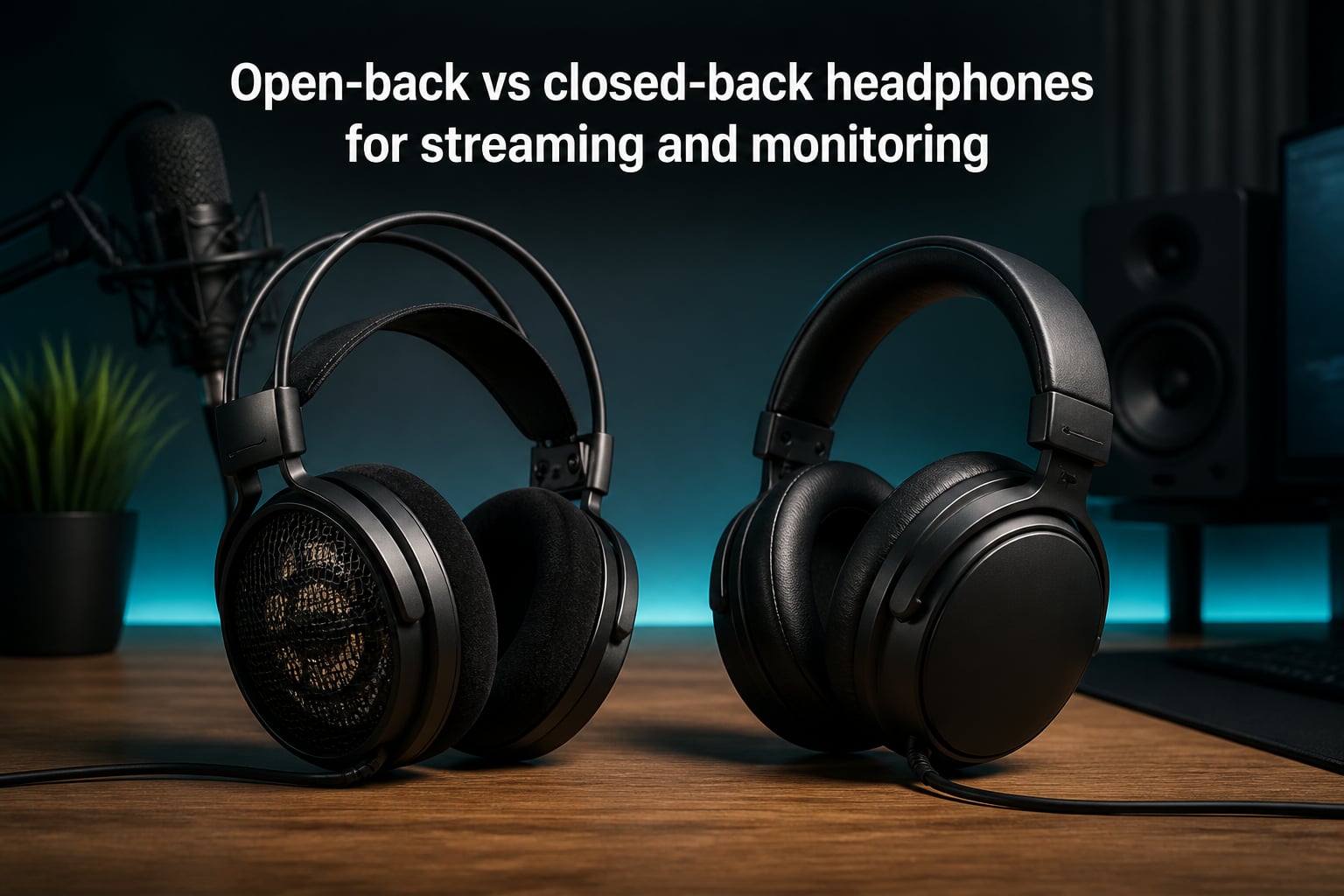
Open-back headphones allow sound to pass freely through the ear cups while letting outside noise in, whereas closed-back headphones use sealed cups that lock audio in and block ambient sound. For streaming and monitoring, this single design choice changes whether your audience hears your game bleed into the mic, how accurately you hear your mix, and how long you can keep the cans on without fatigue. I have spent hundreds of hours streaming with both styles, and the right pick depends on where you broadcast, how loud your room gets, and what you need to hear while you are live.
This guide walks through the real-world tradeoffs of open-back vs closed-back headphones for streaming and monitoring. We will cover the core definitions, the sound quality differences that matter for your stream, the comfort factors that hit after hour three, and a simple decision framework to help you choose. I have also pulled in feedback from streamers, audio engineers, and producers on Reddit and audio forums so you hear what actually happens in real setups, not just what marketing copy says.
If you are deciding between open-back vs closed-back headphones for streaming, you are in the right place. By the end, you will know which style fits your room, your audience, and your ears.
Table of Contents
- What Are Open-Back and Closed-Back Headphones?
- Open-Back vs Closed-Back Headphones: Key Differences
- Open-Back Headphones: Pros and Cons
- Closed-Back Headphones: Pros and Cons
- Which Is Better for Streaming and Monitoring?
- How to Choose Between Open-Back and Closed-Back Headphones
- Frequently Asked Questions
- Final Verdict
What Are Open-Back and Closed-Back Headphones?
The difference comes down to the ear cup design. That single structural choice rewrites how the headphones handle sound, isolation, and airflow.
What is open-back?
Open-back headphones have perforated or grille-covered ear cups that let air and sound pass through both ways. Sound waves from the drivers escape outward instead of bouncing back into your ear, which gives the headphones a roomier, more natural sound. The trade-off is that the same openings also let environmental noise in, and they let your audio out into the room.
Open-back designs sit closer to speaker listening than headphone listening. Because the cup is not sealed, your ears do not sit inside a pressure chamber. This is why mixing engineers who sit in treated rooms often reach for open-back headphones first.
What is closed-back?
Closed-back headphones have solid ear cups with a sealed back. The drivers push sound directly into your ears with nowhere else to go, and the seal stops outside noise from sneaking in. Closed-back designs also keep your audio locked inside the cups, which matters when a microphone is anywhere near the headphones.
This sealed design is what most consumer and gaming headphones default to, and for good reason. Closed-back headphones handle noise better, leak less, and let you focus on what is playing through them.
Open-Back vs Closed-Back Headphones: Key Differences
Here is a side-by-side comparison of how the two designs stack up across the factors that matter most for streaming and monitoring.
Soundstage and audio accuracy
Open-back headphones produce a wider, more spacious soundstage. Because sound waves reflect off the room instead of bouncing back into the cup, you get a more speaker-like presentation with better left-to-right imaging. For mixing or for immersive single-player games, that airiness is hard to beat. Closed-back headphones trade that spaciousness for impact, with tighter bass and a more focused, centered image that helps in competitive FPS titles.
Positional audio is where the two diverge most. Open-back gives you subtle directional cues thanks to the open staging, while closed-back delivers those cues through precise but narrower imaging. If you play Apex Legends or Valorant, you already know the difference between “I heard footsteps” and “I heard footsteps to the right.” Both styles give you that information, but in different ways.
Noise isolation and sound leakage
Closed-back headphones passively block outside noise, while open-back headphones barely block anything. A solid closed-back can knock 15 to 25 dB off your environment, which matters when your PC fans, AC unit, or roommate’s TV start leaking into your stream. Open-back headphones let all of that straight in.
Sound leakage works the same way. Open-back bleeds your audio into the room and into your mic, which means your chat can pick up your game, music, or alert sounds. Closed-back keeps your audio contained so your chat only hears your voice, not your mix. That difference alone is why most professional streamers end up on closed-back.
Comfort and breathability
Open-back headphones breathe. Air moves through the cup, heat escapes, and your ears stay cool even during six-hour streams. Closed-back headphones trap heat against your ears, and after long sessions you can feel the warmth building. If you have ever pulled off closed-back cans after a marathon stream with sweaty ears, you already know.
Weight and clamping force also affect comfort, but the cup design plays the bigger role over long sessions. Open-back wins for breathability, while closed-back pads have improved a lot in the last few years and many newer models stay comfortable for hours.
Weight and build
Open-back headphones often weigh slightly more because of the grille and additional structural support to keep the driver stable. Closed-back headphones can be lighter and more portable since the sealed cup doubles as protection. Neither style is dramatically heavier than the other, so this usually comes down to the specific model you pick rather than the design itself.
Open-Back Headphones: Pros and Cons
Open-back headphones are great for sound quality and long sessions but rough for noisy environments and mic-heavy setups. Here is the full breakdown.
Pros of open-back headphones:
- Wider, more natural soundstage that mimics speaker listening
- Better positional imaging for immersive single-player games and spatial audio
- Cool, breathable ear cups that reduce heat during marathon streams
- Less ear fatigue over multi-hour sessions
- Cleaner midrange reproduction that audio engineers prefer for mixing
Cons of open-back headphones:
- Significant sound leakage into the room and your microphone
- Little to no passive noise isolation
- Useless in noisy or shared environments
- Not safe for commuting or public use
- Audience can hear audio bleed on stream without heavy processing
Closed-Back Headphones: Pros and Cons
Closed-back headphones are the workhorse of streaming setups. They keep audio contained and outside noise out, but they pay for that with heat and a smaller soundstage. Here is the full picture.
Pros of closed-back headphones:
- Excellent passive noise isolation for loud rooms
- No sound leakage, so mics pick up only your voice
- Tighter bass response that suits competitive gaming
- Portable and safe for shared spaces
- Wider selection of models across every budget
Cons of closed-back headphones:
- Heat and sweat build up during long sessions
- Smaller, more closed-in soundstage compared to open-back
- Can cause ear fatigue faster when the seal is tight
- Less natural midrange for critical mixing work
- Cheaper models can sound “boxy” due to the sealed cup
Which Is Better for Streaming and Monitoring?
For most streamers, closed-back is the safer and more practical choice. The mic bleed issue alone settles the debate for anyone broadcasting from a normal room. That said, open-back has a place if your environment is dialed in and you know the tradeoffs. Let me break it down by scenario.
Why streamers typically use closed-back
Closed-back headphones keep your game audio, music, and alerts locked inside the cups so your microphone only picks up your voice. This is the single biggest reason most streamers end up on closed-back. If your audience hears double audio (your game plus your mic picking up your game), the stream sounds sloppy and chat notices fast.
Pair that with passive noise isolation, and you get a focused listening environment where distractions stay out. Closed-back also tends to deliver punchier bass, which suits the energy of most live content. For Twitch, YouTube, or Kick streams where engagement matters, closed-back is the default for a reason.
When open-back works for streamers
If you stream from a treated, quiet space and you use a broadcast-quality dynamic mic (like an SM7B or a shotgun mic) with proper gain staging, open-back can work. The airier sound helps with immersive games and music sets, and your ears stay cool.
Reddit streamers on r/Twitch and r/audioengineering have shared that they run open-back successfully when they have acoustic treatment, dynamic mics with rejection patterns, and noise suppression on top. If you tick those three boxes, open-back becomes a viable choice rather than a compromise.
Gaming use cases (competitive vs immersive)
For competitive FPS gaming, closed-back wins. Tight imaging, punchy bass, and isolation let you hear footsteps and call out positions clearly. For single-player RPGs, story-driven adventures, or horror games where atmosphere matters, open-back pulls ahead with its natural soundstage. Many gamers keep two pairs for this exact reason.
If you only game and do not stream, the choice opens up. Pick open-back for immersion, closed-back for focus. If you do both, the safer bet is to start with closed-back and add open-back later as a second pair.
How to Choose Between Open-Back and Closed-Back Headphones
Choosing between open-back vs closed-back headphones for streaming and monitoring comes down to your room, your workflow, and how long you wear them. Use this framework to land on the right style.
Match to your environment
Noisy rooms with fans, traffic, roommates, or street noise call for closed-back. Open-back headphones will let all of that into your ears and your stream. If you stream in a quiet, treated space, open-back becomes an option. Be honest about your environment, because the headphones cannot fix a noisy room on their own.
Match to your use case
Streaming primary, gaming secondary: closed-back. Mixing or production primary: open-back for the accuracy. Mixed use with both heavy streaming and competitive play: closed-back. Pure immersive single-player gaming with light streaming: open-back can work. Match the design to the job you do 70% of the time.
Hybrid considerations
If your budget allows, the strongest setup is two pairs: closed-back for streaming and competitive games, open-back for mixing, music listening, and immersive single-player sessions. A lot of audio professionals do this because no single design does both jobs perfectly. If you can only buy one, start with closed-back for streaming and add open-back when you know what you really need.
Frequently Asked Questions
Why do streamers use open-back headphones?
Streamers occasionally use open-back headphones for the wider soundstage and breathability during long broadcasts, especially when streaming immersive single-player games or doing music sets. Open-back works only in quiet, treated rooms with broadcast-quality microphones and noise suppression, because sound leakage can bleed into the mic and the stream. Most streamers stick with closed-back to avoid bleed and isolate from room noise.
Is open-back better than closed-back headphones?
Neither is universally better. Open-back headphones deliver a more natural, spacious sound with better positional imaging and cooler comfort, which makes them ideal for mixing, immersive gaming, and long listening sessions. Closed-back headphones isolate noise, prevent sound leakage into microphones, and provide tighter bass, which makes them better for streaming in normal rooms, competitive gaming, and shared spaces. The right pick depends on your environment and primary use case, with many professionals owning both styles.
What is the 60-60 rule for headphones?
The 60-60 rule for headphones recommends listening at no more than 60 percent of the maximum volume for no more than 60 minutes at a time. After 60 minutes, you take a short break to let your ears recover before resuming. This guideline helps prevent noise-induced hearing loss, which is a real risk for streamers and audio professionals who wear headphones for many hours each day. Combining the 60-60 rule with comfortable, breathable open-back headphones for long sessions is a strong hearing-safety habit.
What are the downsides of open-back headphones?
Open-back headphones leak sound in both directions: your audio escapes into the room and outside noise enters your ears. They offer little to no passive noise isolation, which makes them a poor fit for noisy environments, commuting, or shared living spaces. Open-back cans also bleed game audio and music into your microphone during streaming, requiring a dynamic mic and noise suppression to compensate. Finally, they are not portable in the traditional sense, since the open design lets sound spill out wherever you use them.
Final Verdict
If you are choosing between open-back vs closed-back headphones for streaming and monitoring, start with closed-back. The lack of sound leakage into your microphone and the passive isolation keep your stream clean and your focus sharp, which matters most when you are live. Closed-back wins for the majority of streamers, podcasters, and competitive gamers in normal rooms.
Open-back headphones earn their place when your environment is treated and quiet, your mic rejects noise well, and you value soundstage over isolation. For mixing, immersive gaming, and long creative sessions, open-back still delivers an experience closed-back cannot match.
Pick the design that fits the room you actually have, not the room you wish you had. Your ears, your audience, and your stream quality will thank you.