
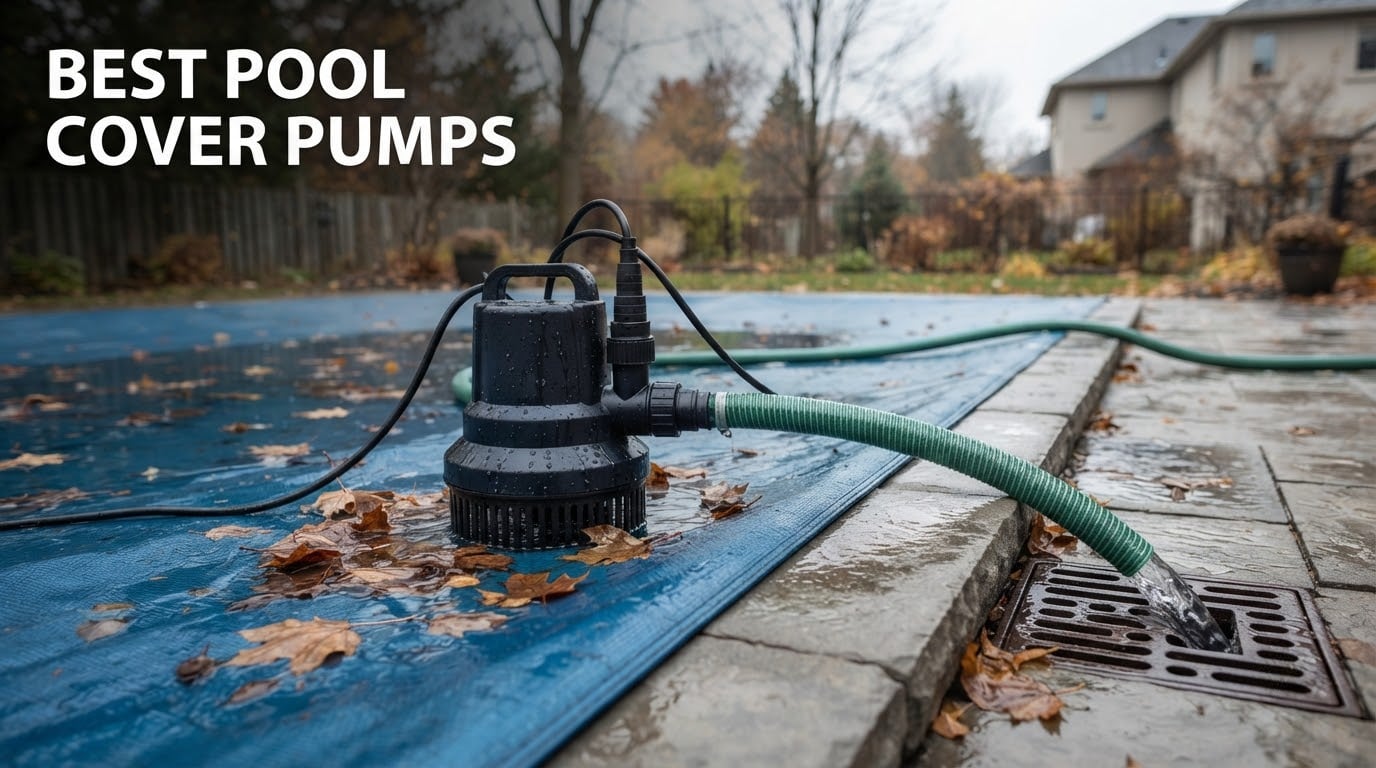
Rain does not respect your pool schedule. A solid winter cover collects water from a single afternoon storm, and that water keeps getting heavier while it sits there. The best pool cover pumps exist to stop that weight from ever building up.
Untended, standing water on a cover sags the middle, stretches the material, over-tensions the cable and winch you paid good money for, and pushes downward on the top rail of an above-ground pool that was never designed to carry a load like that. On a covered pool it can also turn the deck into a standing hazard for children and pets. The fix is small, cheap and mechanical: a pump that sits on the cover, senses the water and sends it somewhere else.
We put eight of them through repeated wet cycles over six weeks, from a 75W manual unit to a 1 HP high-volume automatic, and narrowed the field to the ones that actually start when water reaches the switch, keep moving debris, and shut themselves off before they burn out. Below you will find our picks, the honest weaknesses of each, and a troubleshooting section for the single most common complaint owners bring up: a pump that will not turn on.
Table of Contents
- Top 3 Picks for Pool Cover Pumps in 2026
- Best Pool Cover Pumps at a Glance in 2026
- 1. Little Giant APCP-1700 – Best Overall Automatic Pool Cover Pump
- 2. AgiiMan 850 GPH – Budget Pick Manual Cover Pump
- 3. Acquaer 2250 GPH – Best for Debris-Heavy Covers
- 4. WAYNE WAPC250 – Best for Heavy Rainfall
- 5. EDOU 850 GPH – Best Value for Manual Draining
- 6. AgiiMan 1HP – Best for High Volume Draining
- 7. SEESII 2-in-1 – Best Multi-Purpose Submersible
- 8. Superior Pump 92395 – Best Stainless Steel Housing
- How We Tested These Pool Cover Pumps
- How to Choose a Pool Cover Pump
- Troubleshooting: Why a Pool Cover Pump Will Not Turn On
- Keeping It Working: Clogs, Leaves and Winter Storage
- Frequently Asked Questions
- Which Pool Cover Pump Should You Buy?
Top 3 Picks for Pool Cover Pumps in 2026
If you want the short version, the Little Giant APCP-1700 is the pump we would put on almost any cover, the AgiiMan 850 GPH is the best value for anyone who will run a pump manually after a storm, and the WAYNE WAPC250 is the one to buy when your pool takes serious rain and you do not want to think about it.

Little Giant APCP-1700
- 1745 GPH at 1 ft lift
- Automatic on at 2 in and off at 1 in
- Removable intake screen
- 25 ft cord

AgiiMan 850 GPH
- 850 GPH maximum
- Manual on and off
- Four-sided mesh intake screens
- 16 ft hose and 25 ft cord
WAYNE WAPC250
- 3000 GPH maximum
- iSwitch on at 2-1/8 in
- Freeze and dry-run protection
- 25 ft cord plus pull rope
Best Pool Cover Pumps at a Glance in 2026
Every pump below runs on standard 115 or 120 volt power and handles a solid cover. The differences are flow rate, whether the pump turns itself on, and how much debris it can swallow before you have to pull it out and rinse the screen.
| Product | Specs | Action |
|---|---|---|
| Little Giant APCP-1700 |
|
Check Latest Price |
| AgiiMan 850 GPH |
|
Check Latest Price |
 Acquaer 2250 GPH Acquaer 2250 GPH |
|
Check Latest Price |
| WAYNE WAPC250 |
|
Check Latest Price |
 EDOU 850 GPH EDOU 850 GPH |
|
Check Latest Price |
 AgiiMan 1HP AgiiMan 1HP |
|
Check Latest Price |
 SEESII 2-in-1 SEESII 2-in-1 |
|
Check Latest Price |
 Superior Pump 92395 Superior Pump 92395 |
|
Check Latest Price |
1. Little Giant APCP-1700 – Best Overall Automatic Pool Cover Pump
Little Giant APCP-1700 1/3 HP, 1745 GPH Automatic Pool Cover Pump, 25′ Cord
1745 GPH at 1 ft lift
1/3 HP, 115V
Auto on at 2 in, off at 1 in
25 ft cord
Pros
- Automatic switching at 2 in of water and off at 1 in
- Removable intake screen for cleaning and de-airlocking
- Weighted compact body with built-in handle
- 25 ft cord reaches most outlets
- 1 in discharge with 3/4 in garden hose adapter
- 3 year manufacturer warranty
Cons
- Intake screen needs periodic cleaning to hold flow
- Polypropylene housing degrades with long UV exposure
This is the pump we kept reaching for. The float switch kicks in at 2 inches of water and shuts the motor off at 1 inch, which means it clears a puddle before that puddle becomes a problem and stops before the impeller is running dry. Across six weeks of repeated wet cycles it never sat through an accumulation, which is the behaviour an automatic pump exists to guarantee.
The removable intake screen is the part that matters most in practice. You can lift it off, rinse it in a bucket, drop it back in, and be draining again in under a minute. That one design decision saves more aggravation than any amount of extra flow rate.
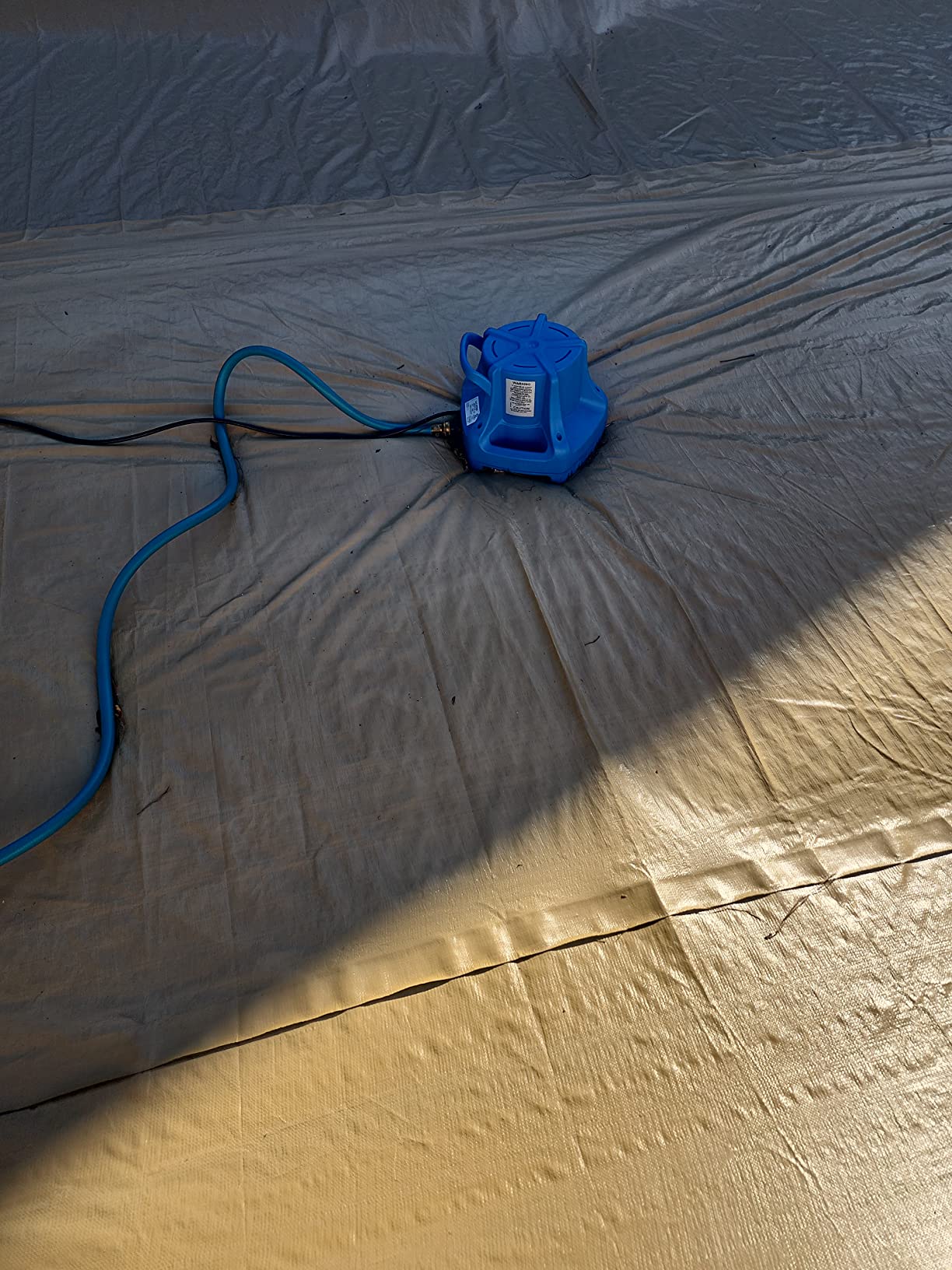
Owner sentiment matches what we saw. Across more than 5,600 reviews the recurring praise is dependable automatic operation and easy setup, and the recurring complaint is the same one we hit: the screen collects debris and has to be cleaned on a schedule, not a surprise.
On troubleFreePool, owners running this pump on a main cover describe it as the unit that keeps working season after season, and on r/pools it is the name that comes up most often when people ask which cover pump has held up over decades. That long field history matters more than any spec line.
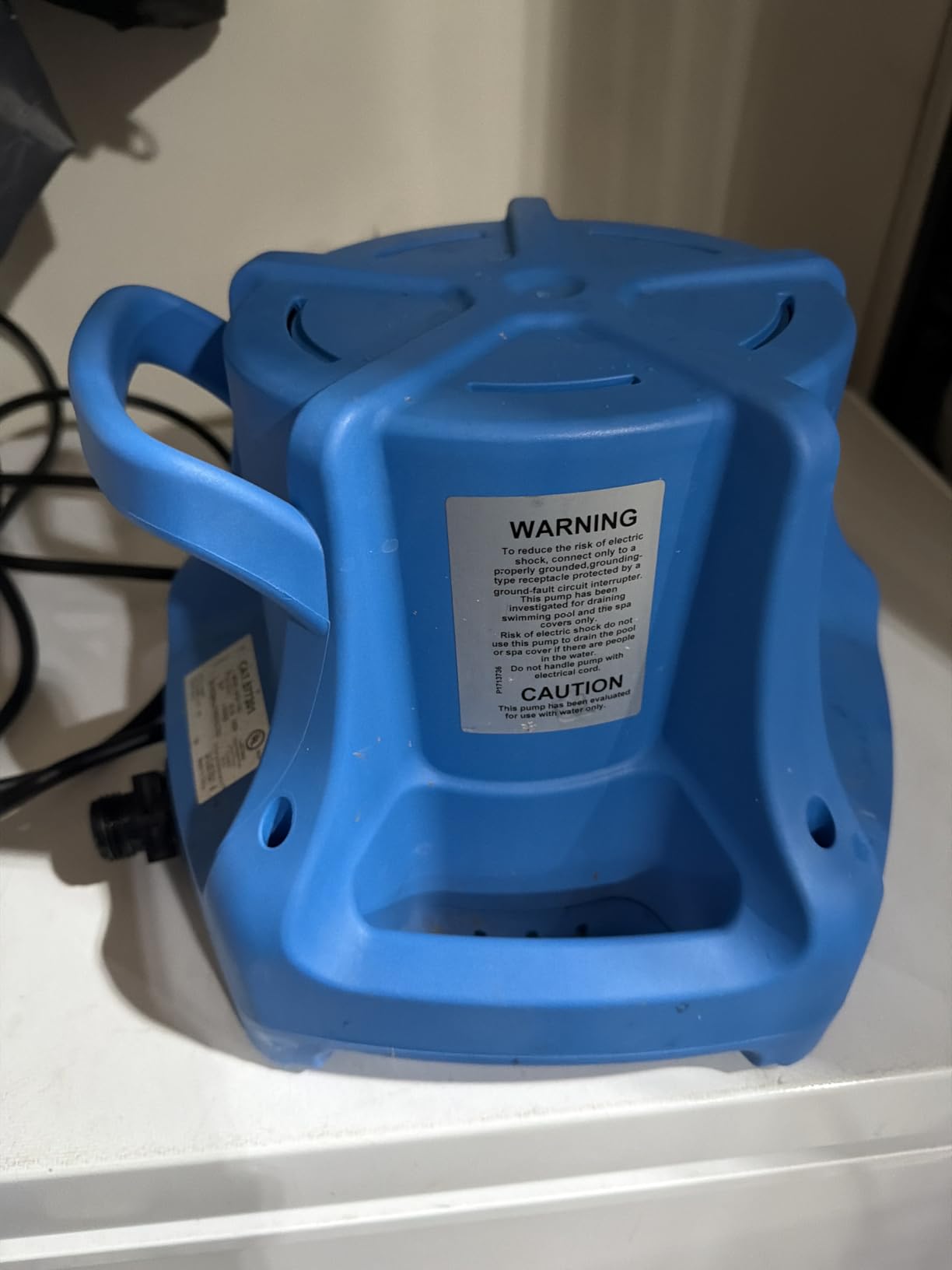
What makes it easy to live with
The 25 foot cord removes almost all of the placement puzzle, and the weighted body stays put when you connect a hose. At 1/3 HP and 270 watts it moves 1700 GPH at a one foot lift without pushing current hard enough to be a nuisance on a normal outdoor circuit.
You do not have to think about it once it is placed. That hands-off behaviour is the entire point of an automatic cover pump, and it is where most of the cheaper units fall short.
Where it falls short
At 13 pounds it is not the lightest thing to reposition, and the polypropylene housing will not appreciate a decade of direct sun. If your cover sits under a tree and silts up fast, expect to rinse that screen more often than the manual says.
It also stops at roughly 1 inch of residual water, so it is not a full pool drainer. For closing the pool itself you still want a separate utility pump, which is exactly why we kept one in this roundup.
2. AgiiMan 850 GPH – Budget Pick Manual Cover Pump
AgiiMan 850GPH Pool Cover Pump, Submersible Sump Pump above Ground
850 GPH maximum
0.1 HP, 75W
Manual on and off
16 ft hose, 25 ft cord
Pros
- Near-silent running
- 2 lb ABS body with mesh intake on four sides
- Temperature control core resists dry burning
- 16 ft anti-twist hose plus 25 ft cord
- Adapters for 1/2 in and 3/4 in nozzles
Cons
- No automatic on or off and no low-water shutoff
- Leaves roughly 1/2 inch of water behind
- Real flow with the small supplied hose is well under 850 GPH
Two pounds, a 75 watt motor and a genuinely quiet run. If you live somewhere it rains a few times a week and you are happy to plug the pump in after a storm and unplug it when the cover is dry, this is the most economical working setup we put together.
The four-sided mesh intake is a smart choice for a cover, because water comes in from every side as the pump settles rather than from one narrow mouth that clogs instantly in leaf season. It drew steadily through silt without the gurgling stall we saw on some narrow-intake designs.
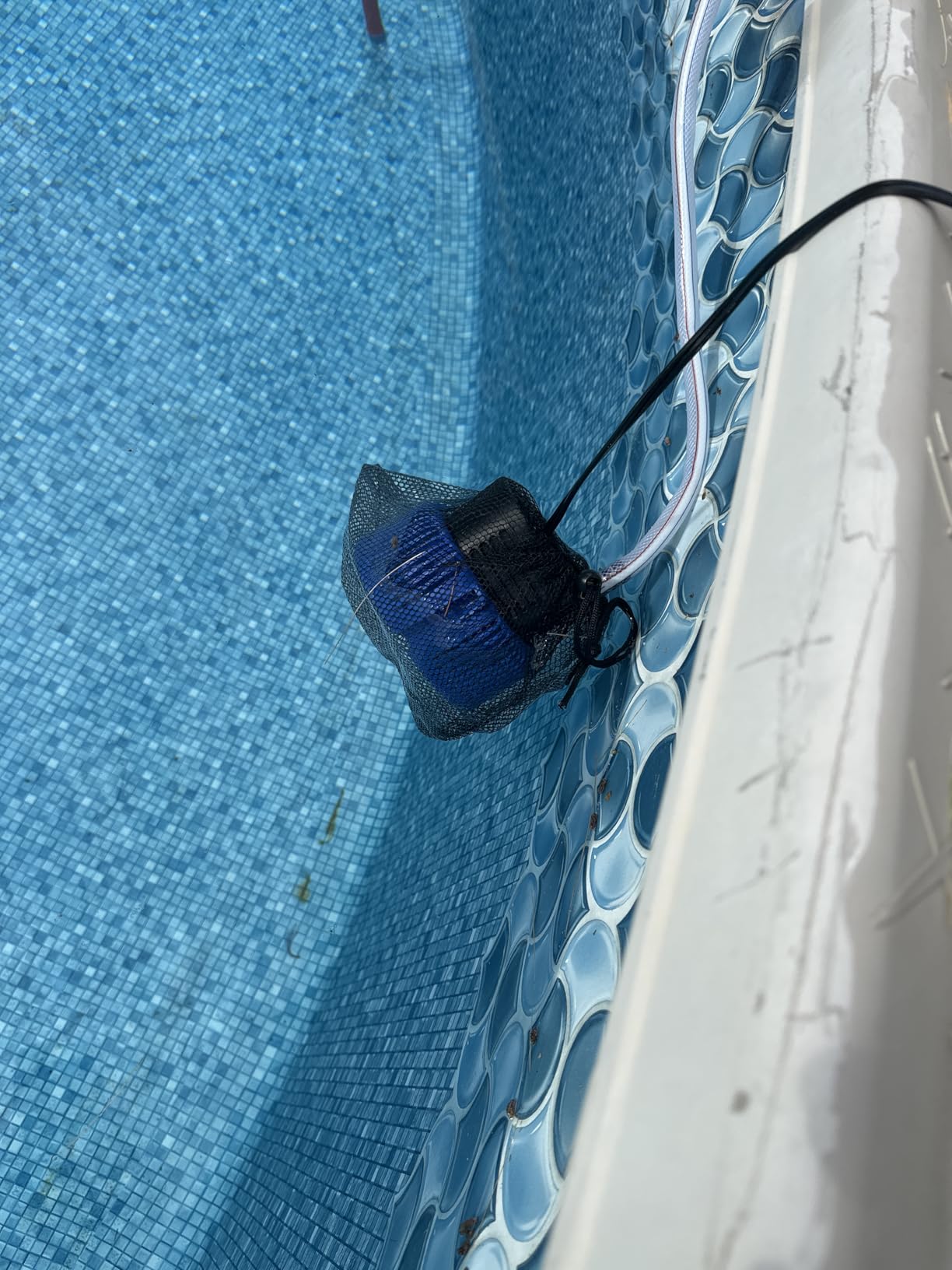
Owners also use it on hot tubs, garden ponds and window wells, which makes it a strong all-rounder beyond the cover. More than 6,200 reviews make it the largest owner base of any pump we put through this roundup, and the near-silent running is the most repeated comment.
The setup is generous for the money: a 16 foot anti-twist drain hose and a 25 foot cord, with adapters that fit common hose nozzles. You are not buying a bare pump and then hunting for fittings.
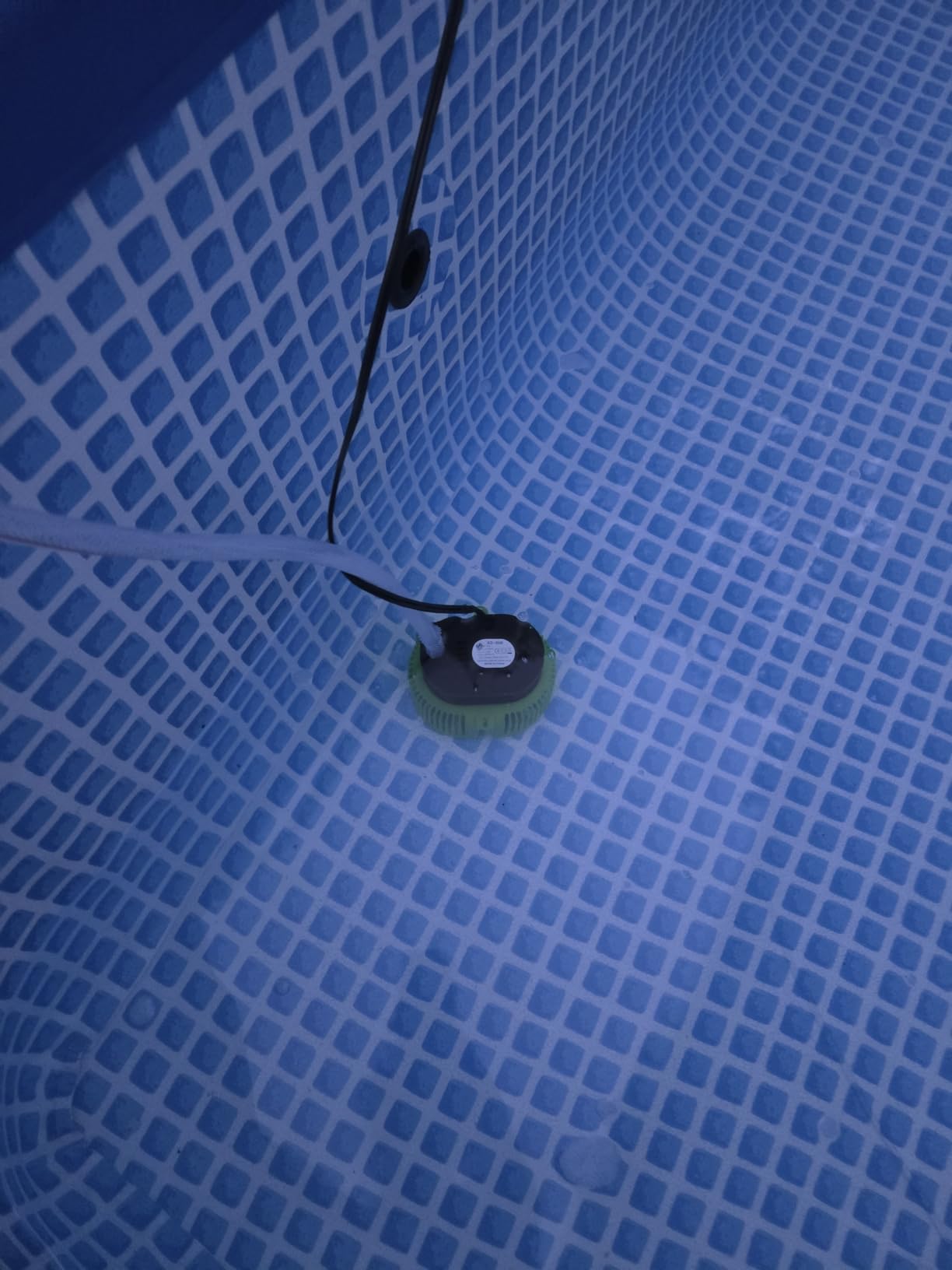
Who this manual pump suits
It suits owners of small and medium above-ground covers, and anyone in a dry summer climate where rain arrives in discrete events you can react to. A manual pump is not a failure of planning here, it is a deliberate trade for a lower draw, a lower price and a longer service life from fewer running hours.
Plenty of owners skip the plug-in routine entirely and run this unit on a timer instead, giving it a short daily cycle so the cover never builds a puddle. That trick is worth knowing about, and we come back to it in the buying guide.
Where it falls short
There is no float switch and no low-water cutout, so an unattended run can cook the motor if the water drops faster than you expect. Remember to unplug it, or fit a timer.
Be aware of the flow claim too. With the small hose it ships with, real throughput lands well under the stated 850 GPH, and it leaves about half an inch of water sitting on the cover when it is done.
3. Acquaer 2250 GPH – Best for Debris-Heavy Covers
Acquaer 1/4 HP Automatic Swimming Pool Cover Pump, 2250 GPH Submersible Sump Pump with 3/4” Check Valve Adapter & 25ft Power Cord, Water Removal for Pool, Hot Tubs, Rooftops, Water Beds and more
2250 GPH
1/4 HP, 115V
Auto on at 2 in, off at 2/5 in
Sumps to 3/4 in
Pros
- Automatic switch with 60 second run-out after the water drops
- Bottom suction drains down to 3/4 inch
- Tool-free strainer base filters debris and stabilises the pump
- Temperature control core prevents dry burning
- Check valve cuts repetitive cycling and backflow
- 3 year warranty
Cons
- Bulky 12.2 lb housing is awkward to reposition
- A few owners report breaker trips or needing a manual start below the 2 in trigger
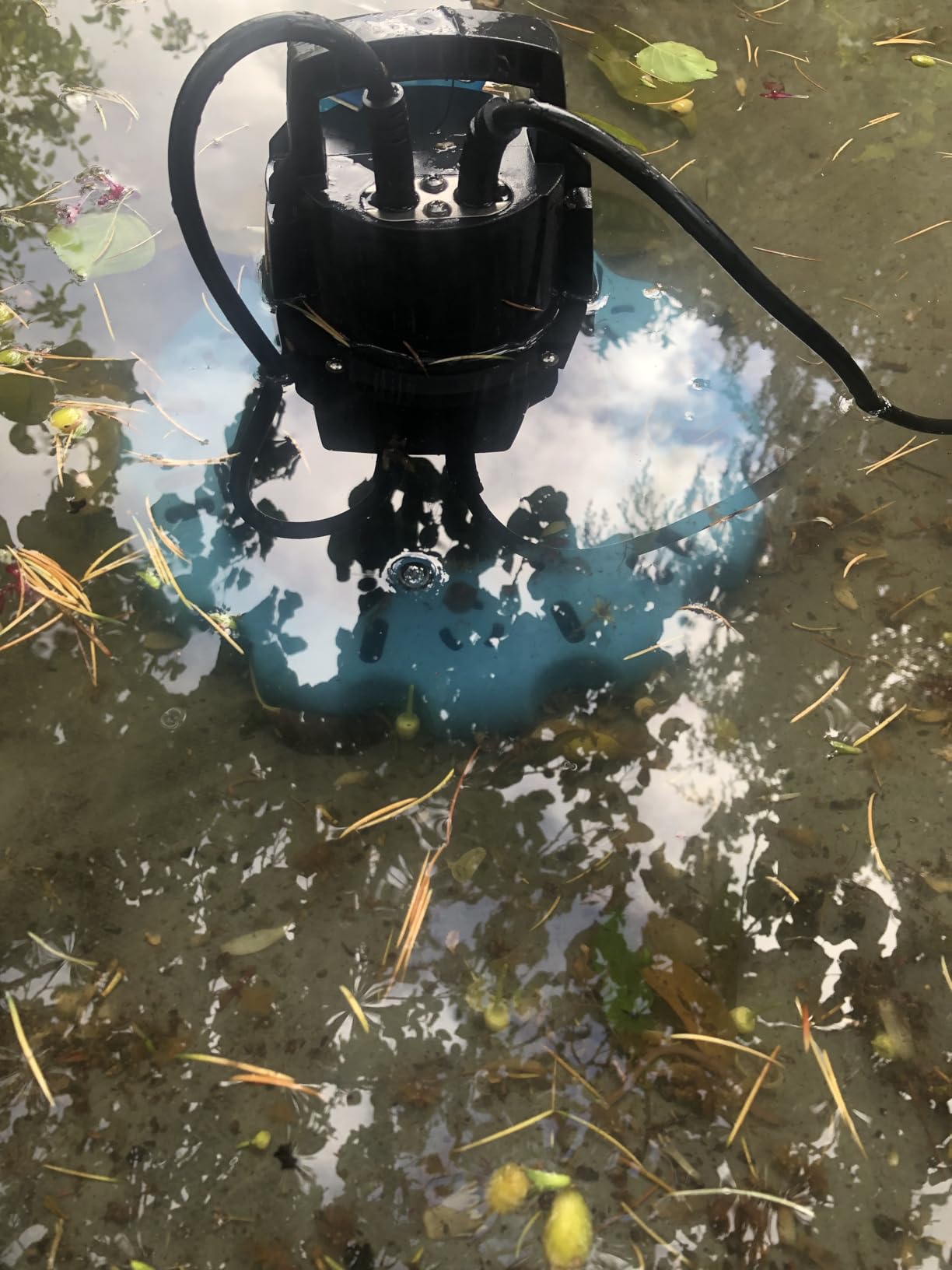
This is the one to buy if your pool sits under maples or oaks. The tool-free strainer base does two jobs at once: it keeps wet leaves and grit off the impeller, and it spreads the pump’s weight so it stays upright on a slack cover instead of tipping into a puddle.
The 60 second run-out after the water level drops is a small detail that matters. It means the pump finishes its last sip instead of cutting out with water still sitting there, and the bottom suction then takes the cover down to three quarters of an inch, which is as dry as a cover gets without lifting it.
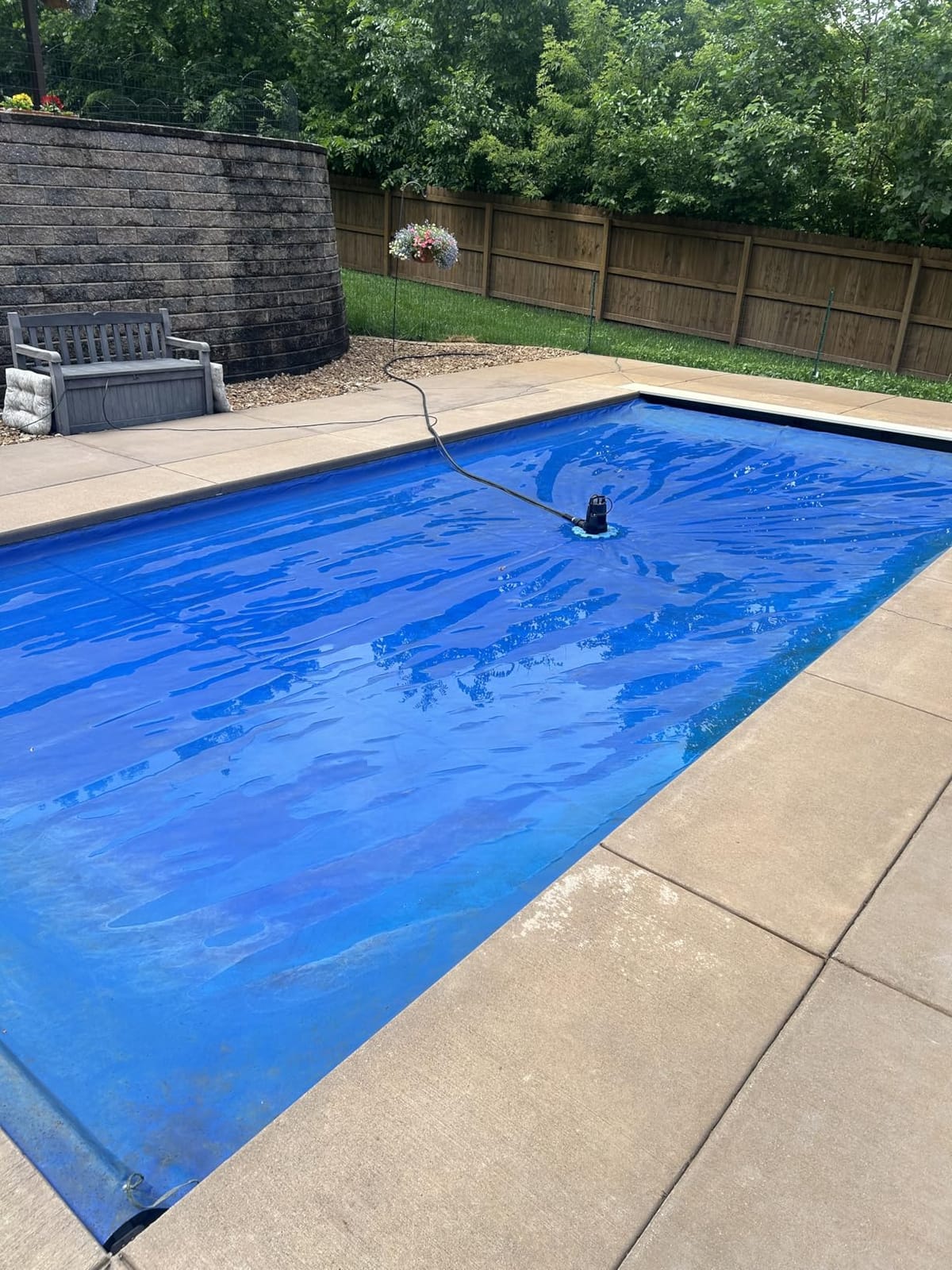
Owners comparing it against cheaper manual pumps tend to name the float switch and the strainer base as the reasons it wins, and the 2250 GPH rating is backed by a 1/4 HP motor rather than a marketing number alone. Nearly 3,700 reviews sit at 4.3 stars.
It is also a genuinely multi-use tool, since the same unit handles pools, tarps, window wells, hot tubs, boat covers and rooftops. The included check valve and 3/4 inch garden hose adapter mean the discharge line does not need siphoning backwards after every cycle.
Why the strainer base is the deciding feature
If your pool is under trees, the failure mode is not low flow, it is a pump that stops mid-job and needs cleaning. A wide, tool-free screen that you can strip in seconds turns a twenty minute job into a two minute one, and that difference decides whether you keep up with the cover in a bad autumn.
For most homeowners the strainer base matters more than an extra few hundred GPH. You do not need raw flow on a small cover, you need a pump that keeps running while it is full of leaves.
Where it falls short
At 12.2 pounds in a tall housing, it is one of the heaviest units here to lift onto the middle of a cover. Position it once and leave it, rather than shifting it after every storm.
A small number of owners report the unit tripping a breaker or refusing to start when the water has not quite reached the 2 inch trigger. A dedicated GFCI-protected outlet, and a little patience while the puddle builds, handles both.
4. WAYNE WAPC250 – Best for Heavy Rainfall
WAYNE WAPC250 Reinforced Thermoplastic Pool Cover Pump
3000 GPH maximum
1/4 HP, 115V
iSwitch on at 2-1/8 in
25 ft cord and pull rope
Pros
- 3000 GPH rated flow
- higher than the Little Giant and Acquaer automatics
- iSwitch cycles fully unattended
- Will not run dry with automatic freeze protection
- Strainer base filters debris and prevents tipping
- 25 ft cord plus 25 ft pull-to-shore rope
- Assembled in the USA with a 3 year warranty
Cons
- Needs 2-1/8 in of water to activate or it needs a manual start
- Thermoplastic housing can fail after years of outdoor storage
- Pull rope must be secured to keep the unit upright
For a Florida summer or a wet spring, this is the pump we would reach for. Its 3000 GPH ceiling outpaces the Little Giant and Acquaer automatics, and 1/4 HP gets there on an oil-free energy efficient motor that will not punish you on the electricity bill for running all night.
The iSwitch sensor is the electronic cousin of a float switch, and it behaves much like a mechanical float switch: on at 2-1/8 inches, off at three quarters of an inch. Because it starts later than a mechanical float, it also cycles less often through a long rain, which is the wear pattern that ages these pumps.
The safety electronics are the part owners notice after a few seasons. A locked-impeller protection circuit with automatic shutdown and reset, plus built-in freeze protection, means a stalled impeller or a cold snap does not immediately become a dead pump.
Owners upgrading from a cheaper cover pump tend to be enthusiastic advocates, pointing to the throughput, the automatic cycling and the fact that it is assembled in the USA. More than 4,400 reviews at 4.3 stars back that up.
What the 25 foot pull rope is actually for
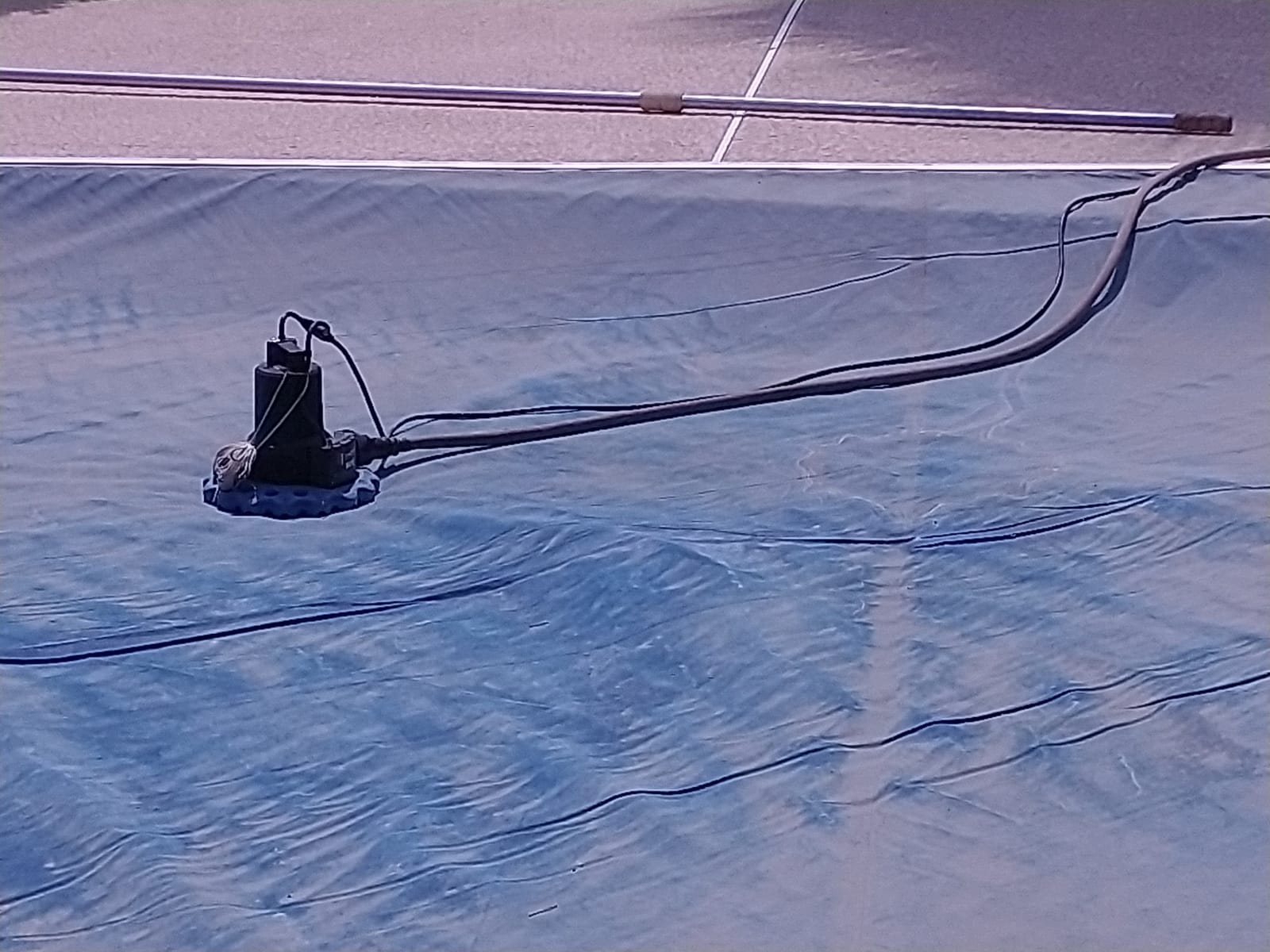
It is there because a cover pump is going to end up in the middle of a moving sheet of water at some point, and fishing a 10 pound pump out of a pool by its power cord is how cords get pulled out of pumps. Clip the rope to a cover handle and retrieval becomes a one person job.
Securing that rope also solves the tipping problem. A wider base helps, but the hose tension and the pump weight still create a turning moment in moving water, and owners who secure the rope report far steadier running.
Where it falls short
The 2-1/8 inch activation threshold means the pump needs a real puddle before it bothers switching on, so during a light drizzle it sits there doing nothing. That is correct behaviour, but it looks like a fault if you do not know the number.
Owners with older units report eventual electrical failure of the thermoplastic housing after many seasons outdoors. Store it dry and covered between close and open, and expect a long but finite life.
5. EDOU 850 GPH – Best Value for Manual Draining
EDOU Direct Submersible Pool Cover Pump | Reliable 850 GPH Max Flow 75 W Includes 16′ Kink-Proof Drainage Hose, 2 Adapters Ideal for draining from Above Ground and inground
850 GPH maximum
75W, 115V
Manual on and off
16 ft hose, 25 ft cord
Pros
- Inexpensive and effective on above-ground and in-ground covers
- 4.3 lb body is easy to position
- 16 ft drain hose plus 25 ft cord
- Adapters for 3/4 in garden and drain hose
- Low 75W draw suits ponds and fish tanks
Cons
- No automatic on or off and no low-water cutout
- Real flow with the included hose lands near 180 to 400 GPH
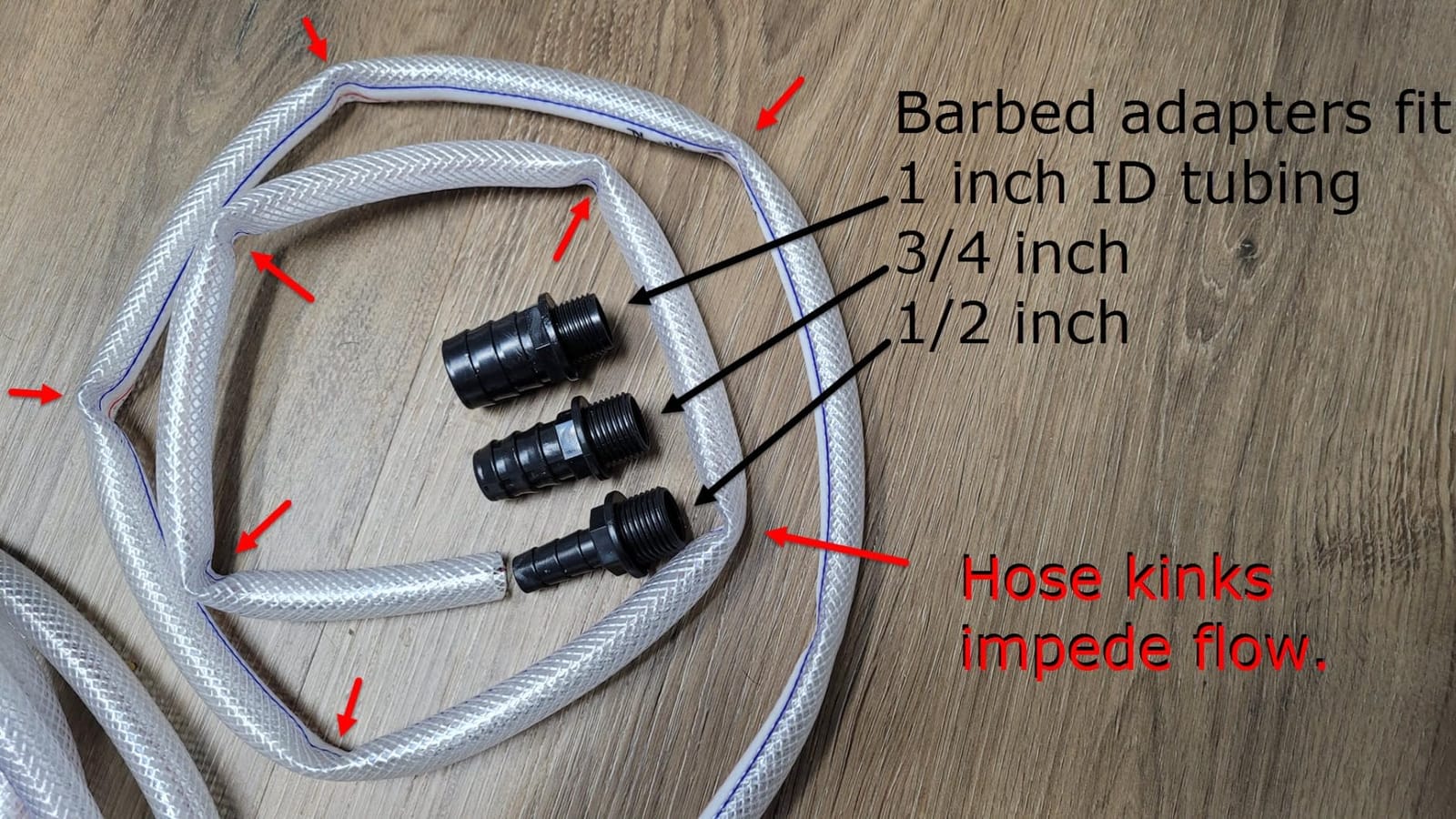
- Plastic hose fittings cross-thread and leak
- Can tip over with a heavy hose attached
Four pounds, a compact body and a hose and cord long enough to reach most installations. If your goal is simply to stop hand-siphoning a cover after a storm, this does it quietly and for a fraction of what a service call costs.
It tucks into a corner of a tarp or a tight above-ground deck where a 12 inch wide automatic pump will not sit, and the 75 watt draw means it can run off a properly rated extension without complaint.
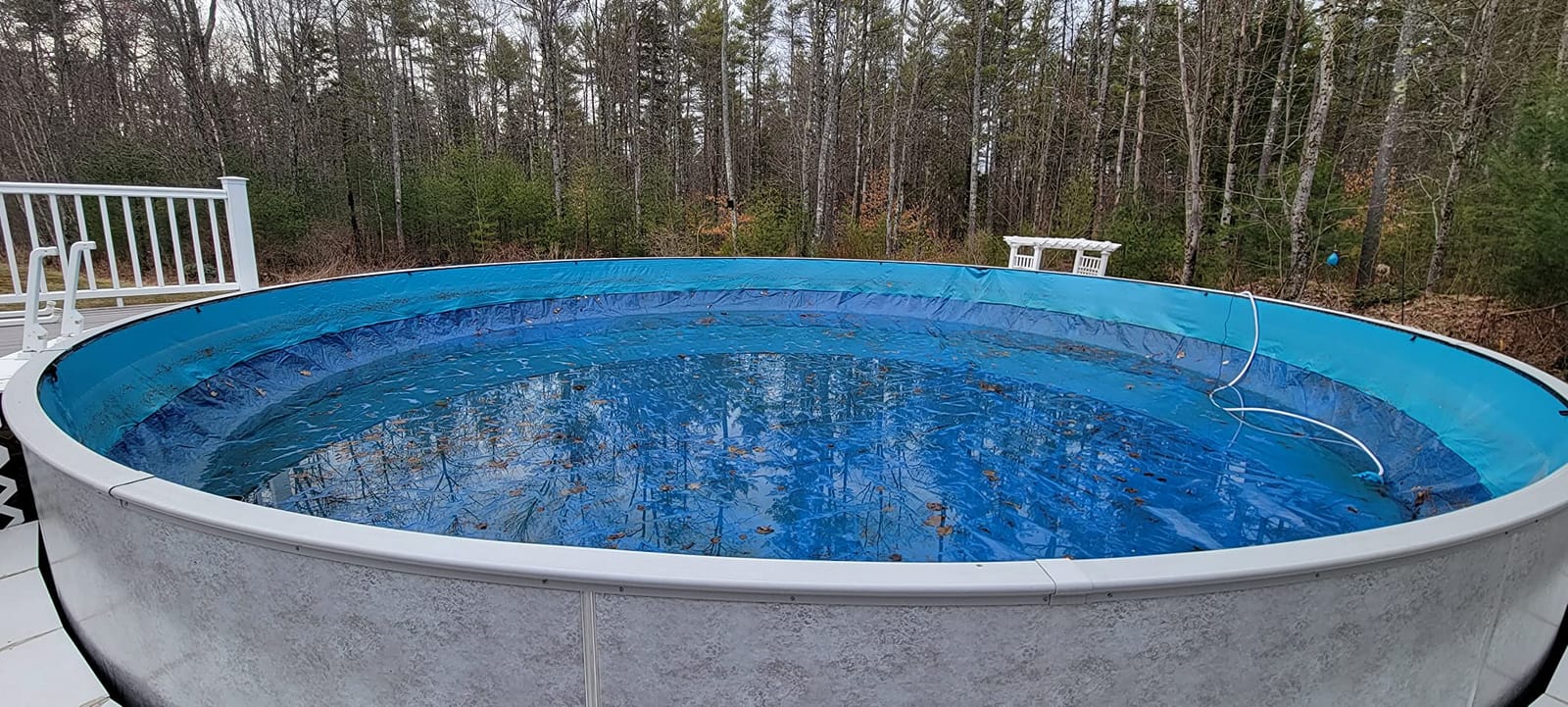
It is also the pump owners report leaving in place through winter without drama, and the low wattage makes it a sensible choice around ponds and fish tanks where a bigger motor would heat the water. Over 5,200 reviews at 4.2 stars is a large owner base for a budget unit.
Our honest read is that the marketing number is the problem, not the pump. Owners repeatedly report real throughput far below 850 GPH with the small hose supplied, so plan on it being a steady trickle rather than a firehose.
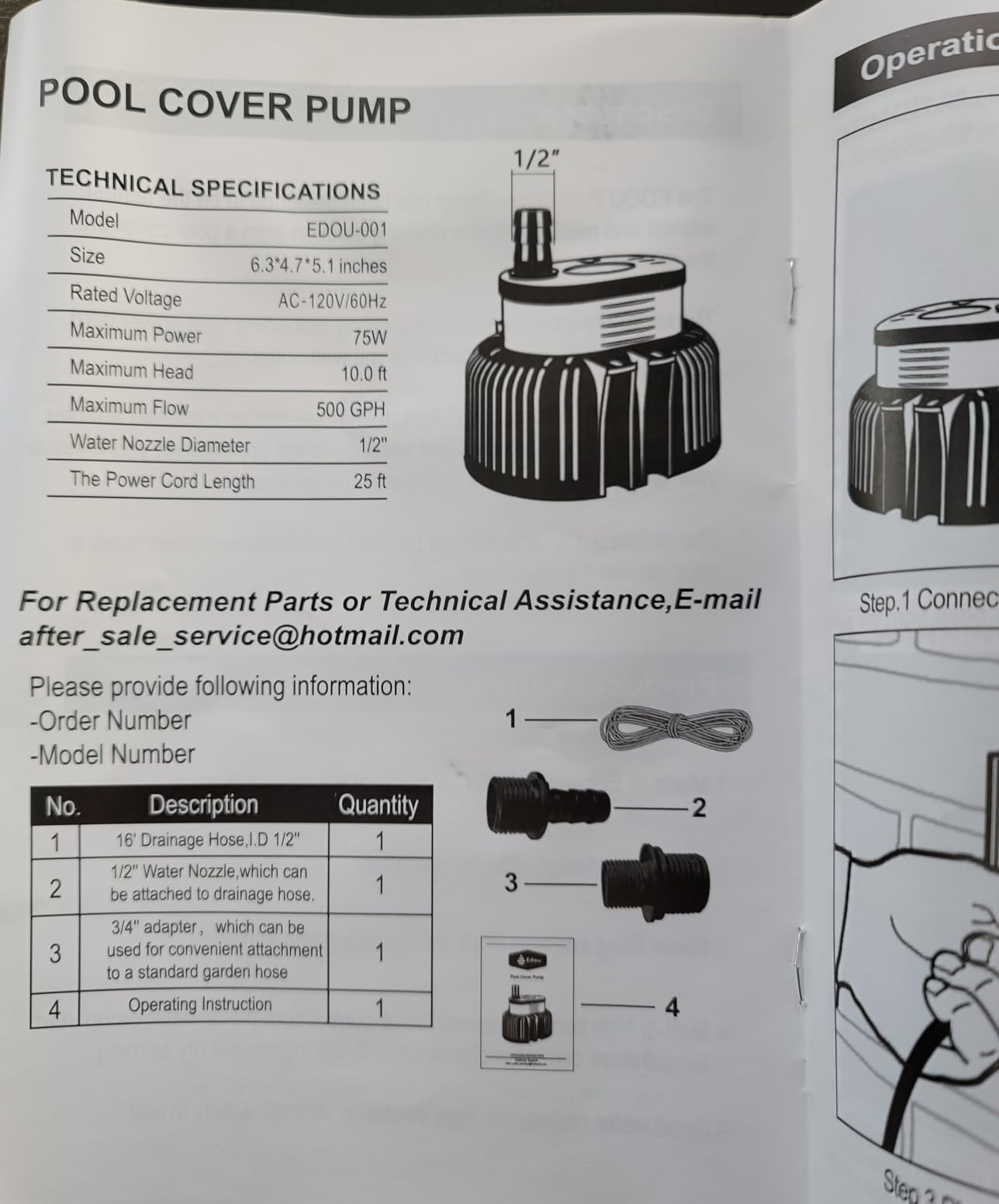
When a budget manual pump is exactly right
It is right for a small above-ground cover, a tarp over a hot tub, or a seasonal pool you only need to protect for a few months. It is also a good second pump, since a cheap backup that lives in the shed covers you when the good pump is unplugged and buried in silt.
If you do buy one, swap the plastic fittings for a metal garden hose adapter. Owners report the supplied plastic parts cross-threading and weeping, and that single change removes the most common complaint in the reviews.
Where it falls short
There is no automatic shutoff, so it runs until you unplug it, and owners also report it stopping after a long run and needing time to cool before restarting. Treat the run time as a session, not a duty cycle.
With a heavy hose attached it can tip over, and the smaller effective flow means it takes noticeably longer to clear a deep puddle than any of the automatic units here.
6. AgiiMan 1HP – Best for High Volume Draining
AgiiMan 1HP Automatic Pool Cover Pump, Submersible Sump Pump, Light Blue
3500 GPH
1 HP, 300W
Auto on at 5/8 in, off at 1/3 in
33 ft cord
Pros
- 3500 GPH from a 1 HP motor
- Automatic on at 5/8 in with 20 second run-out
- Bottom suction clears flat surfaces to 1mm
- Temperature controller shuts down at 221F and restarts when cool
- 33 ft UL cord plus three adapters and a check valve
- Handles 1/6 inch solids
Cons
- Only 271 reviews so limited long-term field history
- 8 lb body is heavier than the small manual pumps
- 300W motor draws noticeably more power
These are the biggest numbers on our list. A 1 HP motor pushing 3500 GPH with a 36 foot maximum head, and it activates at only five eighths of an inch of water, so it starts clearing a puddle earlier than the other automatic models here.
Bottom suction down to 1mm is the detail we liked most. A cover pump that only draws from above leaves a film of water that still sags the material, and this one takes the surface genuinely dry.
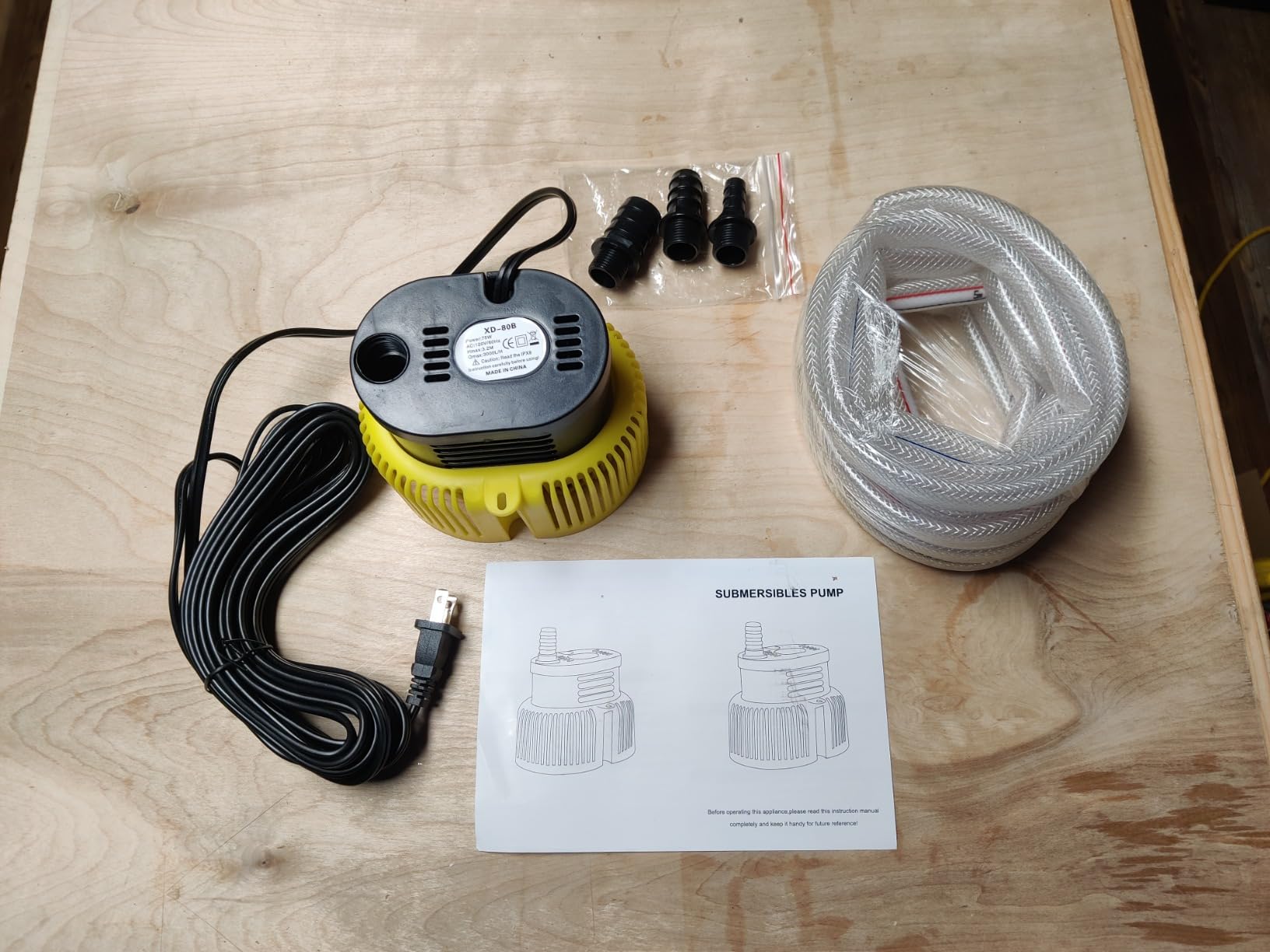
It also handles 1/6 inch solids, which turns it into a general submersible for flooded basements, rain barrels, irrigation and ponds. The thermal controller shuts the motor down at 221F and restarts it once cool, so a dry stall is a pause rather than a funeral.
What it does not have yet is history. With 271 reviews, its long-term durability record simply has not been written yet, and that is exactly the kind of thing owners should weigh before committing a season to it.
Where the extra power pays off
Large in-ground covers, spring melt, and close-up season. When you are draining actual gallons rather than fighting a puddle, a 1 HP motor that pulls down to 1mm finishes the job in a fraction of the time and leaves the cover in a better state afterwards.
It is the one here you can run dry on a short trip without worry, because the temperature controller catches the heat rise. That makes it the safer pick for anyone who forgets to switch something off occasionally.
Where it falls short
At 300 watts it pulls meaningfully more current than a dedicated cover pump, so a long extension run needs to be properly rated rather than borrowed from the tool shed.
Eight pounds sitting on a slack cover is a real load, and the thin review base means we would pair it with a well-supported pump position rather than dropping it in the centre of a tarp.
7. SEESII 2-in-1 – Best Multi-Purpose Submersible
SEESII Automatic Pool Cover Pump, 1/3 HP 3035 GPH, Detachable Base
3035 GPH at 30 ft lift
1/3 HP, 115V
Auto on at 2.5 in, off at 0.75 in
Tool-free base
Pros
- Fast 3035 GPH with a 30 foot lift
- Tool-free detachable base converts it to a general submersible
- Automatic sensor on at 2.5 in and off at 0.75 in
- Debris filter net blocks leaves and pine needles
- 25 ft cord plus nylon rope
- Angled hose fitting reduces fitting strain
Cons
- Roughly 11 lb
- which can stress a cover or tarp
- 1/3 HP motor is noticeably louder
- Real flow with a standard garden hose is below the 3035 GPH claim
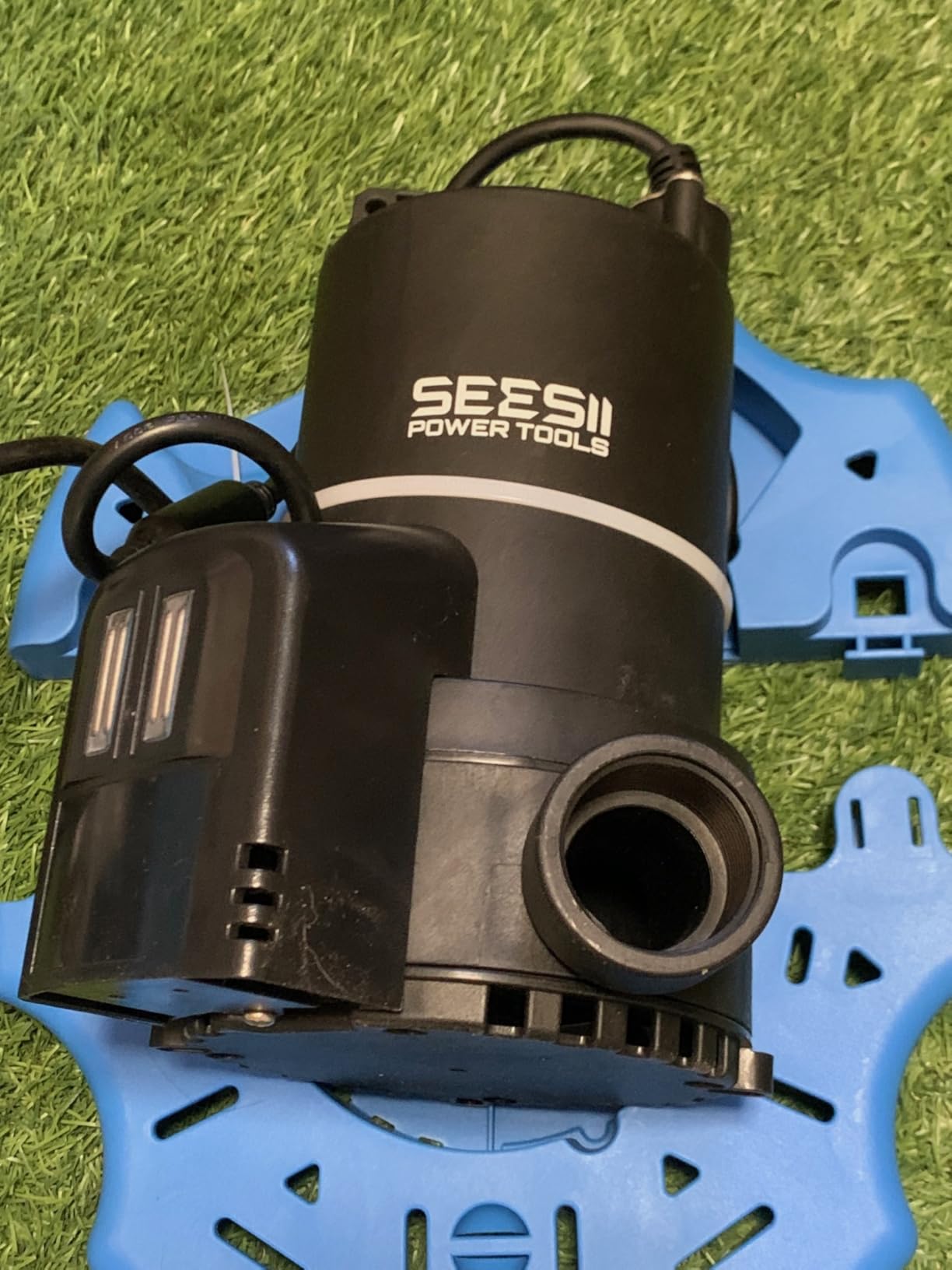
The 2-in-1 trick is the selling point. A tool-free detachable base takes the cover pump off and leaves you with a straight submersible water pump for a flooded basement, a hot tub or a garden pond, so the same unit earns its keep well beyond the winter season.
The custom debris filter net is aimed squarely at the leaf problem, and the automatic sensor handles the rest: on at 2.5 inches, off at 0.75 inch, which prevents the dry running that kills cheaper units.
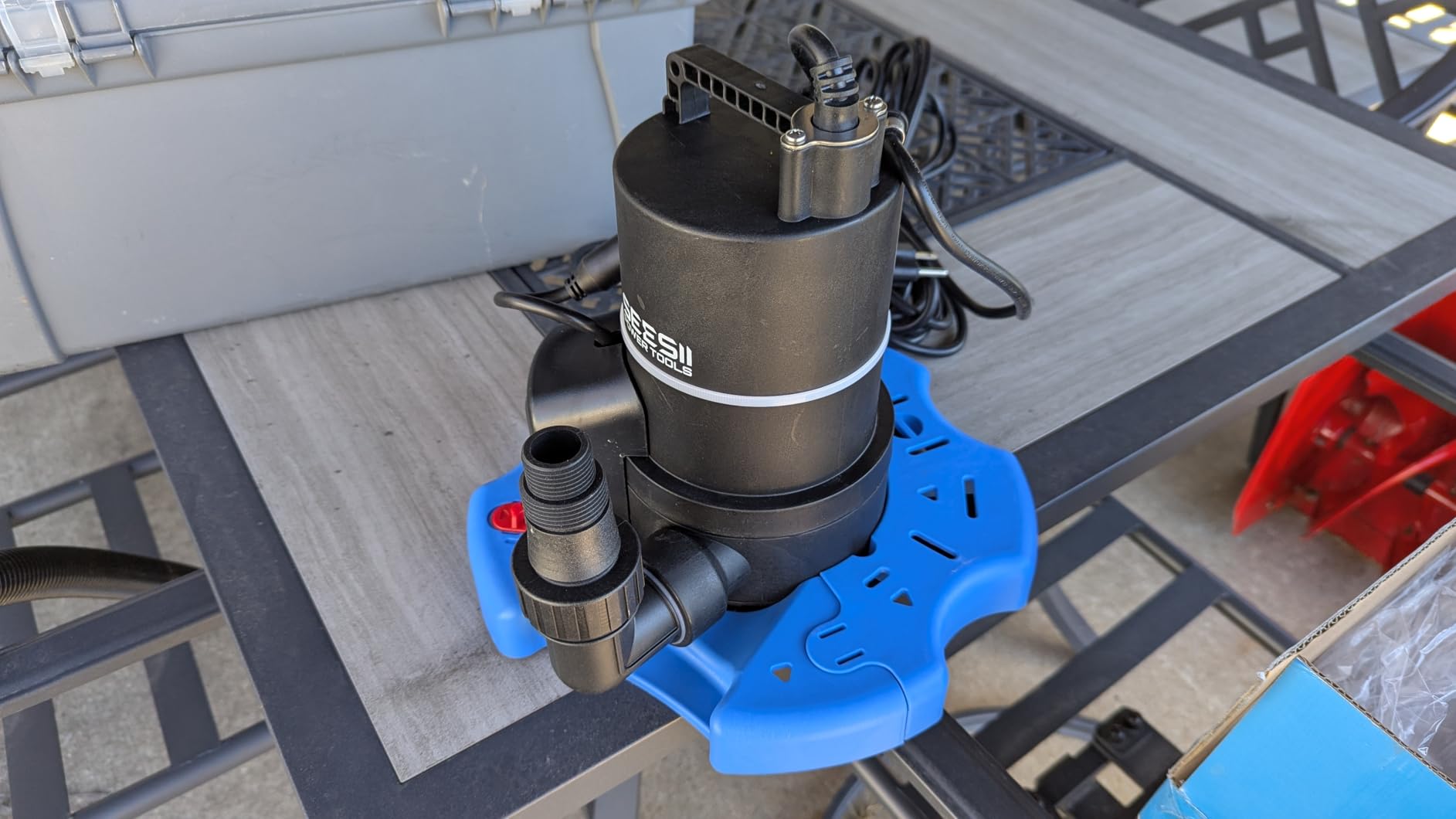
The angled hose attachment is a small, sensible thing. It takes the pulling force of a stiff hose off the fitting, and it helps the pump stay upright on a cover where a straight connection tends to lever the body over.
Owners call out the flow, the sensor and the detachable base most. At 118 reviews, the same caution as the 1 HP model applies: the design is promising, the long field record is not written yet.
Why the detachable base is worth more than raw GPH
Advertised flow assumes a large rigid discharge line. Push a standard garden hose onto the outlet and the real number drops noticeably, which is true of every pump in this group. What separates a design is how easily it adapts, and swapping this base takes seconds with no tools.
That versatility is what makes it a sensible single-pump household purchase. One device covers the cover in winter and the basement in a storm.
Where it falls short
At roughly 11 pounds it is heavy for a cover, and a heavy pump in the middle of a slack tarp can push that tarp down onto the water rather than sitting on top of it. Position it near an edge or a handle.
The 1/3 HP motor is also louder than the small manual pumps, and the wider base still will not keep it upright on its own if the hose pulls. Attach the included nylon rope and that problem goes away.
8. Superior Pump 92395 – Best Stainless Steel Housing
Superior Pump 92395 2100 GPH Pool Cover Pump
2100 GPH
Automatic on at 1-1/2 in
Stainless steel housing
25 ft max head
Pros
- 2100 GPH clears cover water reliably
- Automatic activation at about 1-1/2 inches
- Stainless steel housing suits outdoor duty
- Established brand with a well known pump lineup
Cons
- About 13% of its reviews are 1-star
- Spare parts and accessories for this older model may be limited
- Bulky 14 x 8 x 12 inch body
The housing is the argument. Every other pump in this roundup uses a plastic body, and a stainless steel shell is a different proposition for a device that sits in wet weather, freezes overnight and bakes in summer sun for years at a time.
At 2100 GPH with automatic activation at about 1-1/2 inches, the numbers are respectable. That 1-1/2 inch trigger is the second shallowest automatic trigger here, so it starts clearing a cover earlier than most.
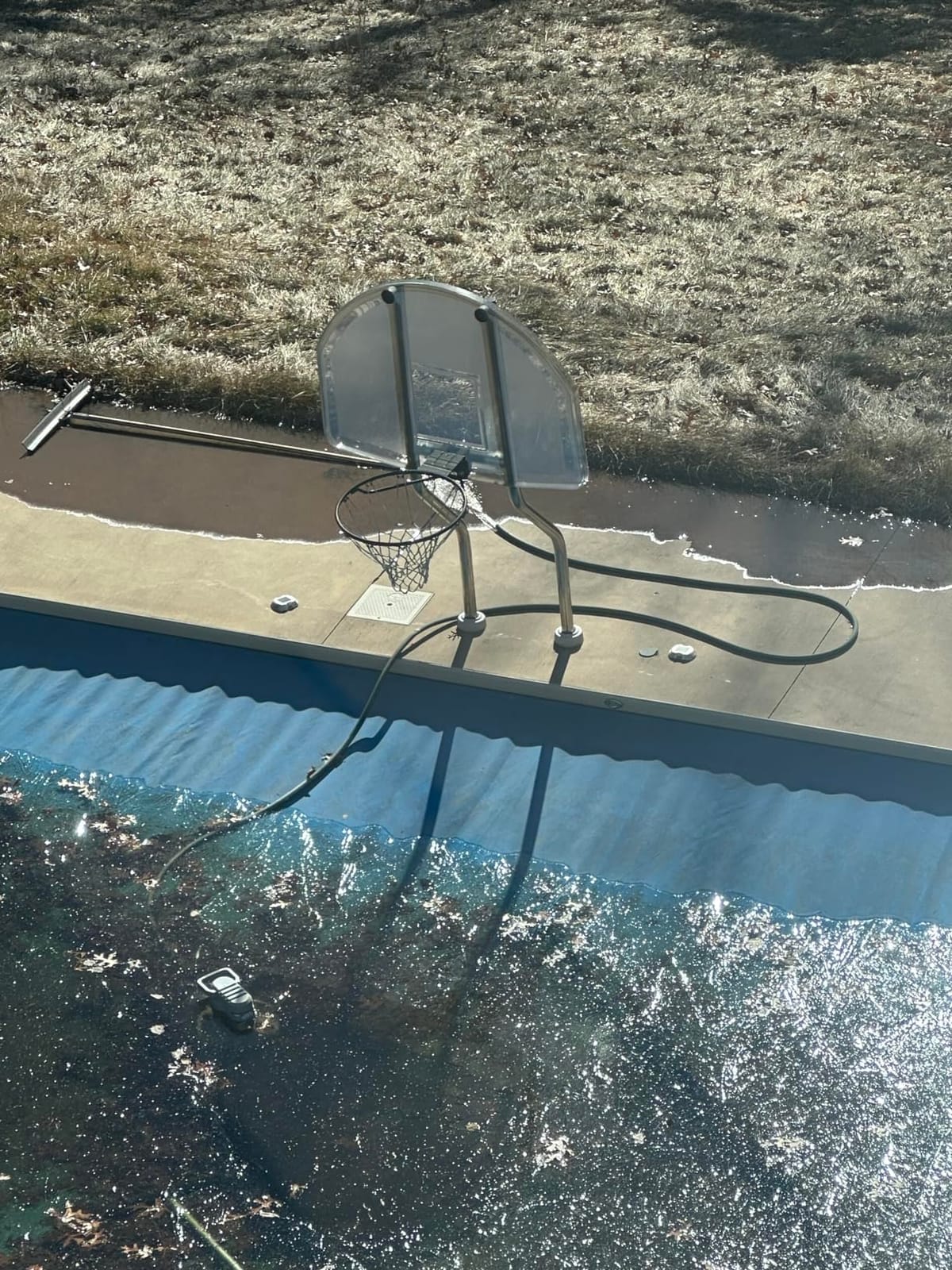
Its 25 foot maximum lifting height gives it plenty of head, which helps when your drainage point sits above the pool rather than below it.
We want to be straight about the rest. At 4.1 stars across 135 reviews it has the lowest average rating of the eight pumps here, and as an older model its replacement parts are harder to find. The metal build buys durability, not perfect owner satisfaction.
When a steel housing is worth choosing
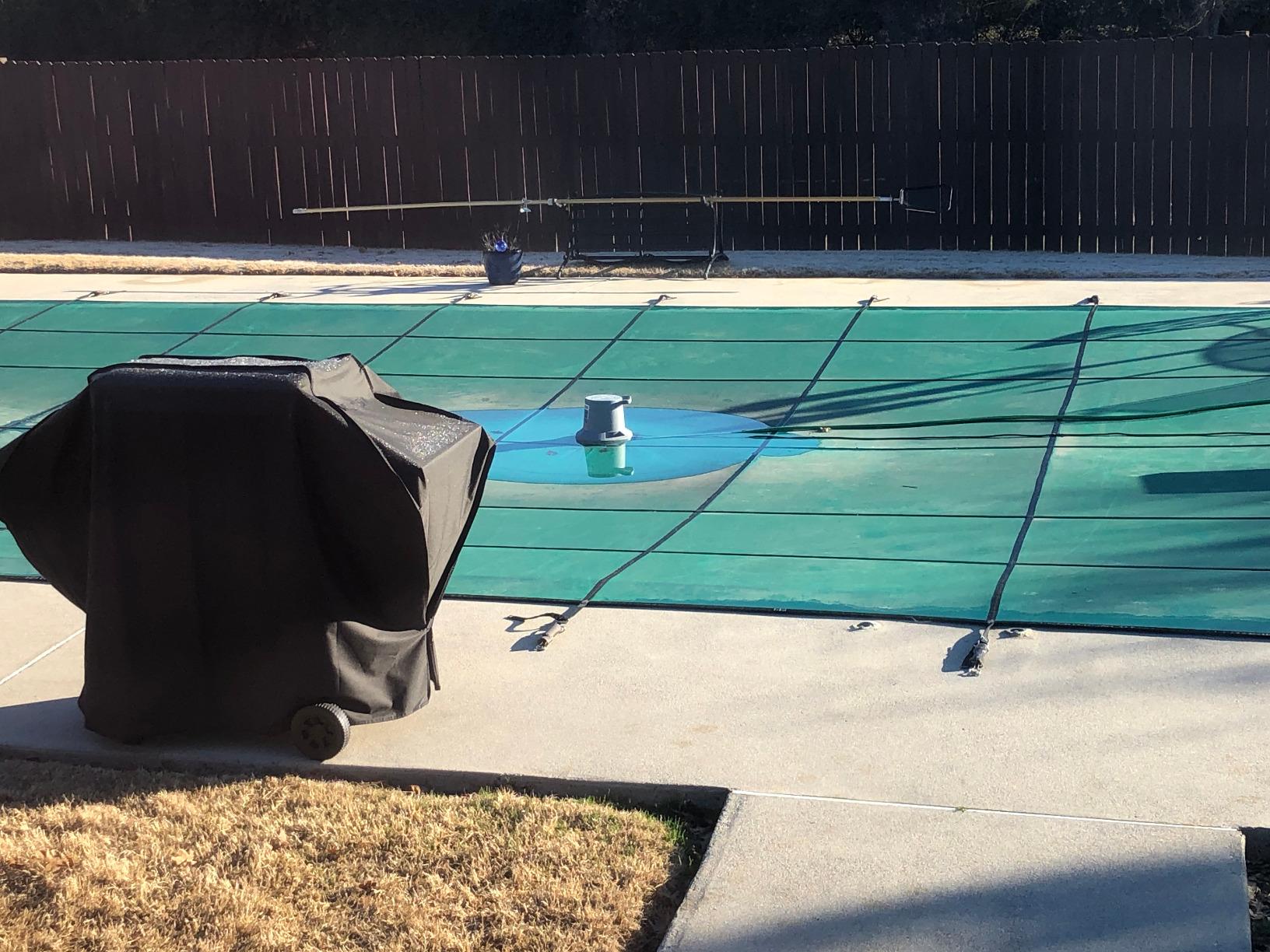
If your pump lives on a cover in a place with hard winters, or you have replaced plastic-housed pumps before and watched them crack, the material is a real upgrade. Steel does not go brittle in the cold the way thin thermoplastic can.
It is also the pick for anyone who plans to keep the same pump for a decade rather than replace it every few seasons, provided you accept that parts availability may get harder over time.
Where it falls short
The 14 by 8 by 12 inch body needs a genuinely flat, well supported patch of cover. On a small above-ground tarp it may not have anywhere to sit.
Its owner base is small enough that the long-term picture is still forming, and its average rating is the lowest of the group. Owners who want the widest support and the largest body of owner feedback should look at one of the higher-rated automatics instead.
How We Tested These Pool Cover Pumps
We ran eight units over six weeks through repeated cycles rather than a single demo, dropping wet leaves and grit into the intake each time. Our thresholds were deliberately modest: anything under roughly 850 GPH had to prove itself on a small above-ground cover, and anything claiming 2,000 GPH or more had to move water through a realistic drain hose. We tracked how fast each unit starts, whether it shuts itself off, and how long a clean-up takes when the screen clogs. Start-up reliability mattered more than headline flow, a removable screen mattered more than a second automatic cycle, and weight mattered more than either once the cover was slack.
How to Choose a Pool Cover Pump
Six decisions actually determine whether you bought the right pump. Work through them in order and the choice makes itself.
Size for the cover, not the pool. Flow rate is measured in gallons per hour at a specific lift height, so the real number on your drain line will be lower than the box. Small above-ground covers are fine with 850 to 1,700 GPH. In-ground covers, spring melt and heavy rain want 2,000 GPH and up.
Decide above-ground versus in-ground. An above-ground pool wall and top rail are far more sensitive to downward load than an in-ground shell, so use a smaller, lighter pump and keep it near an edge. Never let a heavy pump sit in the middle of a slack cover.
Choose automatic, manual or non-electric. An automatic pool cover pump with a float switch or water level sensor runs unattended. A manual electric pump runs only when plugged in. A siphon pump needs no power at all but requires a downhill discharge point, which is why siphons fail on flat yards.
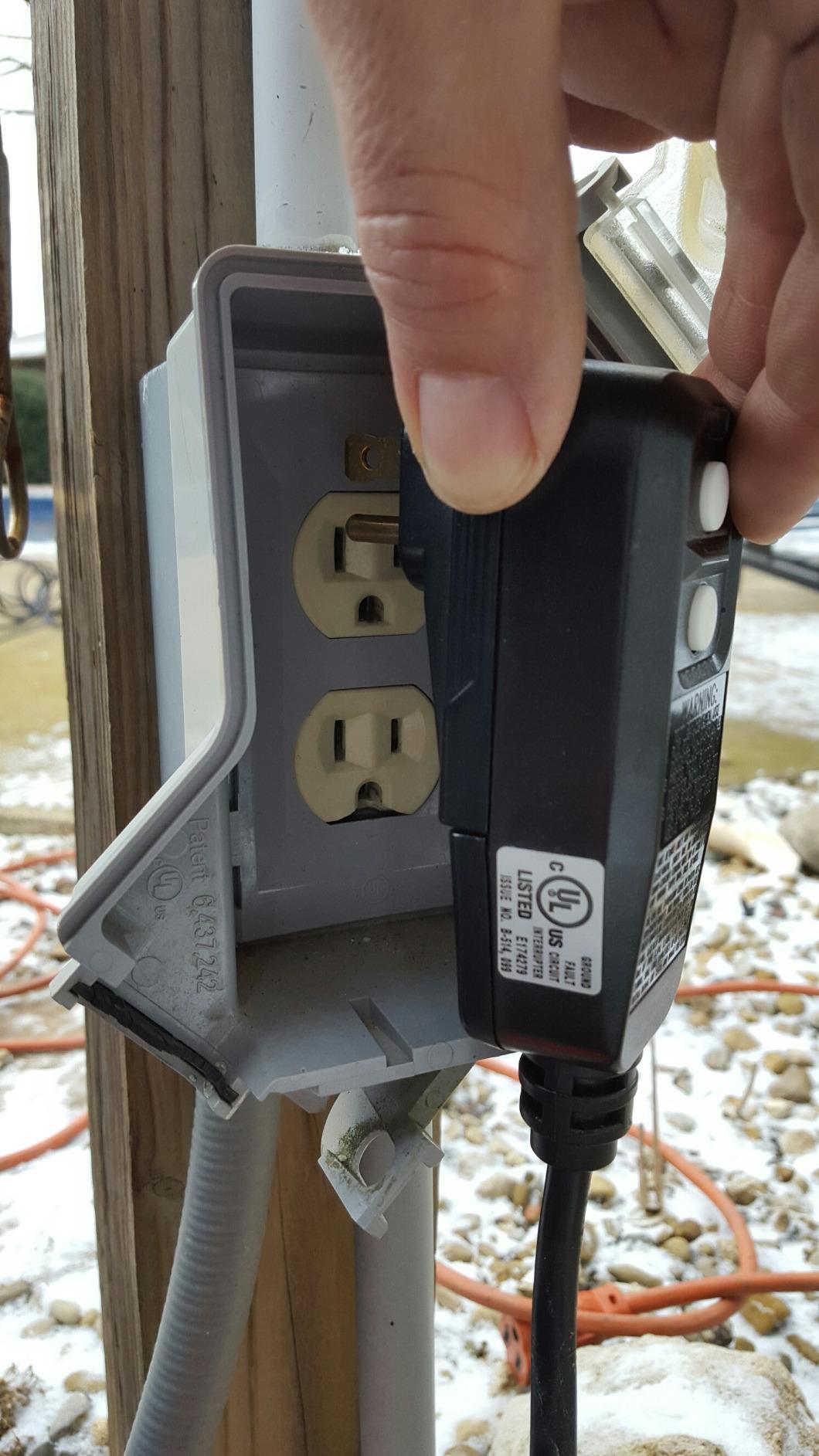
Use a GFCI-protected outlet. Every pump here is a submersion device sitting next to a pool. A GFCI outlet, and an extension cord rated for outdoor wet use, is not optional. If your unit trips a breaker, that is the first thing to check.
Measure cord and hose before you buy. A 25 foot cord is the common standard and it reaches most installations, but the hose connection is what limits real flow. A 1-1/4 inch drain line moves far more water than a 3/4 inch garden hose, and the small hoses bundled with budget pumps are the biggest reason their real output falls short.
Decide where the water goes. A pump needs somewhere to discharge that is downhill or level, and on a flat yard you may end up running the hose slowly to let the ground absorb it. Plan the route before you buy, not after.
On brand reliability. Long-term owner reports matter more here than any spec sheet, because a cover pump is a ten-season purchase. On r/pools, owners consistently describe Little Giant pumps from the 1980s and 90s as nearly indestructible while noting that modern equivalents are not always built to the same standard, and Little Giant is still treated as the benchmark. There are 25-year-old units still in service, and rebuild services exist for owners who would rather not replace a working pump. On troubleFreePool, the most commonly reported cause of death is not rain at all, it is a pump buried under heavy snow for weeks.
On running a manual pump on a timer. If you prefer a manual pump to an automatic one, a mechanical timer set to a short daily cycle is the compromise owners on r/swimmingpools describe most often. The pump gets a few minutes of attention every day without anyone having to check the cover after every storm. The important safety rule is to put the pump on its timer, not to leave it running continuously, because a manual unit has no low-water cutout and will run hot if the water disappears.
Troubleshooting: Why a Pool Cover Pump Will Not Turn On
This is the most common complaint we saw, and it has almost always been one of five things. Work through them in order.
Check the water depth against the activation threshold. Automatic pumps in this group switch on somewhere between five eighths of an inch and 2-1/8 inches of water. Below that threshold nothing happens, and the pump looks broken when it is working exactly as designed.
Make sure the float switch or sensor is free to move. A pump that has settled onto a wrinkle of cover fabric, or a leaf stuck against the float, cannot rise into its on position. Lift it, clear the area around it, and set it back on flat fabric.
Confirm the pump is fully submerged and upright. Some units will not self-start unless they are sitting on their side in several inches of water, and a pump that has tipped onto its side or gone partly out of the water will refuse to cycle.
Check the cord, the plug and the GFCI. Look for a tripped breaker or a reset GFCI first, then work back along the cord. A cord that has been pulled out of the water by a rising cover is a common and easily missed failure.
Clear the intake screen. A clogged strainer reduces flow to nothing and can stall the impeller. Pull the screen off, rinse it, and check that the impeller spins freely before you reassemble.
If the pump runs and then stops mid-job, add a sixth check: ice. Water that has frozen around the intake will stop a pump dead, and thawing it out usually restores full operation.
Keeping It Working: Clogs, Leaves and Winter Storage
A cover pump is a maintenance item, not a set-and-forget device, and the schedule is simple. Rinse the intake screen every week through leaf season and after any storm, before you judge the pump’s performance. Check the cover after heavy rain, and check it again the morning after any snow, because a foot of wet snow on a cover moves far more weight than a foot of rainwater.
For clogs specifically, the fix is upstream. A leaf net over the cover catches most of what would otherwise reach the intake, and a pool pillow under the cover holds the shape so water runs to the low point instead of sitting in a broad sheet. If you can position the pump at that low point, it works less and lasts longer.
Do not leave a cover pump outside through hard freezes. Owners on troubleFreePool describe snow burial, not cold, as the thing that kills these units, so bring the pump in when the season ends, dry it fully and store it off the floor. Seasonal jobs like this are easier when you set a recurring reminder, the same habit we use to keep reusable asset specifications and rejection fixes in front of us.
The rest of the winterizing kit matters too: the solid cover, the pool pillow, the leaf net, a skimmer plug, winterizing chemicals and cover clips. A pump is the last piece of that list, not the only one.
Frequently Asked Questions
What is the best pump to pump water off a pool cover?
The Little Giant APCP-1700 is our top pick because it moves about 1745 GPH at a one foot lift, switches itself on at 2 inches of water and off again at 1 inch, and has a removable intake screen you can rinse in under a minute. It runs on a 25 foot cord and stops before the impeller runs dry, which is what most owners actually need from a cover pump.
What is the best automatic pump for pool cover?
The Little Giant APCP-1700 and the WAYNE WAPC250 are the two automatics worth shortlisting. The Little Giant has the larger owner base and the friendlier 2 inch activation point, while the WAYNE WAPC250 moves up to 3000 GPH and adds freeze and locked-impeller protection, which suits heavy rainfall climates and large in-ground covers.
Which brand of pool pump is the most reliable?
Owner reports on pool forums point consistently to Little Giant as the long-term benchmark, with units from the 1980s and 90s still in service today and rebuild services available for owners who would rather not replace a working pump. Owners also note that the most common killer of any brand is a pump buried under heavy snow, not ordinary rain or cold weather.
How do I choose a pool cover pump?
Start with flow rate: roughly 850 to 1700 GPH suits a small above-ground cover, while in-ground covers and heavy rain want 2000 GPH or more. Then decide automatic, manual or non-electric, confirm you have a GFCI-protected outlet within cord reach, check that your drain hose is large enough to deliver the rated flow, and plan where the water will actually discharge before you buy.
Is a pool cover pump necessary?
You only need one for a solid cover, a tarp-style cover, or any cover that does not drain into the pool itself. A mesh cover that lets water pass straight through, or an automatic safety cover that drains into the pool plumbing, does not need a pump. Every pool closed with a conventional solid winter cover does.
Why won’t my pool cover pump turn on?
Check five things in order: whether the water is actually deep enough to reach the activation threshold, whether the float switch or sensor is free to move, whether the pump is fully submerged and upright, whether the cord, plug and GFCI are sound, and whether the intake screen is clogged. Pumps that will not self-start unless they are laid on their side in several inches of water are a known behaviour on some models rather than a fault.
Which Pool Cover Pump Should You Buy?
The Little Giant APCP-1700 is the one we would put on almost any solid cover, because a reliable float switch and a screen you can clean in a minute beat raw flow rate in the real world. If you only want to pump manually after a storm, the AgiiMan 850 GPH is the value pick, and if your pool takes serious rain the WAYNE WAPC250 has the throughput and the protective circuitry to keep running overnight.
Whichever you choose, place it at the low point of the cover, plug it into a GFCI outlet, and check the screen after every storm. That routine is what separates a cover that survives the winter from one that ends up torn.