
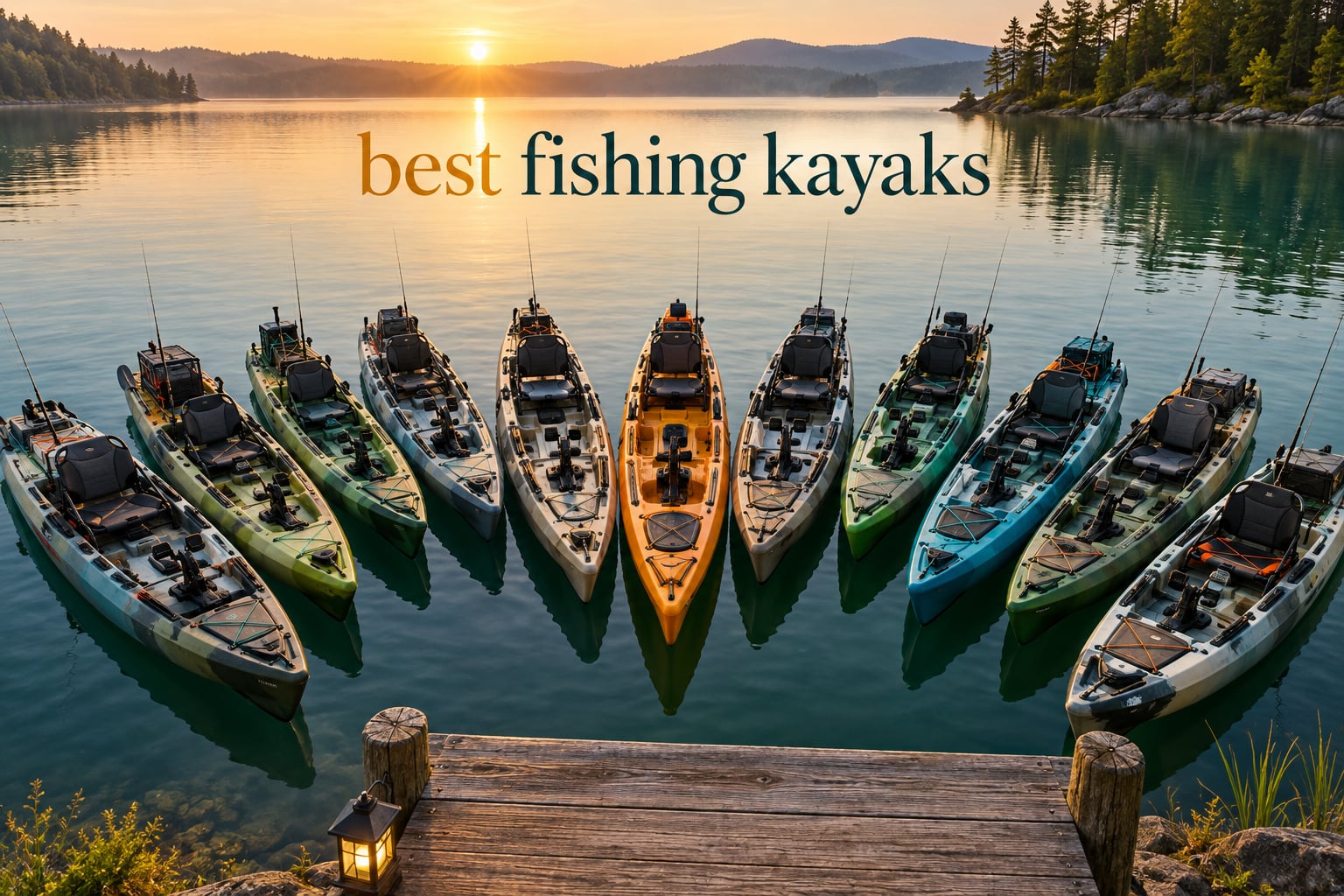
Picking the right fishing kayak comes down to three questions: how wide you need to be for standing casts, how heavy the boat is that you can actually lift to the water, and whether your water is open enough that paddling alone will wear you out by hour three. Get any one of those wrong and you end up with a boat that sits on a rack gathering dust.
We spent 2026 season comparing the 12 fishing kayaks below, and the short version is that this is a paddle-dominant field. Most of the strongest options are sit-on-top polyethylene boats between 9 and 12 feet, and the pedal-drive picks split into two very different camps: fin drives for quiet water and propeller drives for current and open water. Sit-inside designs still make the most sense for a specific kind of angler, and one tandem boat covers the two-person case on its own.
Before the individual reviews, here is where each of these 12 kayaks lands, and why.
Best overall: the Pelican Catch Mode 110, because a 34.5 inch beam, a retractable skeg, rigging tracks and a 4.6 star rating across 348 reviews cover the most water types for the least compromise.
Best for beginners: the Lifetime Tamarack Angler 100, which is the most-reviewed boat here by a wide margin, comes with a paddle, and carries a skeg and deep tracking channels that you would otherwise have to learn to add later.
Best for big anglers: the Perception Outlaw 11.5, with 425 pounds of rated capacity, a 35 inch beam, four integrated rod holders and a tankwell that swallows a real cooler.
Best value: the Pelican Sentinel 100X, a boat under 50 pounds with removable ExoPak storage and a padded high backrest at a weight you can carry solo.
Best lightweight sit-inside: the Perception Flash 9.5 at 41 pounds, for anglers who want a dry cockpit and nimble handling in chop.
Best first pedal drive: the Reel Yaks Raptor 9.5, the only fin-drive boat here, and it breaks into two pieces for apartment storage.
Best for current and open water: the Reel Yaks Raider 9.5, whose propeller drive holds speed where a fin drive bogs down.
Best modular pedal boat for larger anglers: the Reel Yaks Radar 10 at 430 pounds of capacity.
Best for the money on a lake: the Pelican Catch Classic 100, a 10 foot tunnel hull with a quick-lock hatch and internal flotation built in.
Best for two anglers: the BKC Brooklyn 12.5, rated for 595 pounds with six rod holders.
Best for apartment storage: the Lifetime Lockport 94, a 40 pound hard shell that breaks in half with no tools.
Best recreational angler boat: the Perception Pescador Pro 10, with large front and rear storage and a folding lawn chair seat.
How we read the spec sheets: every length, beam, dry weight and capacity figure below comes from the manufacturer listing rather than a rounded blog number, because a boat quoted at 12 feet is frequently sold at 11 foot 6 inches. Ratings and review counts are the live figures attached to each listing, so a boat with 35 reviews is a different kind of recommendation than one with 1,340, and we say so where it matters.
One more note before the reviews, because it trips up most first-time buyers. A trolling motor is not included with any boat in this roundup except where the manufacturer mount is noted as built in, and the motor, battery, wiring and switch hardware are a separate purchase that changes the real cost of any hull. The same goes for the drive systems: a pedal drive needs a working prop or fin, a shaft, and a battery, and those parts age faster than the hull does.
Table of Contents
- Top 3 Picks for Fishing Kayaks (October 2026)
- Best Fishing Kayaks (October 2026)
- 1. Pelican Catch Mode 110 – Best Overall Fishing Kayak
- 2. Lifetime Tamarack Angler 100 – Best Budget Pick
- 3. Perception Outlaw 11.5 – Best for Big Anglers
- 4. Pelican Sentinel 100X – Best Value Fishing Kayak
- 5. Perception Flash 9.5 – Best Lightweight Sit-Inside
- 6. Reel Yaks Raptor 9.5 – Best Entry Pedal Drive
- 7. Reel Yaks Raider 9.5 – Best Modular Drive for Current and Open Water
- 8. Reel Yaks Radar 10 – Best Modular Pedal Kayak for Larger Anglers
- 9. Pelican Catch Classic 100 – Best for the Money on a Lake
- 10. BKC Brooklyn 12.5 – Best Tandem Fishing Kayak
- 11. Lifetime Lockport 94 – Best Modular Kayak for Apartment Storage
- 12. Perception Pescador Pro – Best Recreational Angler Kayak
- How to Choose a Fishing Kayak in 2026
- Safety Before You Launch: PFD, Leash and the 120 Rule
- Frequently Asked Questions
- Which of these fishing kayaks is the most stable?
- What is the best fishing kayak for a beginner?
- Is a pedal drive fishing kayak worth it?
- How much weight capacity do I need in a fishing kayak?
- What is the best fishing kayak for a larger angler?
- Do I need a license or registration for a fishing kayak?
- Can you stand and cast from a fishing kayak?
- What is the best fishing kayak for the money?
- The Best Fishing Kayak for You
Top 3 Picks for Fishing Kayaks (October 2026)
Pelican Catch Mode 110
- 34.5 inch beam
- 375 lb capacity
- Ergoboost seat with EVA pad
- Stern retractable skeg
- Two 4 inch rigging tracks

Pelican Sentinel 100X
- 44.6 lb dry weight
- 275 lb capacity
- Ergolounge padded high backrest
- Removable ExoPak storage

Lifetime Tamarack Angler 100
- 51 lb dry weight
- 275 lb capacity
- Skeg and deep tracking channels
- Two flush rod holders plus top mount
Best Fishing Kayaks (October 2026)
| Product | Specs | Action |
|---|---|---|
| Pelican Catch Mode 110 |
|
Check Latest Price |
| Lifetime Tamarack Angler 100 |
|
Check Latest Price |
 Perception Outlaw 11.5 Perception Outlaw 11.5 |
|
Check Latest Price |
| Pelican Sentinel 100X |
|
Check Latest Price |
 Perception Flash 9.5 Perception Flash 9.5 |
|
Check Latest Price |
 Reel Yaks Raptor 9.5 Reel Yaks Raptor 9.5 |
|
Check Latest Price |
 Reel Yaks Raider 9.5 Reel Yaks Raider 9.5 |
|
Check Latest Price |
 Reel Yaks Radar 10 Reel Yaks Radar 10 |
|
Check Latest Price |
 Pelican Catch Classic 100 Pelican Catch Classic 100 |
|
Check Latest Price |
 BKC Brooklyn 12.5 BKC Brooklyn 12.5 |
|
Check Latest Price |
 Lifetime Lockport 94 Lifetime Lockport 94 |
|
Check Latest Price |
 Perception Pescador Pro Perception Pescador Pro |
|
Check Latest Price |
1. Pelican Catch Mode 110 – Best Overall Fishing Kayak
Pelican Catch Mode 110 Fishing Kayak – Premium Angler Kayak with Lawnchair seat – 10.5 Ft., Venom
Length 128 inch
Beam 34.5 inch
Dry weight 75 lb
375 lb capacity
Paddle power
Pros
- 4.6 star rating matched only by the Lifetime Lockport 94
- Retractable skeg pulls straight in wind
- Ergoboost seat with EVA pad and under-seat storage
- Rigging tracks and three flush rod holders as standard
Cons
- 75 lb is a heavy solo lift on land
- Retractable skeg needs deploying for best tracking
- Heavier hull than the 9 and 10 foot models in this roundup
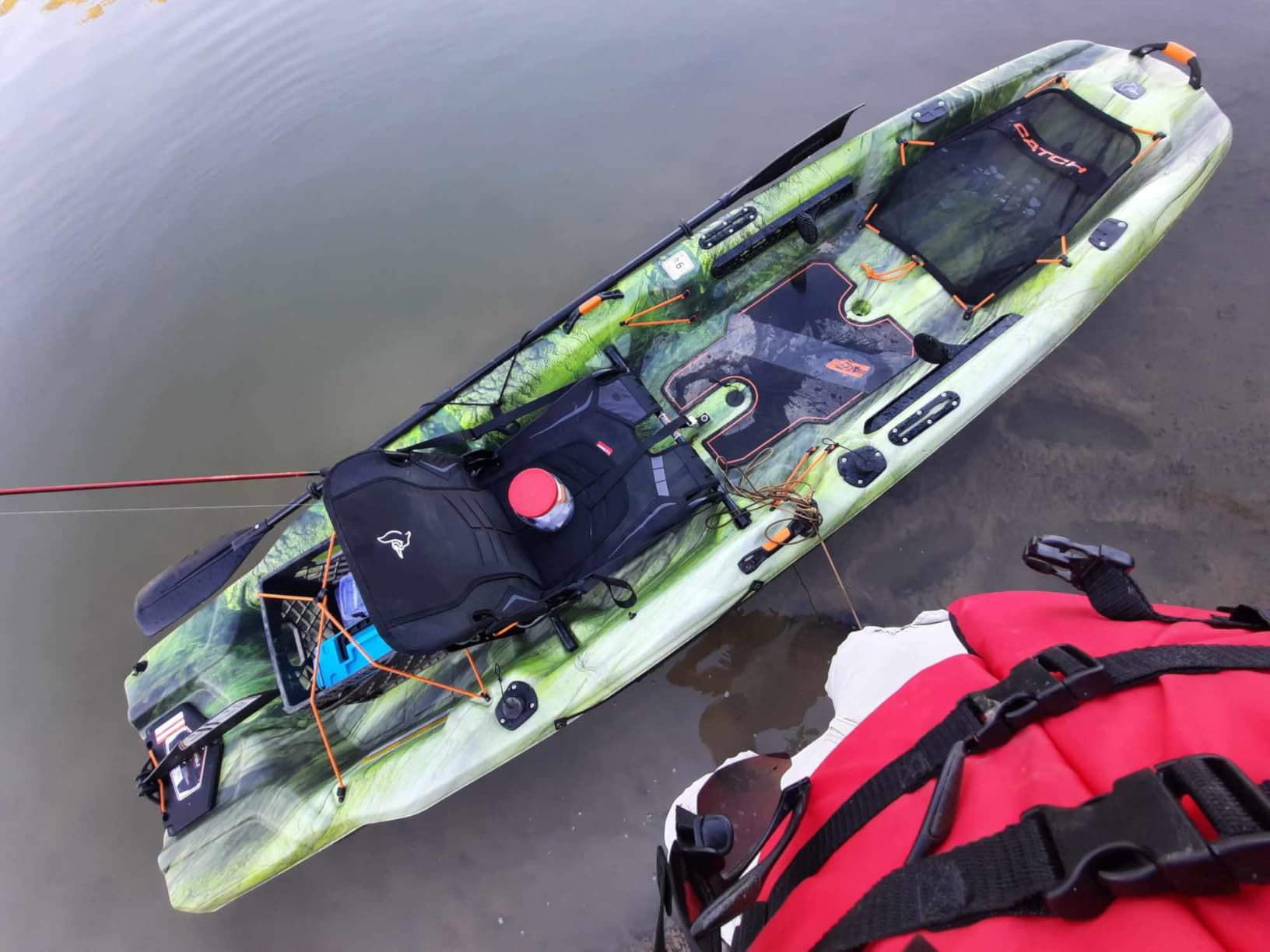
The Catch Mode 110 is the boat I kept coming back to while working through this list, because it does the boring things right. The hull is 10 foot 8 inches long and 34.5 inches across, which is wide enough to stand in for a cast without the slow-motion wobble you get on a 30 inch boat, and it is still short enough that one person can drag it to a launch on a cart. The flat, wide bottom is what actually does the work when you rise up out of the seat.
Two details separate it from the entry-level sit-on-tops. The Ergoboost seat is a height-adjustable framed chair with an EVA pad and storage underneath, so it can drop low for casting and come back up for moving, and the stern carries a retractable skeg that most competitors in this class do not offer at all. Owners consistently single the skeg out as the reason the boat holds a line in wind rather than slewing sideways on every stroke.
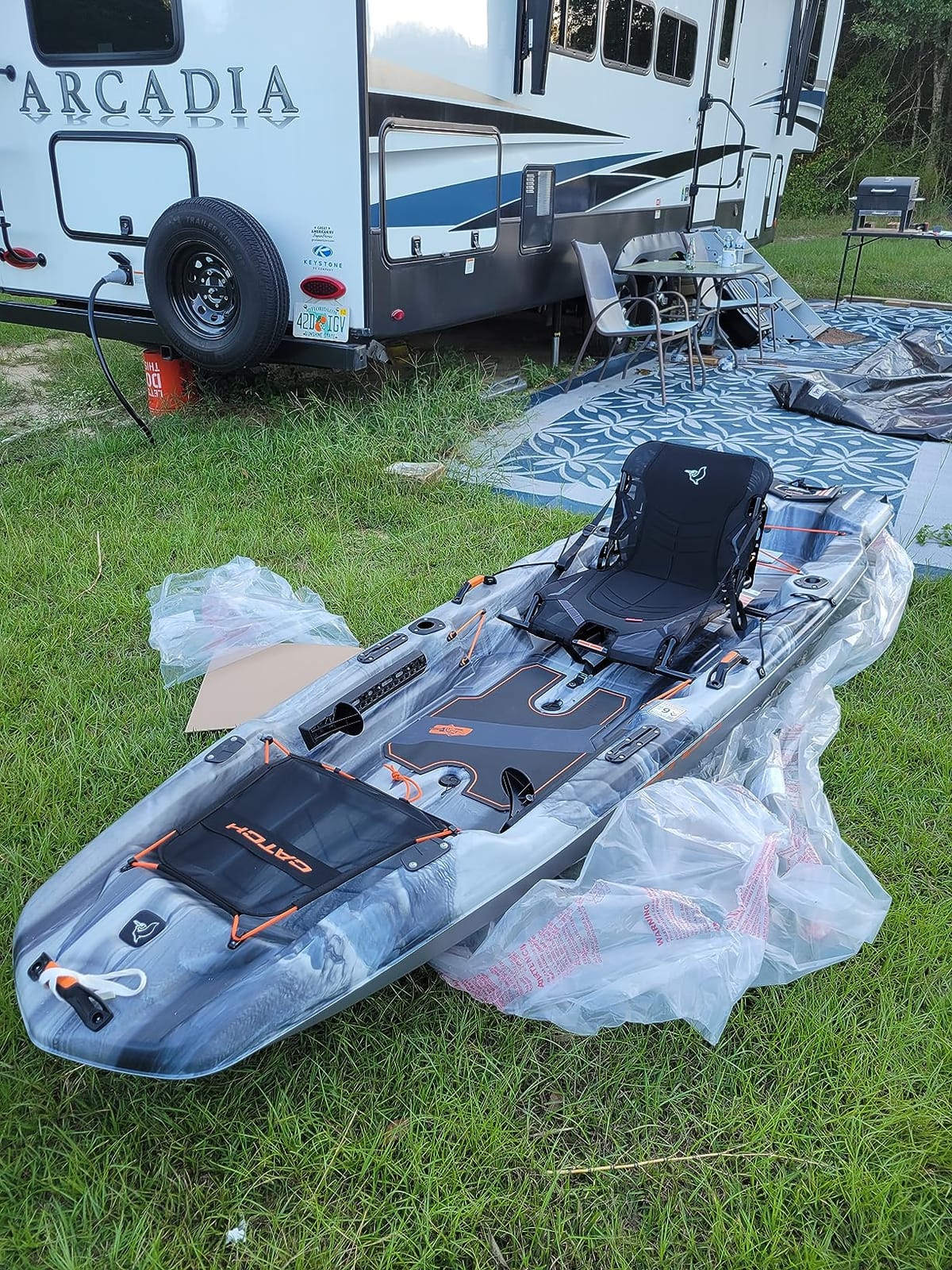
Rigging is unusually complete for a hull at this level. There are two 4 inch accessory tracks running along the deck, three flush-mounted rod holders, paddle and rod tie-downs, and anti-slip traction pads that have a ruler printed on them, which sounds like a gimmick until you are trying to measure a fish on the deck. Capacity is rated at 375 pounds, which covers an angler at 250 with a full cooler, tackle bags and a motor battery behind the seat without crowding the rating.
The honest drawback is weight. At 75 pounds it is a heavy solo lift, and the load sits entirely in the hull rather than in a detachable part. If you launch from a dock you can walk, that does not matter. If you are carrying it across a soft bank alone, plan on a cart with a balloon-style tire, because a narrow-wheeled cart on a polyethylene hull is an argument you will lose.
Pelican backs the hull with a limited lifetime warranty against manufacturer defects and one year on parts and accessories, so the shell is covered for a long time and the moving pieces are not. That is a fair split, and it is a reason to keep your eye on the seat hardware and skeg cable after the first season of use.
What you get that the entry-level boats do not
The deck space is the quiet advantage. At 10 foot 8 inches with a 34.5 inch beam, there is enough flat area forward of the seat to stand with both feet while keeping your tackle within reach, and the anti-slip pads mean your shoes are not fighting you while you balance. Anglers who came from a 10 foot plastic sit-on-top consistently describe the Catch Mode as the first boat they felt genuinely planted on.
The second advantage is the skeg. If you fish water with any fetch to it, a boat with a fixed skeg and a long waterline will out-run a boat without one, and the retractable version lets you lift it in the shallows where a fixed skeg would dig in. That single feature is why this boat is a reasonable choice for a lake with wind, which is exactly where a lot of first-time buyers end up fishing.
Where it falls short for you
If you are under about 130 pounds and fish ponds and slow creeks, this boat is more than you need, and the 75 pound lift is a real tax for a feature set you will not use. The same applies to anglers without a vehicle or cart, or anyone who wants to walk a boat to a shoreline launch alone. In those cases the Sentinel 100X or the Lockport 94 is a better fit.
Also worth knowing: the retractable skeg is a cable-operated part, and cables need periodic inspection after a season of salt water or sand. And the version you want is the rudder-equipped package, since the base variant differs in how it steers. Check the listing carefully before you order, because that difference changes how the boat handles on a windy day.
2. Lifetime Tamarack Angler 100 – Best Budget Pick
Lifetime Muskie Angler Sit-On-Top Kayak with Paddle, Tan, 120″
Length 120 inch
Beam 31 inch
Dry weight 51 lb
275 lb capacity
Paddle included
Pros
- Most reviewed kayak here with 1340 ratings
- Skeg and deep tracking channels give confident tracking
- Flat bottom is stable for moving around
- Paddle and storage compartments included
- Front and rear T-handles for transport
Cons
- Included paddle is flimsy and short
- Molded seat connector clips bend out of the slot
- Storage compartment cup inserts are not included
- Drifts to one side when you stop paddling
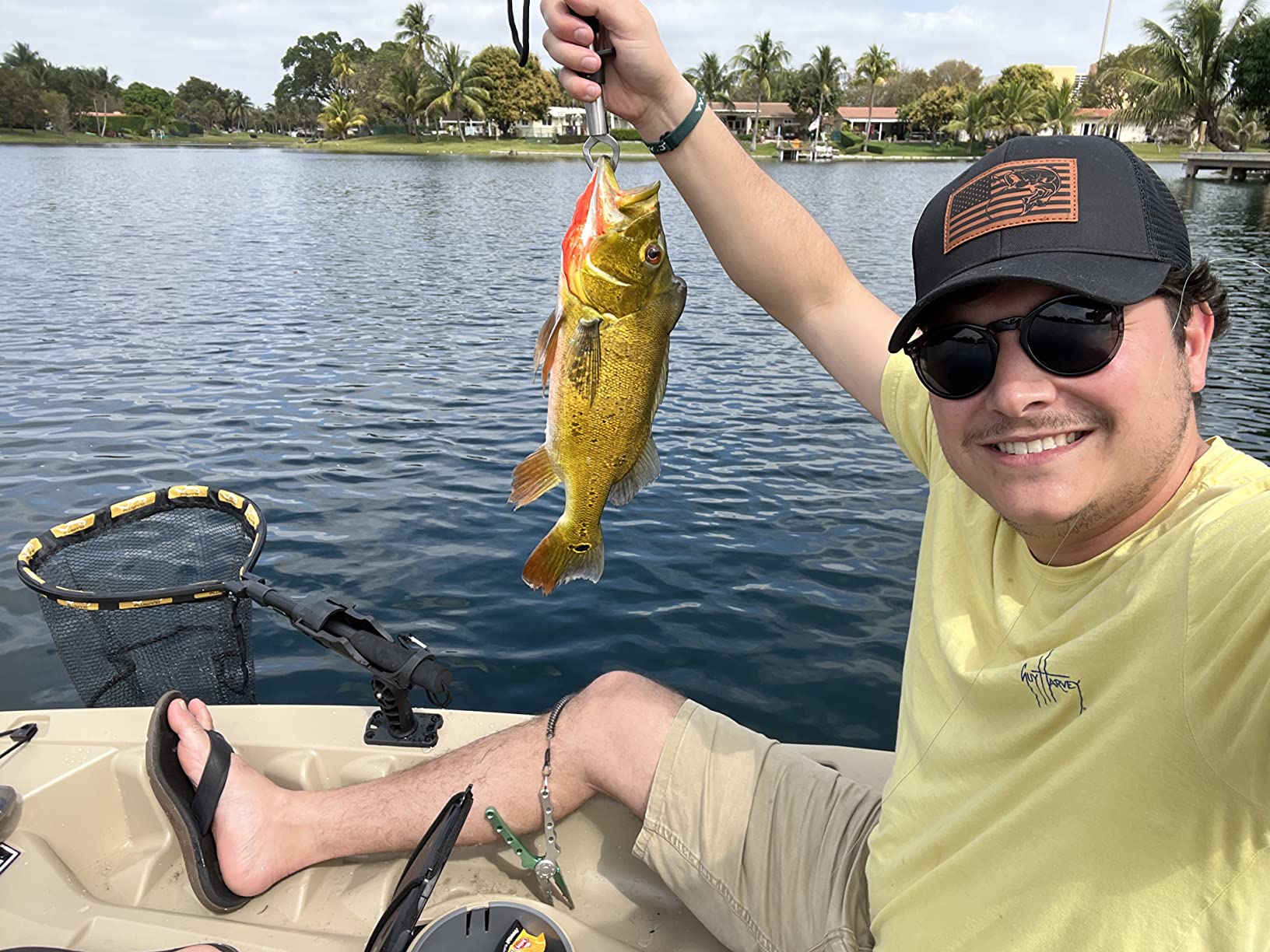
The Tamarack Angler 100 is where most people start, and after 1,340 ratings on the listing it is still the boat most first-time owners end up with. It is a 10 foot rotomolded polyethylene sit-on-top at 51 pounds, which is a genuinely manageable two-hand carry for one person, and the boat comes with a paddle so there is nothing to buy on day one beyond a life jacket.
What makes it a fishing kayak rather than a general sit-on-top is the deck: two flush-mounted rod holders, one top-mounted holder, a pair of 6 inch storage compartments at the rear and center, multiple footrest positions and a flat bottom. Reviewers commonly report adding a stadium seat, extra rod holders and a fish finder mount, which tells you the hull is fine as a platform and the factory trim is entry level.

Tracking is better than the class usually manages. The sharp bow, the skeg and the deep hull channels work together so the boat holds a line instead of wandering, and a 31 inch beam with a flat bottom gives you a stable platform to stand on for a cast even though it is not as planted as a 35 inch hull. For pond, creek and small lake fishing, that combination is exactly right.
The complaints are consistent and mostly cosmetic. The molded plastic connectors that clip the seat back into its slot bend out if you force them, the paddle that ships in the box is short and flimsy enough that most owners replace it, and plastic chips inside the hull need vacuuming out before the first launch. None of that is structural, and reviewers describe the plastic itself as durable and UV protected with a 5-year limited warranty behind it.
One handling note that shows up often enough to matter: with no paddle moving, the boat tends to drift toward one side. If you are fishing a seam or working the windward edge of a drop-off, keep a hand on the paddle rather than setting it down.
Why beginners end up buying this one
The reason is simple. It is complete enough to fish on the afternoon you receive it, light enough to carry without help, and cheap enough that a first-time buyer is not risking much on an unknown brand. It is also the model most often used as a stepping stone, and owners who later upgrade to a larger angler boat talk about it the way people talk about a first bicycle that taught them something.
The flat bottom also makes it forgiving. If you are still working out how to brace, how to get in and out without capsizing, or how to keep your rod tip out of trouble while you paddle, a flat-bottomed boat gives you more margin for error than a rounded recreational hull.
Where it is the wrong boat
Capacity is 275 pounds, and that is the ceiling. An angler at 200 pounds with a 25 pound motor battery and a full cooler and tackle load is already at the practical limit, so for larger anglers it is a hard stop rather than a compromise. The 31 inch beam is also on the narrow side for standing casts, so if you plan to fish upright in open water, look at a 34 inch hull or wider.
On the water, the fixed skeg and modest top speed make it less suited to long paddles across a big lake. And the storage compartments are small, so a full day of live bait and a cooler means the rest of the gear goes in a dry bag lashed to the deck.
3. Perception Outlaw 11.5 – Best for Big Anglers
Perception Kayaks – Outlaw 11.5 Fishing Kayak – Sit on Top – Fold Away Lawn Chair Seat – 4 Rod Holders – Integrated Tackle Trays – 11.5 ft – Dapper
Length 138 inch
Beam 35 inch
Dry weight not listed
425 lb capacity
Paddle power
Pros
- Class leading 425 lb capacity for a solo angler hull
- 35 inch beam is stable standing
- Large rear tankwell plus front storage
- Four integrated rod holders and tackle trays
- Made in the USA with 5 year hull warranty
Cons
- Longest solo hull here at 138 inch so transport is a two person job
- Lift it with a cart or a second person
- Dry weight is not published in the listing
If your body weight plus your gear approaches 300 pounds, this is the boat built for it, and the number is the whole argument. The Outlaw 11.5 is rated at 425 pounds on an 11 foot 6 inch hull that is 35 inches across, and that combination of beam and length is rare in this category. It is also made in the USA under a 5-year warranty on the hull and deck.
The layout is built for gear, not just for a rod. There is a large rear tankwell that accepts a cooler or a crate, a front storage area behind the bow, four integrated rod holders and molded-in tackle trays that keep the small stuff off the deck. Owners use the front space for a tackle center, which is exactly what the space is for, and they report that the room changes how much they bring on a trip.
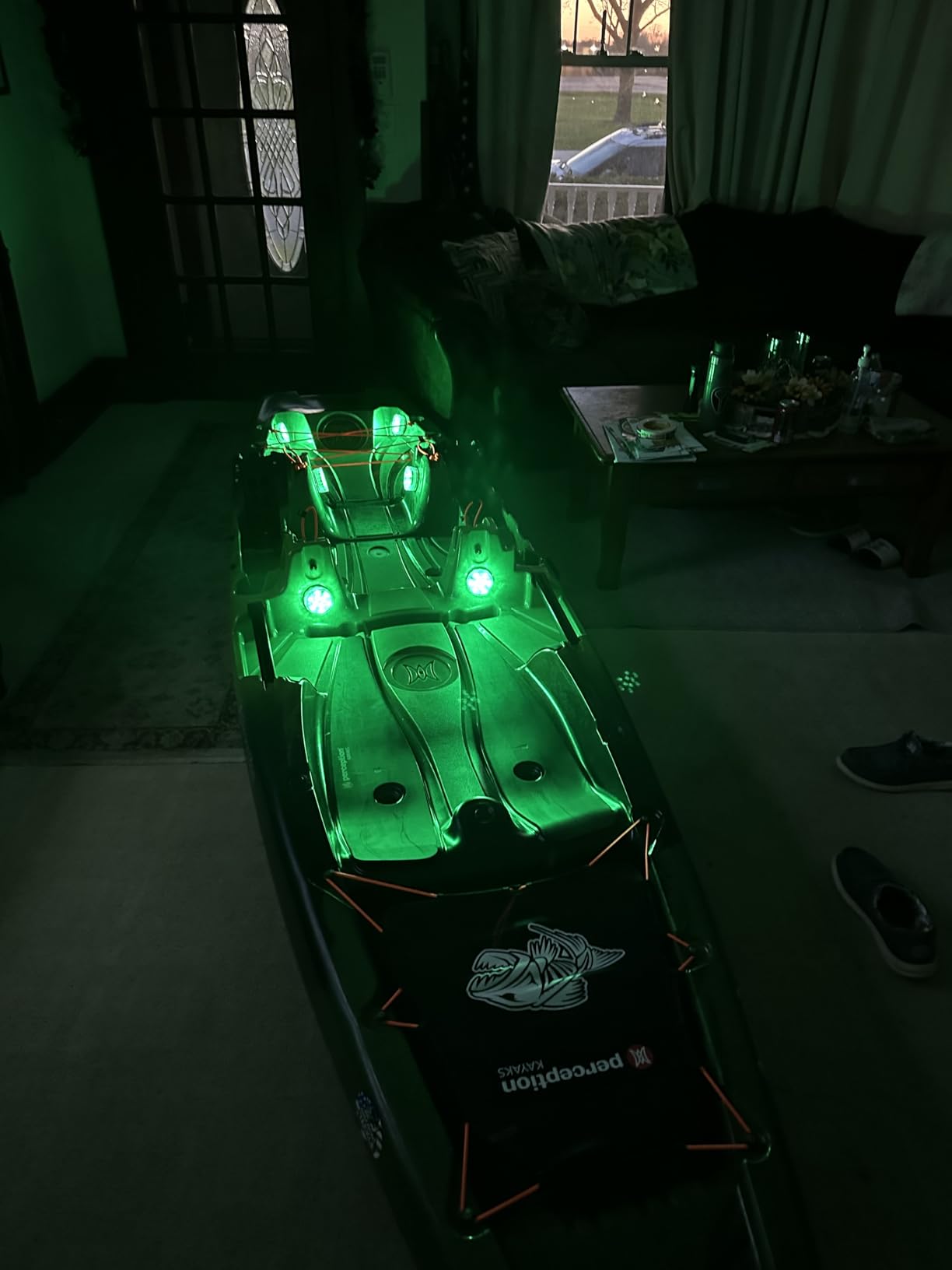
The seat is a fold-away frame chair. It is not a premium padded seat, and reviewers who swap it for a stadium seat report liking the boat more, but the frame design folds out of the way and does not add a fixed post in the middle of the deck. That keeps the standing area clear, which matters on a hull this wide because you have the width to actually stand up and fish from it.
Where the capacity comes from is worth being honest about. A 425 pound rating is not a suggestion to load 425 pounds. As a rule, staying at or under 80 percent of the rated figure keeps the boat tracking properly and reduces the chance of the bow digging in when you move, so a realistic working load here is around 340 pounds of angler, motor, batteries and gear, and only the two modular Reel Yaks boats carry a higher single-angler rating in this group.
One spec is genuinely missing from the listing, and buyers should note it: the dry weight is not published. At 11 foot 6 inches by 35 inches, this is not a boat you carry to a launch, so treat the missing figure as an inconvenience rather than a dealbreaker, but plan on a trailer, a roof rack or a cart that can handle a load in the 80 to 90 pound range.
Why larger anglers keep landing on this hull
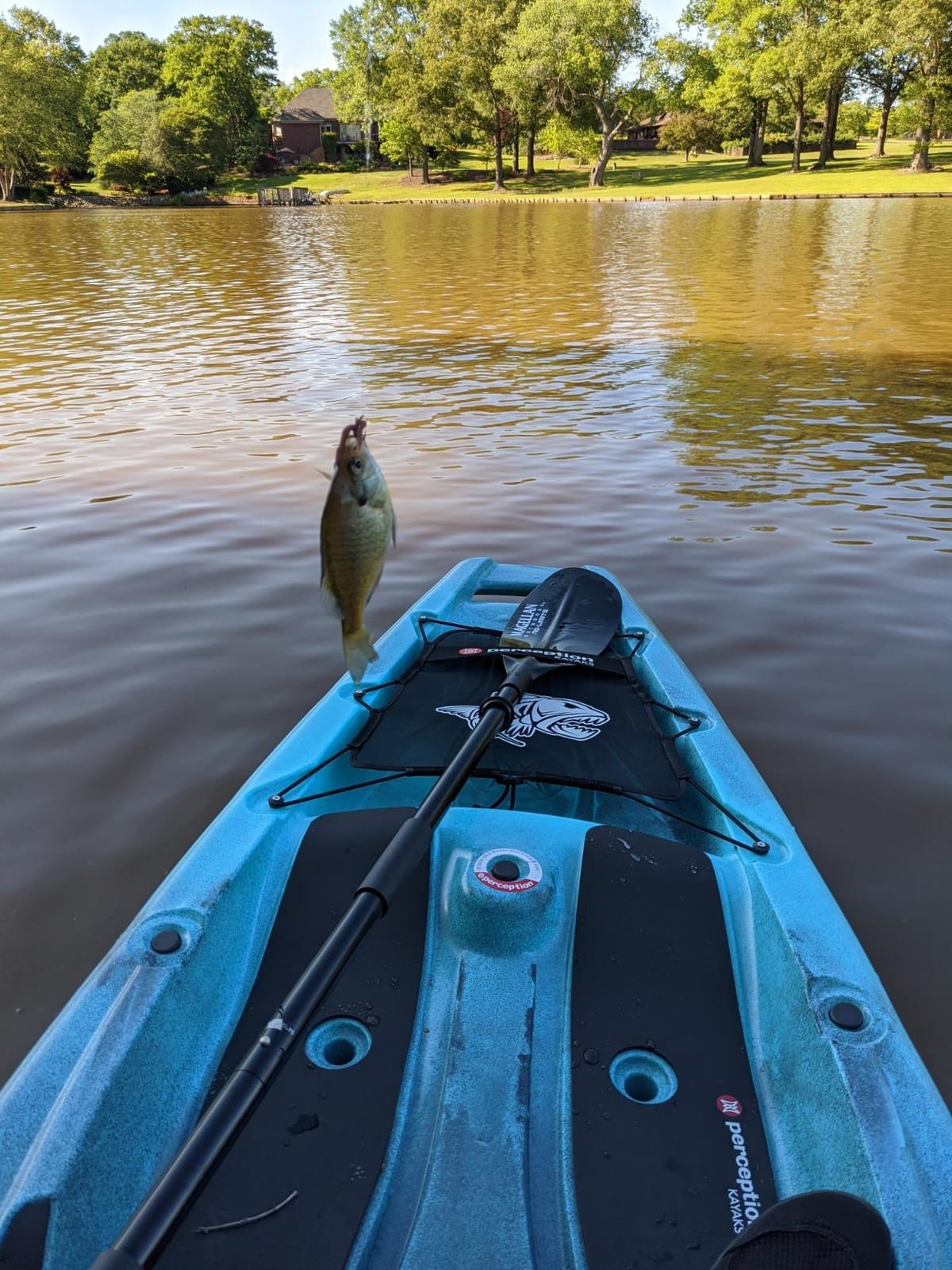
Because capacity alone is easy to claim and hard to design for. Rated capacity only matters if the boat still tracks and stays level with that weight aboard, and that comes down to beam and hull volume. At 35 inches of beam and 11 foot 6 inches of length, this hull has enough volume to float an angler at 220 or 250 pounds with a heavy load without feeling like the stern is dragging.
The tankwell is the second reason. On smaller boats, a full-size cooler plus tackle plus a battery is the point where the deck becomes a trip hazard. Here, the heavy items drop into molded storage and the deck stays clear for standing, which is the arrangement a big angler actually needs.
Where it is the wrong boat
Portability, plainly. This hull needs a vehicle, a rack and generally a second person at the tailgate. If your launch is a walk from a parking spot, or you want a boat that lives in a garage and goes out on a whim, this is the wrong size, and something in the 9 to 10 foot class will serve you better.
It is also overkill in the other direction. A 120 pound angler on a pond will not use 425 pounds of capacity, and the size of the boat is exactly the reason you cannot carry it solo. Reviewers who bought it for a small-angler household tend to end up with something more manageable.
4. Pelican Sentinel 100X – Best Value Fishing Kayak
Pelican Sentinel 100X – Angler Sit on top Fishing Kayak – Forest Mist – Lightweight – Ergolounge™ Seating System – 10 ft, Sentinel 100X Angler Fishing Kayak
Length 114 inch
Beam 30 inch
Dry weight 44.6 lb
275 lb capacity
Paddle power
Pros
- Exceptionally light at 44.6 lb with a padded high backrest
- Removable ExoPak lets you pack gear at home
- Four rod holders including two vertical on the ExoPak
- Sub 10 foot length stores in small spaces
Cons
- Capacity limited to 275 lb
- Molded carrying handles rather than grab handles
- ExoPak is a proprietary box that limits aftermarket storage
The Sentinel 100X is the pick I send people to when they tell me they want a fishing kayak they can pick up and carry without thinking about it. At 44.6 pounds and 9 foot 6 inches long, it is one of the smallest boats here, and small boats with a good seat are how people stay in the sport past their first season. The rating is 4.4 across 528 reviews, with 74 percent five-star feedback, and the sentiment centers on comfort and portability rather than capacity.
The seat is the standout. The Ergolounge system uses extra-thick cushioning with a high, wide padded backrest, and that back support is the difference between a boat you can sit in for six hours and one you cannot. It is a raised back rather than a low perch, so it works for anglers who find traditional frameless seats punishing, and reviewers call it out as the feature that made them stay in the kayak after the novelty wore off.
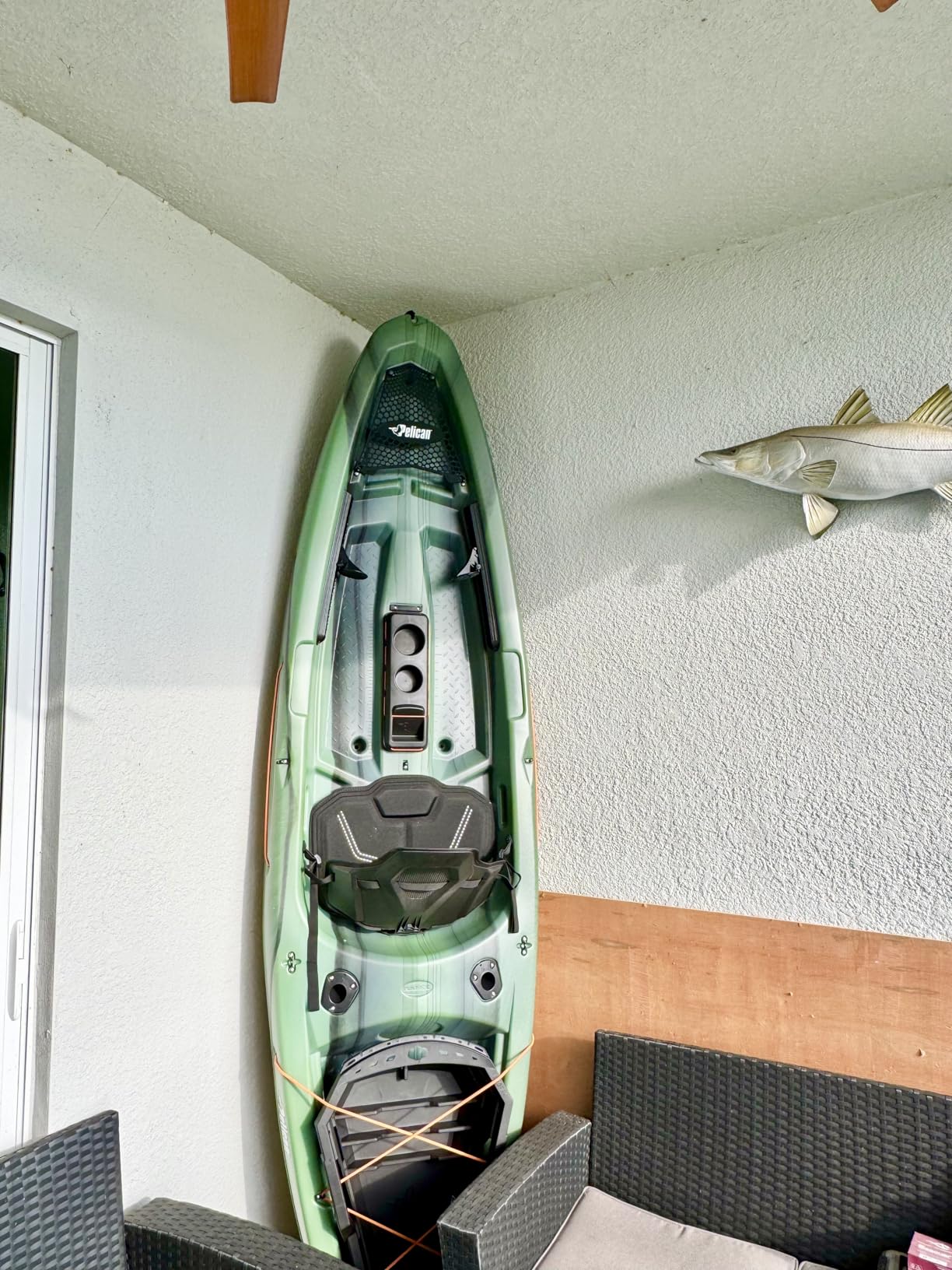
The ExoPak is a removable storage compartment that sits behind the seat and comes out with its contents, which means you can load tackle at the kitchen table and drop the whole unit into the boat at the launch. It also carries two of the four rod holders on its back face, so the fishing layout moves with the storage. For an angler who organizes gear the night before, that is a better system than lashing a dry bag to bungees.
Capacity is 275 pounds, the same ceiling as the Lifetime Tamarack and lower than several rivals in this roundup, so this is a boat for an angler up to about 190 pounds with a normal gear load. The hull carries a limited lifetime warranty against manufacturer defects and one year on parts and accessories.
At 30 inches of beam, this is not a standing-cast boat. The deck is narrow and the cockpit is snug, and the boat is at its best for anglers who sit, cast from the seat and use the rod holders to cover water. That is a real style of fishing and it is how a lot of people fish, but it is a different experience from standing in a 35 inch hull.
What makes this the value pick
It is the combination of a light hull and a good seat at a weight most people can handle solo. A boat that is 20 pounds heavier is a worse value for most households, because the part you tolerate forever is the weight on launch day, not the number on the invoice.
The ExoPak system is the other half of that argument. Pre-packing gear at home is the habit that keeps people fishing instead of skipping a trip because loading up felt like work, and having the storage come out with you is a small design idea that pays off repeatedly.
Where it is the wrong boat
Larger anglers should look elsewhere. 275 pounds of rating with a 30 inch beam leaves no margin for a big person with a heavy load, and the low rating is the most common complaint in the reviews. It is also one of the narrowest hulls in the group, so if you want to stand and cast, this is not the boat.
Transport is a mixed picture. The boat is light, but the handles are molded into the side rather than proper grab handles, so a single person carries it with a hull handle or under the arm rather than rolling it on a cart easily. And because the ExoPak is proprietary, if it is damaged you are shopping for a Pelican box, not a generic dry storage unit.
5. Perception Flash 9.5 – Best Lightweight Sit-Inside
Perception Kayaks Flash 9.5 | Sit Inside Kayak for Fishing and Fun | Two Rod Holders | Multi-Function Dash | 9′ 6″ | Sunset
Length 114 inch
Beam 28.5 inch
Dry weight 41 lb
325 lb capacity
Paddle power
Pros
- Very light at 41 lb for solo loading
- Lightest hull in the roundup
- Dry cockpit in chop and wind
- Turns quickly in shallow water
- Rod holders and rear storage included
- Made in the USA with 5 year hull warranty
Cons
- Factory seat uncomfortable on long outings
- Foot braces feel fragile under heavy use
- Tracking degrades in strong wind
- 28.5 inch beam is not for standing
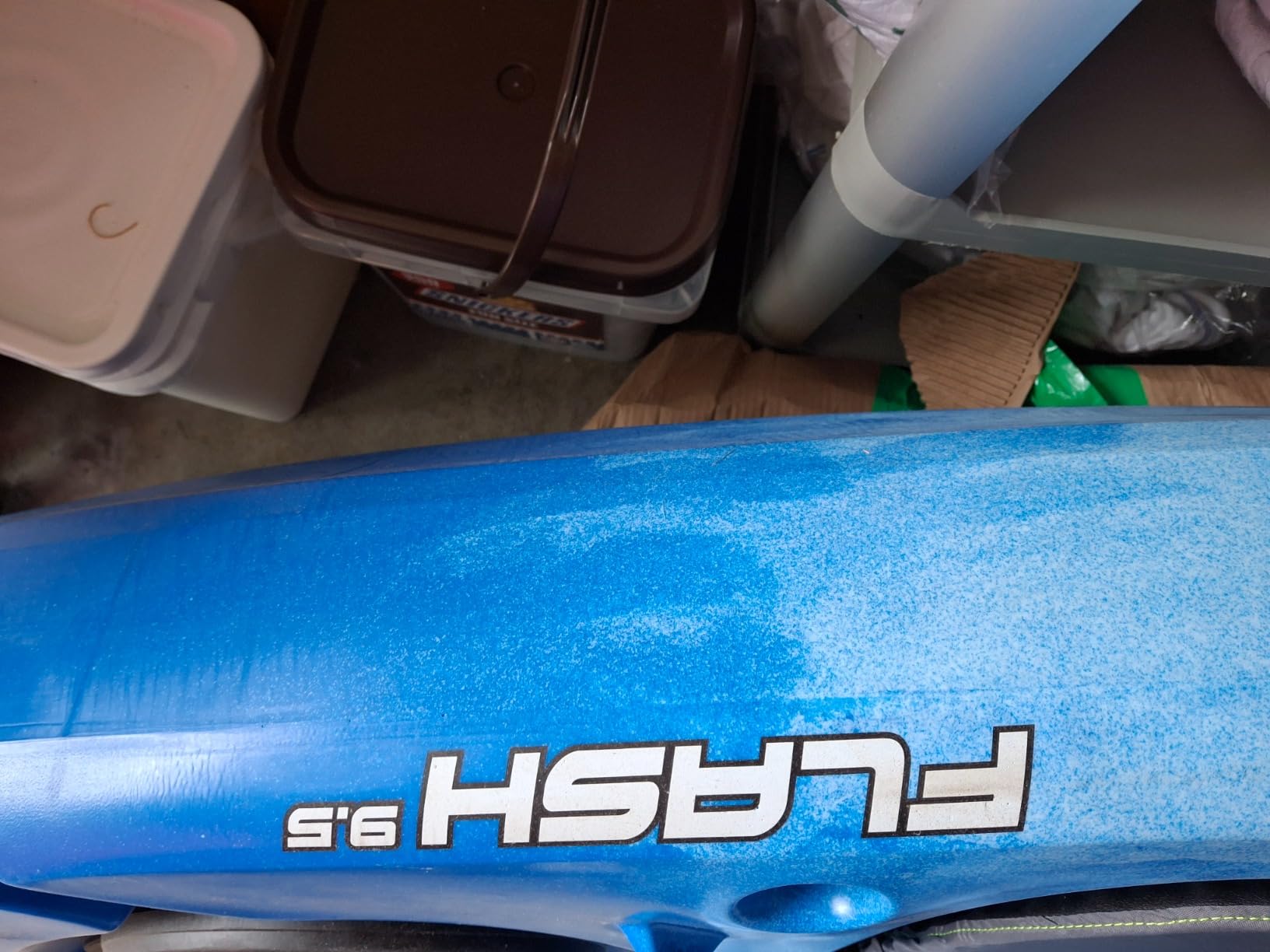
Most of this roundup is sit-on-top because that is what anglers buy. The Flash 9.5 is here because the one situation where a sit-inside is the better tool is small, sheltered, choppy water where you want to stay dry. It is a 9 foot 5 inch polyethylene sit-inside at 41 pounds with a 325 pound capacity, made in the USA under a 5-year hull and deck warranty, and it carries a 4.5 rating across 241 reviews with 76 percent five-star feedback.
Being inside the boat changes things in practical ways. Spray does not come over the deck on a choppy pond, wind pushes at a smaller target, and the cockpit gives your knees room so a 325 pound capacity rating is more usable than the same number on a narrow sit-on-top. Anglers who fish early in the morning in cooler weather, and anyone who does not want wet legs before work, notice this immediately.

Handling is nimble in a way the bigger boats are not. At 9 foot 5 inches the Flash turns in its own length, which makes working a shoreline, a creek channel or the edge of a reed bed genuinely easy, and the built-in rod holders and rear storage mean you can fish it without buying anything on day one. Adjustable foot braces and an adjustable seat back let you set the fit before you launch rather than after.
The two recurring complaints are seat comfort and the foot braces. Owners fishing three hours or more add a cushion or a replacement backrest, and a small number report the molded foot braces cracking after heavy use. If you are in the market for this boat, budget for a seat pad as a realistic accessory rather than an extra.
Tracking in wind is the third limitation, and it is not specific to this boat. At 28.5 inches of beam there is less lateral resistance than a wide sit-on-top provides, and a sit-inside will yaw more in a crosswind. On a sheltered pond that is irrelevant. On a big open lake with fetch, it changes how you cover water.
Why a sit-inside still makes sense in 2026
Three situations. Fishing in cool weather, where a dry cockpit is a comfort argument that outweighs every stability advantage of a sit-on-top. Fishing water that is very shallow, tight and full of structure, where a short nimble hull is easier to control than a long wide one. And carrying the boat, because at 41 pounds it lifts with one hand into a mid-size vehicle without a rack.
It is also the least intimidating boat to learn in. Sit-insides have a cockpit rim you can grip, which makes getting in and out far less of a tipping exercise for new paddlers, and a narrower beam is more forgiving of small balance corrections than a wide flat hull that feels tippy until you trust it.
Where it is the wrong boat
Standing casts are the answer. A 28.5 inch beam with a sit-inside cockpit is not a standing platform, and if your plan is to rise up and cast at fish on a shallow flat, you will be sitting. Owners who try it report exactly that.
Long open-water paddles and any water with strong wind are the other mismatch, for the tracking reasons above. And for a full day of fishing you will be replacing the seat. If your trips are two hours on a local pond, this boat is a very good answer; if they are eight hours across a reservoir, the seat and the tracking will both work against you.
6. Reel Yaks Raptor 9.5 – Best Entry Pedal Drive
Reel Yaks Raptor Modular Fishing Kayak, Fin Drive 9.5ft, 380 lbs Capacity
Length 115 inch
Beam 30.3 inch
Dry weight 62 lb
380 lb capacity
Fin pedal drive
Pros
- Quiet hands-free propulsion frees both hands for casting
- Two-piece body stores in a trunk or closet
- Stadium seat paddle and rod holder included
- W-hull is stable enough to cast from while seated
Cons
- Drive has a learning curve and is awkward to install
- Only 1 year hull warranty
- Drive failures and wear are the recurring negative
- Fixed hatch covers limit access when seated
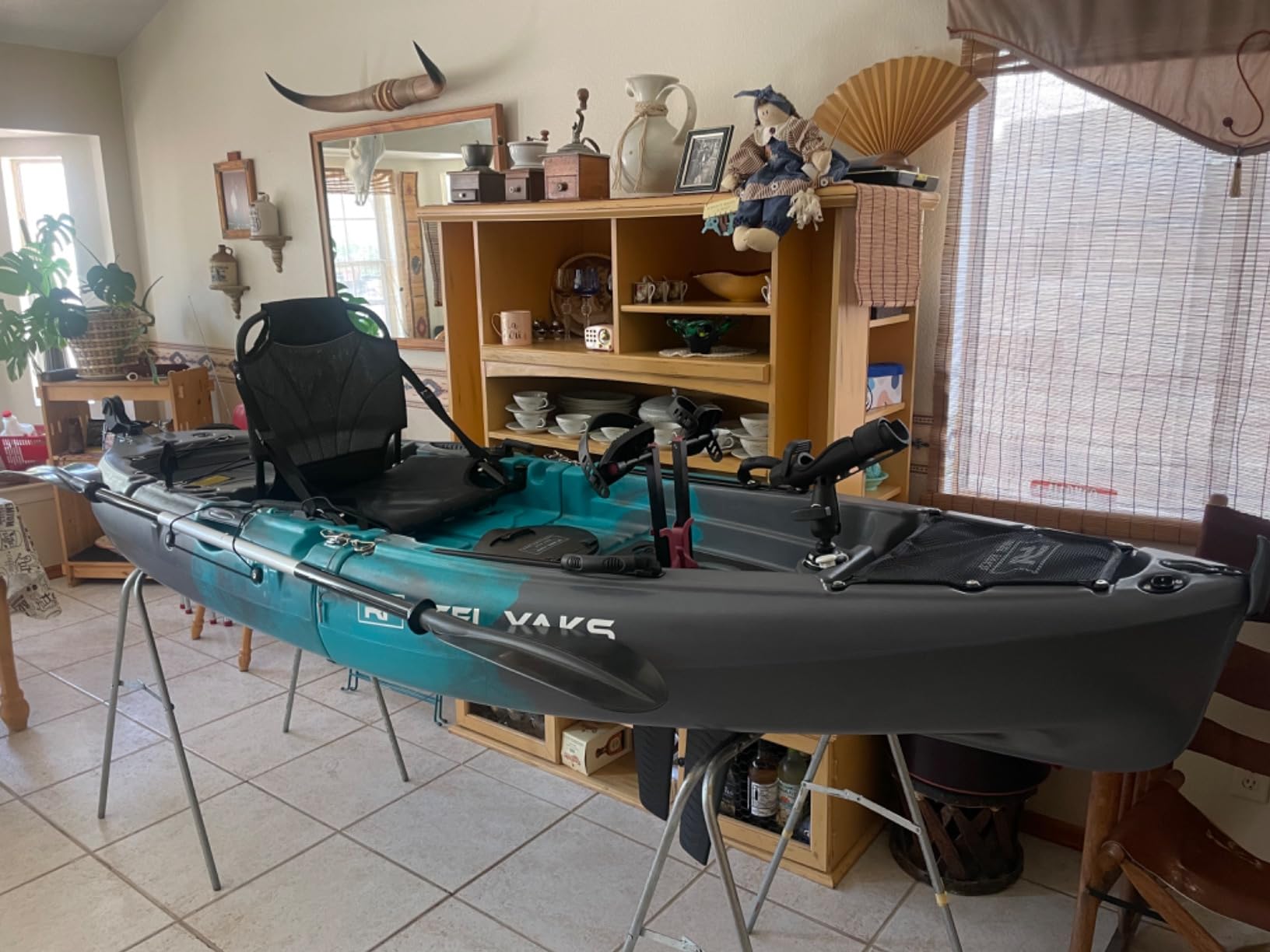
The Raptor is the boat to look at if pedal drive is the feature you actually want and you are not ready to spend pedal-drive money. It is a 9 foot 6 inch modular hull at 62 pounds with a 380 pound capacity, and the drive is a fin system rather than a propeller, which makes it quiet and simple. The rating is 4.2 across 171 reviews, and the two things reviewers praise most are the propulsion and the fact that the boat breaks in half.
Modularity is the practical headline. This is a two-piece design, so it fits in an apartment, a small garage or the trunk of a car, and it means you do not need a roof rack or a truck to own a pedal kayak. For a lot of people that is the whole decision, because the barrier to kayak fishing is more often storage and transport than money.
The included kit is generous for a pedal boat. You get a stadium seat, a paddle, a fin drive and a fishing rod holder in the box, and the hull carries flush-mounted rod holders, track rails and storage hatches. The W-hull shape is wide and stable enough to cast from while seated, which is the practical test for a boat driven by feet rather than hands.
The negatives cluster around one component. Owners describe the drive as having a learning curve, being heavy and awkward to fit once the boat is on the water, and being the source of most complaints, including noise, wear and expensive replacement. At 171 reviews, about 11 percent are one-star, which is a meaningful share for a boat that is otherwise well liked, and it is worth weighing before you commit.
Warranty length is a second flag. A 1-year hull warranty is the shortest in this group, and on a boat where the drive is the costliest part to replace, that is not generous. Ask yourself whether you would rather repair a fin drive or a propeller drive, because that is the practical difference between this boat and the Raider.
When a fin drive is the right call
Fin drives are quiet, simple and weed-tolerant, and that combination is exactly right for lakes, ponds and any water where you are more likely to hit bottom than open water. They are also easier to service than a propeller system and generally less expensive to replace, which is why this boat is the sensible first pedal purchase for someone fishing calm water.
Hands-free propulsion is the real upgrade. Once you learn the pedal, you cover water without a stroke cadence, your hands stay free for casting and working a lure, and holding position in a light wind becomes practical rather than a constant paddling effort.
Where it is the wrong boat
Moving water and open water. A fin drive needs water moving under it, so in current or a strong headwind it loses the authority that a propeller has, and owners report the drive collecting in weeds and taking on noise and wear over time. If your water is a river, a bay or anything with a fetch, look at the Raider or Radar instead.
There is also the install question. Fitting the drive once the boat is launched, in water, on a slope, is the part people dislike most, and it is a reason to test the mechanism at home first. With a 1-year warranty and a drive-heavy failure profile, budget for the possibility that this is the boat you sell in five years rather than the boat you keep for fifteen.
7. Reel Yaks Raider 9.5 – Best Modular Drive for Current and Open Water
Reel Yaks Raider Modular Fishing Kayak – 9.5ft, 380 lbs Capacity, Red White Black – Pedal Fishing Kayaks for Adults & Youth, Sit on Top, Compact Storage, Lightweight, Easy Transport
Length 114 inch
Beam 35.4 inch
Dry weight 66 lb
380 lb capacity
Propeller drive
Pros
- Propeller drive holds speed in current and open water
- 35.4 inch beam is stable for standing casts
- Modular two-piece body fits a mid-size SUV
- Stadium seat and paddle are comfortable for long sessions
Cons
- Expensive relative to the paddle boats in this roundup
- Drive noise and stripped pedal threads reported inside a season
- New drive knobs are extremely tight and may need pliers
- Each 31 lb section is awkward to lift solo
The Raider is the pedal boat to buy if your water is not a sheltered pond. It uses a propeller drive rather than a fin, and the difference shows up exactly where it matters: in current, in a headwind and across open water, where a propeller keeps its authority and a fin bogs down. At 9 foot 6 inches with a 35.4 inch beam and a 380 pound capacity, it is also a wide boat that is stable for standing casts.
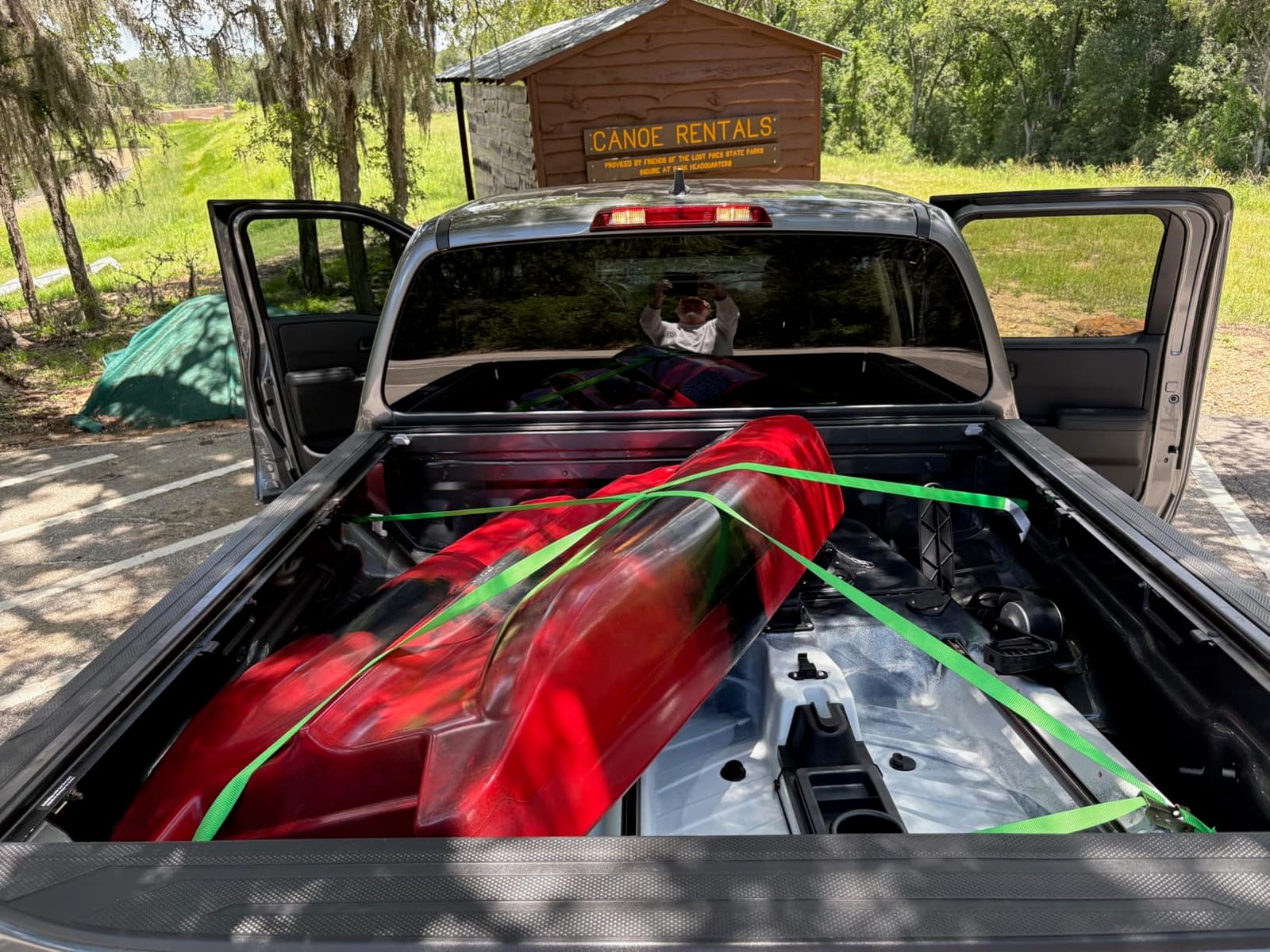
It is modular in the same two-piece way as the Raptor, but the sections here are 31 pounds each with built-in handles, and the manufacturer lists a four-step assembly that owners describe as quick and intuitive even on a first build. A mid-size SUV without a roof rack is realistic, which is the practical advantage for anyone without a truck.
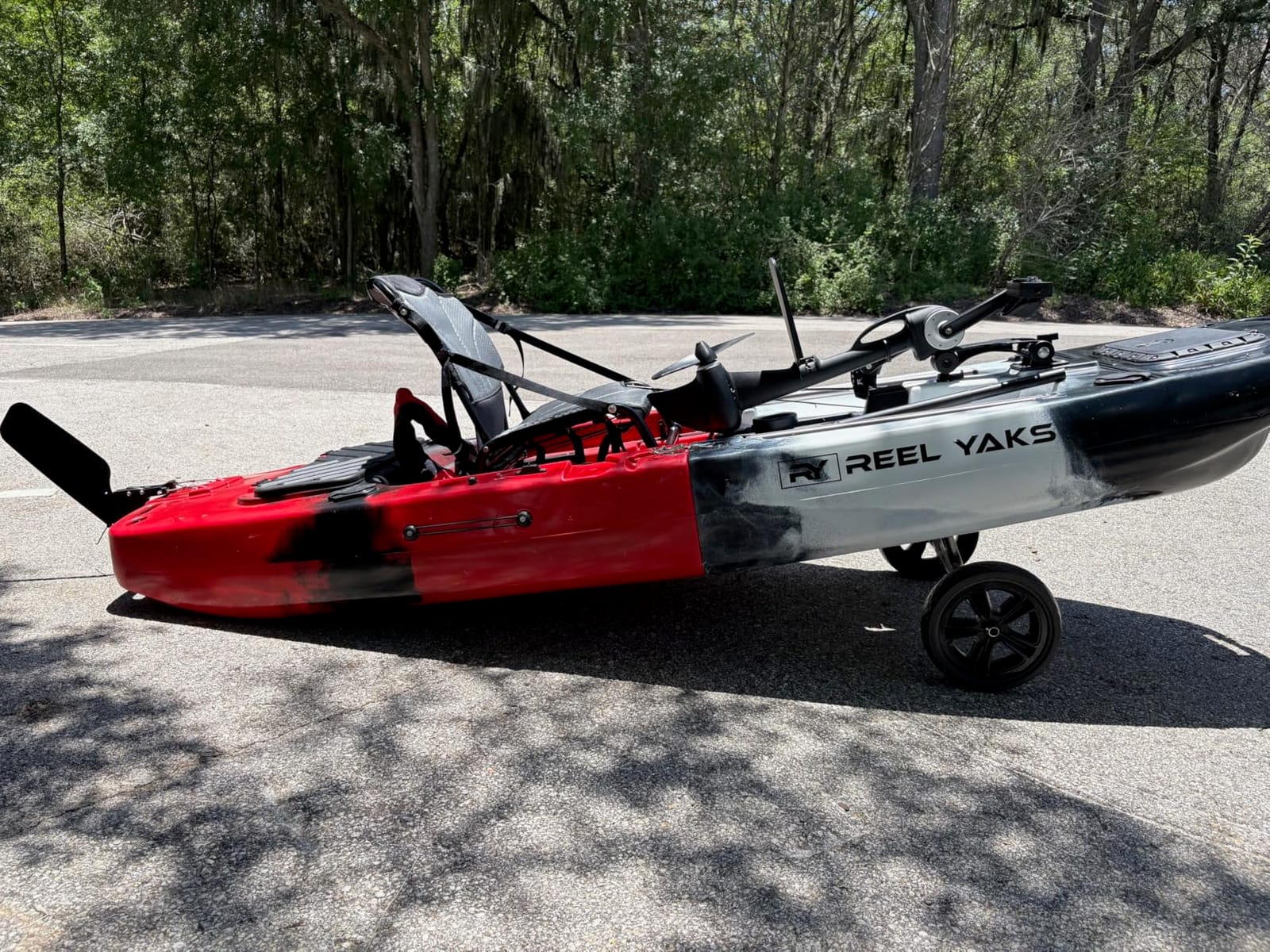
The cockpit is listed at 35 inches, and the included kit is good: a stadium seat, a paddle, a propeller drive and a 360 degree rod holder all ship in the box. The stadium seat is comfortable for long sessions according to owners, and the manufacturer is a US Coast Guard registered operation, which matters for a boat with a powered drive system.
Now the part that gives us pause, and it is worth being direct. Several owners report grinding gear noise and stripped pedal threads within about 60 days, along with weed pickup and drive knobs tight enough on a new boat that pliers are needed. A replacement drive is quoted at a substantial figure, which is a durability risk on a costly purchase, and it should factor into the decision rather than be discovered in the first season.
Add to that the sections themselves. At 31 pounds apiece, each half is awkward to lift solo, so a kayak cart is effectively required rather than optional. And the two halves do not always mate perfectly flush, which owners mention as cosmetic but noticeable.
Why the propeller drive earns its place
Because most pedal kayak complaints are about a drive losing efficiency, and a propeller is the answer to exactly that. When you are pushing into a current, holding position over a rocky point in a crosswind, or covering a mile of open water to reach a shoal, the drive that keeps working is the drive you want, and reviewers consistently report the Raider handling current far better than a fin-drive boat.
The 35.4 inch beam is the other reason. That width is unusual on a 9 foot 6 inch boat, and it means the Raider is stable enough to stand and cast, which is the most common request we hear from pedal-drive buyers used to a wide angler platform.
Where it is the wrong boat
If you are a careful buyer with a long horizon, the drive reports are a real caution. Pack it with marine grease from the start, inspect the pedal threads regularly, and treat the drive as a consumable rather than a permanent part, because that is how several owners now describe it.
It is also not the boat for calm ponds. A propeller in still shallow water picks up weeds, and on a 66 pound hull that splits into 31 pound halves you are carrying, the complexity is not worth it if you were going to paddle anyway. Calm water anglers get more boat for their effort with a paddle or fin-drive model.
8. Reel Yaks Radar 10 – Best Modular Pedal Kayak for Larger Anglers
Reel Yaks Radar Modular Fishing Kayak, 10ft, 430 lbs Capacity
Length 118 inch
Beam 33 inch
Dry weight 88 lb
430 lb capacity
Propeller drive
Pros
- 430 lb capacity is the highest of any solo hull here
- Propeller drive gives instant forward and reverse
- Rigid molded holder behind seat accepts a stabilizer kit
- Two sections break down for RV or apartment storage
Cons
- 88 lb hull needs a cart or two people on land
- Propeller drive developed noise after minimal use
- Lock knobs very tight on a new boat
- Some units reported missing hardware or parts detaching
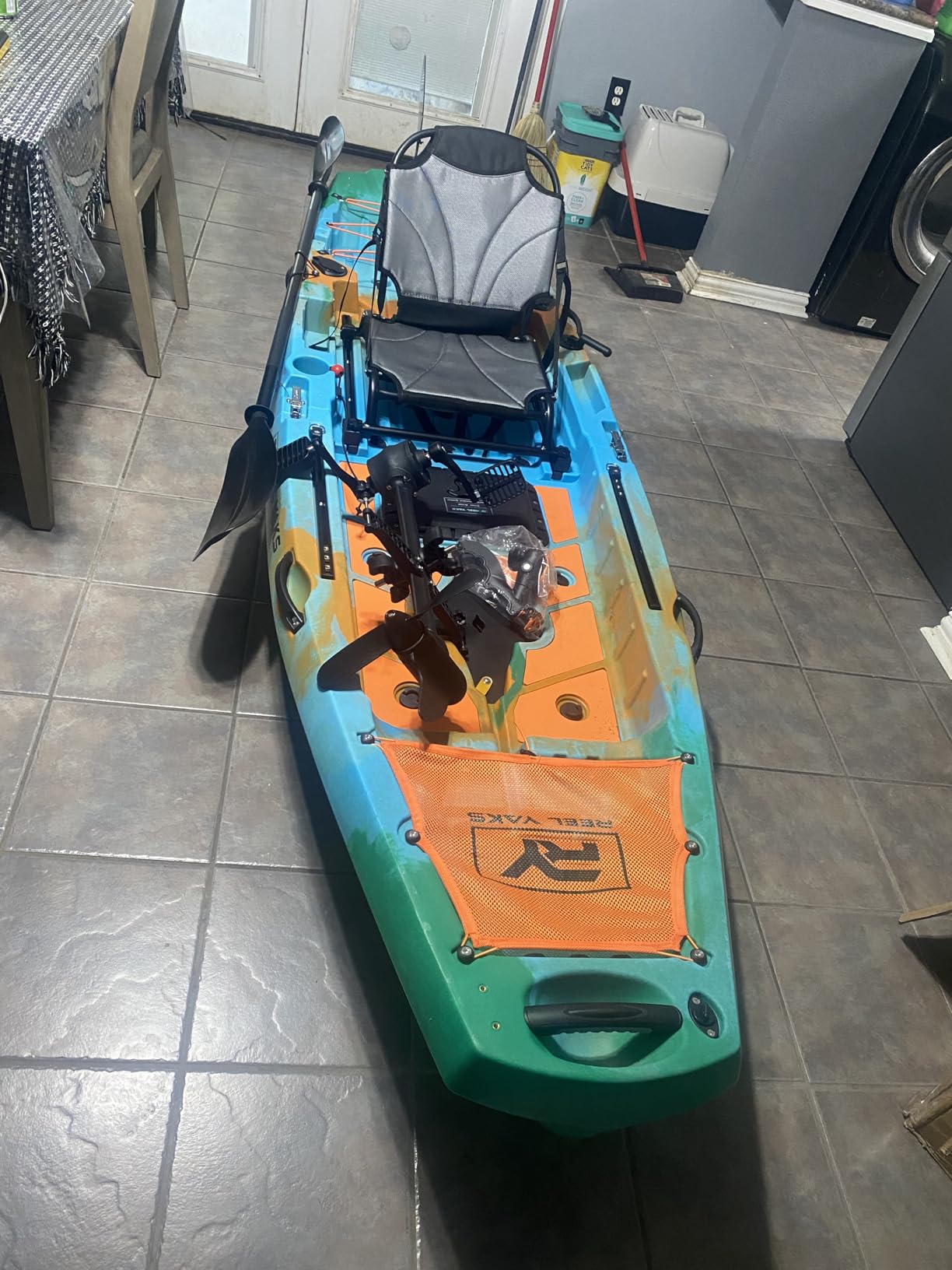
The Radar is the answer for an angler who wants pedal drive and also wants the capacity to bring a second person, a large battery and a full cooler without giving up stability. The 10 foot hull is rated at 430 pounds, which is the highest solo capacity in this roundup, and it runs a propeller drive with instant forward and reverse for maneuvering in tight spots.
Instant reverse is not a small detail. With a fin drive you can only go forward, so backing out of a dead end or repositioning off a point means paddling backwards or doing a long turn. Owners who fish structure call the reverse a real advantage when the fish move behind you.
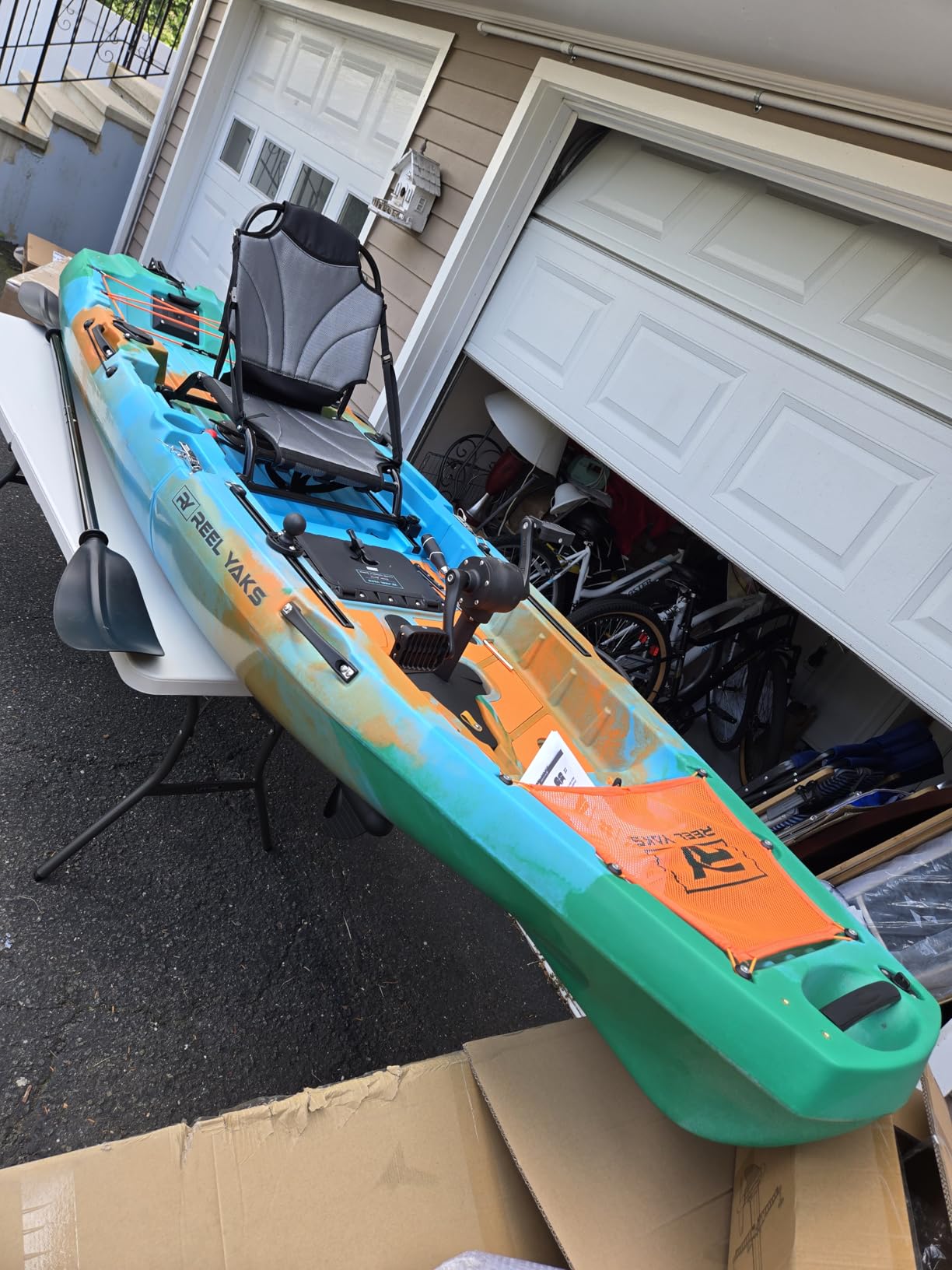
The build quality draws praise, and the boat includes a stadium seat, a paddle and a 360 degree rod holder. Flush-mounted rod holders, track rails and storage hatches cover the rigging basics. A detail that stands out is the rigid molded stabilizer holder behind the seat, which is designed to accept a stabilizer kit later, so an angler who wants standing stability has a supported upgrade path rather than a clamp-on workaround.
It is also available with a fin drive, which matters if you eventually decide your water is calmer than the boat is set up for. That option makes the hull less of a commitment, and it is the version we would point a first-time pedal buyer toward on a lake.
The weaknesses are physical and mechanical. At 88 pounds this is the heaviest boat in the roundup, and a cart or two people on land is not a convenience here, it is a requirement. Then there is the drive: owners report chirping and grinding after minimal use, with marine grease recommended as a routine fix, plus missing hardware and detached parts on a small share of delivery units.
What 430 pounds of capacity actually gets you
A realistic working load at the 80 percent guideline is around 340 pounds, and that is a genuinely useful number for a solo angler. An angler at 220 pounds with a 30 pound motor and battery, a 20 pound cooler and 60 pounds of tackle and safety gear lands right at that line, which means the boat carries you and the whole day of equipment without feeling overloaded.
The wide W-hull at 33 inches of beam supports that weight better than the rating alone suggests, because a beam that holds with a heavy load is what keeps the boat level and tracking instead of heeling over as you move. For an angler who has been paddling a 300 pound-rated boat and fighting it, the difference is felt immediately.
Where it is the wrong boat
Transport is the headline problem, and at 88 pounds there is no workaround other than a cart with good tires, a trailer, or a second person. The 33 inch beam is also narrower than the Raider, so it is stable but not as planted for standing casts, and if standing is a priority the Raider is the better-framed boat.
On maintenance, the same caution applies as with the Raider, with the addition that this is the heavier boat of the two. Grease the drive at the start of each season, check the pedal threads, and keep an eye on the hull joint when you break it down for storage. A fin drive version avoids most of the noise complaints entirely.
9. Pelican Catch Classic 100 – Best for the Money on a Lake
Pelican Catch Classic 100 Angler – Sit-on-Top Fishing Kayak – Ergocast Dual Position Seating System – 10 ft – Outback
Length 120 inch
Beam 34 inch
Dry weight 57 lb
350 lb capacity
Paddle power
Pros
- Tunnel hull makes entry and exit easy and the ride steady
- Dual position adjustable seat switches high and low
- Rear tank well and quick-lock front hatch as standard
- ABYC compliant internal flotation built into the hull
Cons
- Heaviest hull among the entry level sit-on-tops
- Only 2 rod holders
- Seat comfort draws mixed reviews over long sessions
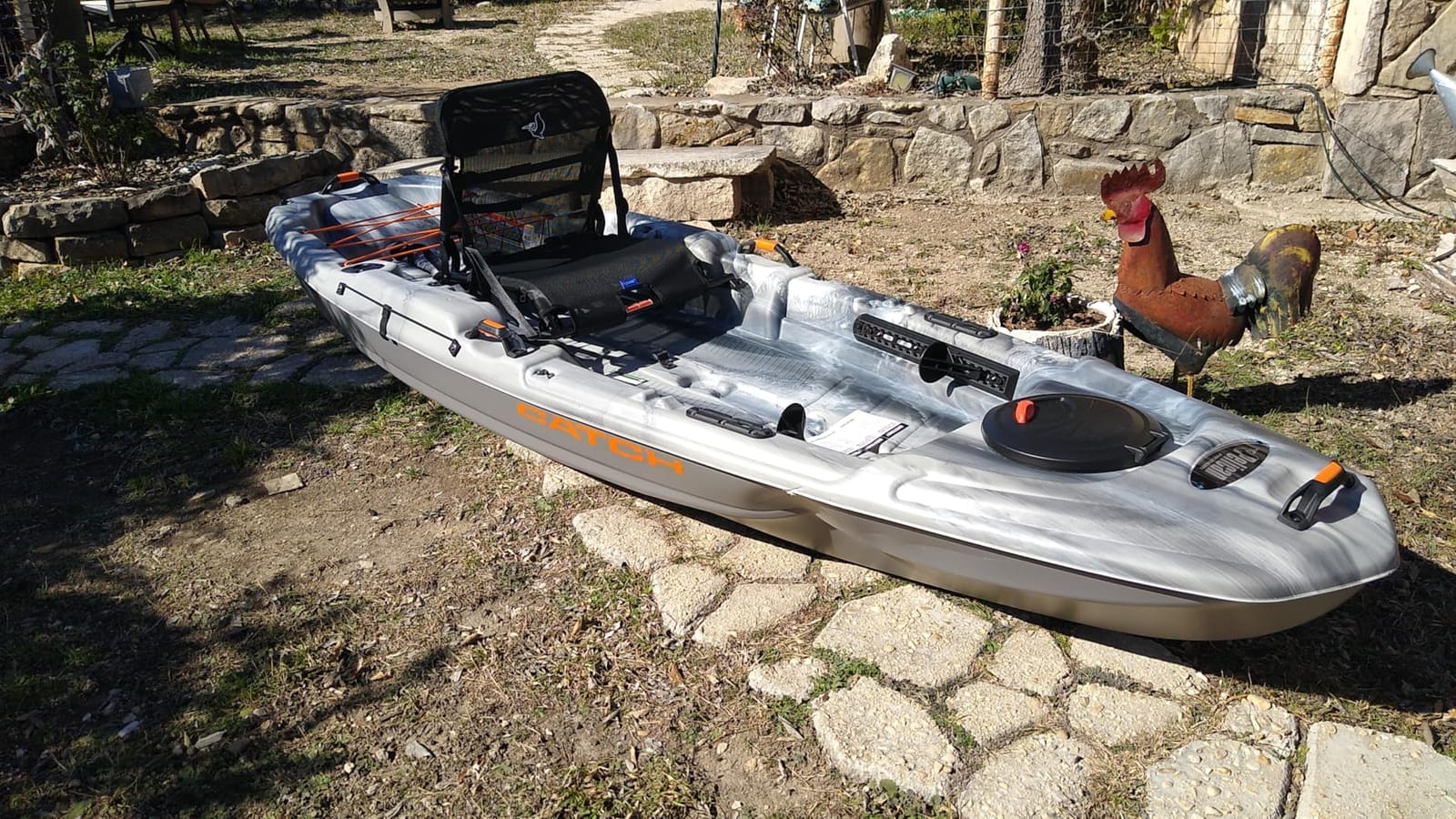
The Catch Classic 100 is the boat that shows up in the hands of people who upgraded from a cheap plastic sit-on-top and never went back. It is a 10 foot tunnel-hull polyethylene boat at 57 pounds with a 350 pound rating, and the tunnel hull is the part that changes the feel. The tunnel gives you a wide platform and firm footing on the deck edges, which is why entry and exit feel easy even in moving water.
Storage is the other reason owners keep it. You get a front quick-lock hatch for tackle that needs to stay dry, a rear tank well with bungee cords for a cooler or crate, adjustable footrests, a bottle holder, paddle tie-downs, two 4 inch rigging tracks and two accessory eyelets. That is a working layout without buying a single accessory, and it is the difference between a fishing kayak and a boat you rig yourself.
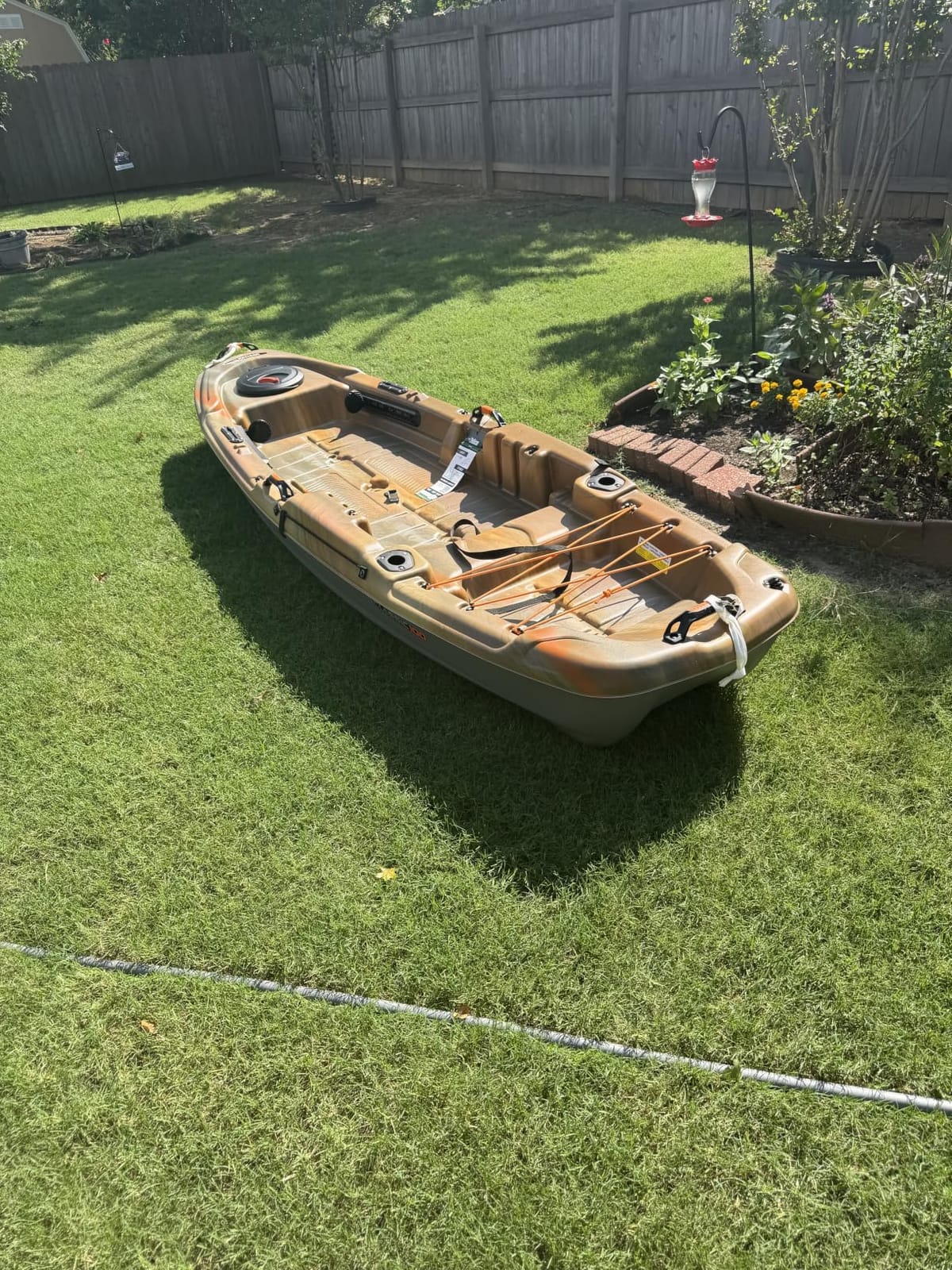
The seat is the ERGOCAST CLASSIC, a dual-position adjustable chair that switches between a high setting for moving and a low setting for casting. Reviewers like the versatility, and a few note that the low position is genuinely useful for sight fishing. The negative feedback on it concentrates on comfort over long sessions, and about 12 percent of ratings are one-star, the largest one-star share in the group, mostly around seat and finish issues.
One specification here is worth more attention than it looks. The hull has ABYC-compliant extra flotation built in, which means the boat carries buoyancy even if it is swamped. That is a real safety characteristic on a boat you might fish cold water in, and it is worth more than another rod holder.
Rigging is otherwise modest for the platform: two flush-mounted rod holders is all you get, and several competitors in this class ship four. If your method is to hold multiple rods and work them, budget for a track-mounted holder from the start.
Why this is the sensible lake boat
Because 34 inches of beam at 10 feet is the ratio most anglers actually need. It is wide enough to stand for a cast with a reasonable margin of error, long enough to track, and it carries a 350 pound rating that covers a typical angler and a full day of gear. It is not a specialty boat, and that is the compliment.
The tunnel hull also makes it a good learner boat. The wide side platforms mean you can get in from the water, stand up on the deck edge and push off, and that forgiving entry is a big part of why so many owners describe it as the boat they stopped renting first.
Where it is the wrong boat
At 57 pounds it is a heavier solo carry than the lighter boats in this class, and it does not break down, so a cart is worthwhile if your launch is more than a short walk. There is no skeg listed, so tracking in a crosswind is more work than on the Catch Mode 110, and the two rod holders are limiting for multi-rod anglers.
And if your day is long, replace the seat. It is the component drawing most of the complaint volume, and a padded seat or a backrest turns this into a boat you can sit in all day.
10. BKC Brooklyn 12.5 – Best Tandem Fishing Kayak
BKC Brooklyn 12.5 Tandem Fishing Kayak, 2 to 3 Person Sit-on-Top
Length 148 inch
Beam 32 inch
Dry weight 70 lb
595 lb capacity
Paddle power
Pros
- Seats two adults plus a child or a heavy gear load
- Six rod holders is more than any other boat here
- Rotomolded single piece HDPE shell is tough and easy to clean
- Two padded memory foam seats and two paddles included
- Built-in trolling motor mount area
Cons
- 70 lb tandem needs two people to roof rack it
- Seat tethers on the included seats are incomplete
- Hatch lid quality control is inconsistent
- Included paddles are average
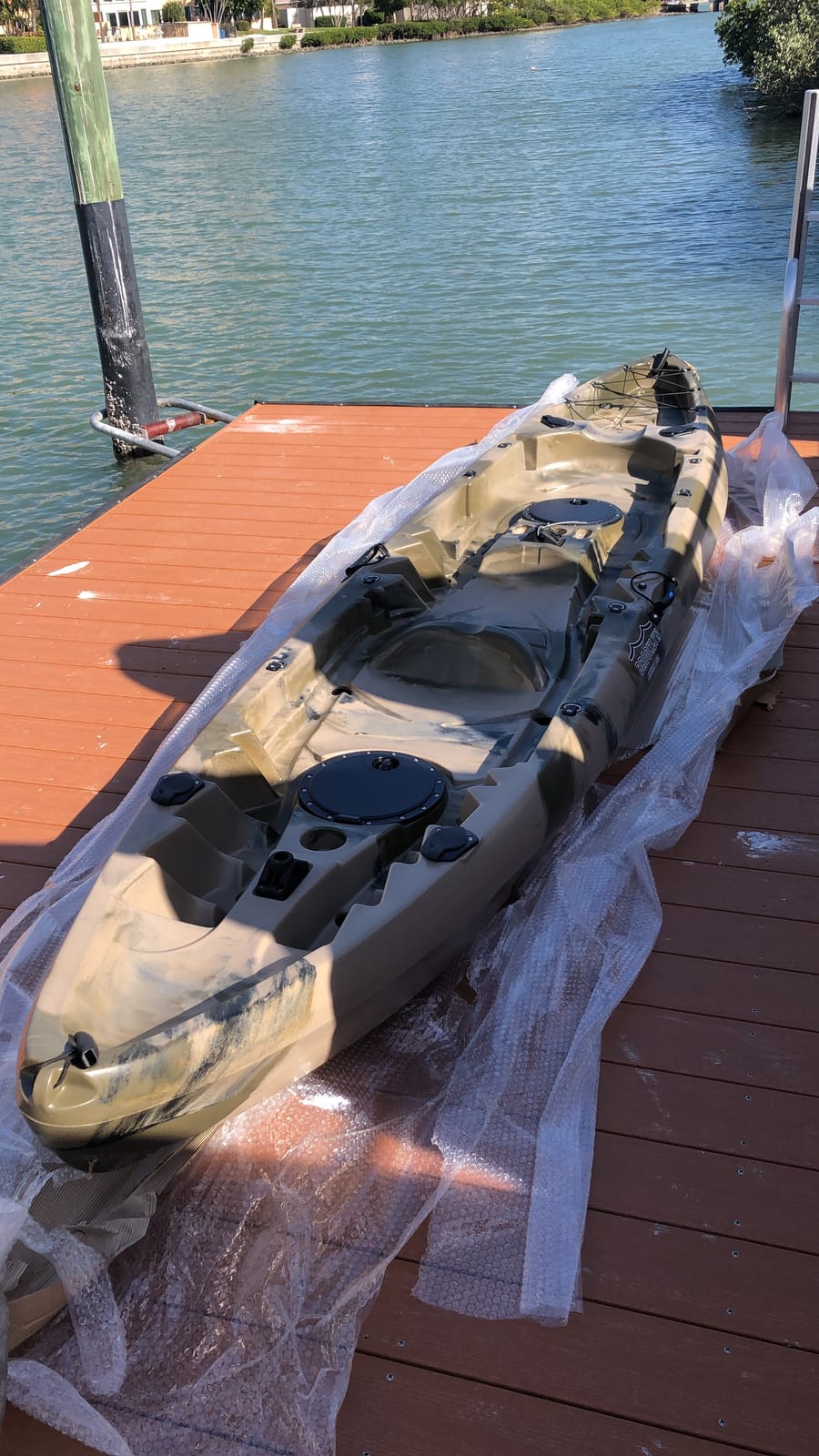
Everything else on this list is a solo boat, which is why the Brooklyn 12.5 is a necessary inclusion. It is a 12 foot 5 inch rotomolded HDPE tandem rated for 595 pounds, with a manufacturer capacity of up to three people, two padded memory foam seats and two paddles in the box. For a couple who fishes together, or an adult and a child, or one angler with a serious amount of gear, the arithmetic only works on a boat this size.
The fishing layout is genuinely better than a solo boat doubled up. Six rod holders is the most in this roundup, split between four flush-mounted holders and two articulating ones, and the 34 inch beam gives enough width for two people to move around without one person standing on the other’s gear. Reviewers rate the shell quality and the seat and rod holder positioning highly, and several call it good value for a tandem.
There is a built-in trolling motor mount area, which no other boat in this list lists as a molded feature. Motor and battery are not included, so treat it as a mounting point rather than a powered boat, and size the motor to the loaded weight of two anglers plus gear. The rotomolded single-piece HDPE shell is impact and UV resistant and wipes clean after a salty session, and the warranty is 5 years from the manufacturer.
The honest problems are weight and quality control. Seventy pounds is a heavy lift, and a 12 foot 5 inch tandem genuinely needs two people to get onto a roof rack. On top of that, owners report incomplete seat tethers on the included aluminum seats, a setup video that does not match the shipped model, and a warped hatch lid on at least one unit.
That last point is worth dwelling on for a moment, because it is the kind of thing that is fixable and simply not checked. Inspect the hatch lid seal on arrival, and check the seat hardware before you are carrying the boat to the water.
When a tandem is the right answer
Three cases. Fishing with a partner, where a single boat that holds two is simpler and cheaper than carrying two solo boats. Fishing with a child, since the boat is rated for three and the extra length gives a real third seating area. And solo fishing with heavy gear, where the 595 pound rating swallows an angler, a partner-sized load of tackle, a cooler and an electric motor without crowding.
The 12 foot 5 inch length tracks well on open water with two people paddling and a load that is genuinely heavy. Tandems that are cramped tend to be short; this one is long for the reason.
Where it is the wrong boat
Solo anglers fishing alone are wasting most of it. A 70 pound, 12 foot 5 inch boat is a difficult single-person load to cart, launch and paddle, and the extra length turns a quick solo trip into a longer one. If you are one person, a boat in the 10 to 11 foot class is a better fit for your money and your effort.
Watch the quality control on arrival, and be realistic about the weight. If neither of you can lift 70 pounds onto a roof rack, this boat needs a trailer or a cart, and that changes the calculation entirely.
11. Lifetime Lockport 94 – Best Modular Kayak for Apartment Storage
Lifetime Lockport 94 Modular Sit-on-Top Kayak with Paddle, Two-Piece Design with SlideLock System, Rod Holders, Adjustable Seat
Length 112 inch
Beam 30 inch
Dry weight 40 lb
250 lb capacity
Paddle included
Pros
- Two-piece design fits an SUV or minivan with no roof rack
- SlideLock joint stays secure through boat wakes
- 40 lb total and each 24 lb half carries under one arm
- No tools needed to assemble
- Rod holders tank well and bottle holder as standard
Cons
- No rudder so wind and current cause significant yaw
- Molded foot braces are fixed and break under load
- Seat has no padding
- 250 lb capacity is lower than the other hulls here
The Lockport 94 solves a problem that stops people from owning a fishing kayak at all. It is a hard-shell polyethylene boat at 40 pounds total that separates into two sections with a SlideLock system and no tools, so it fits in an apartment, a closet, a minivan or the back of an SUV. Reviewers describe it as a hard-shell upgrade over an inflatable, and the 4.6 rating comes with an enthusiastic 81 percent five-star share from an early buyer base.
The joint is the engineering question, and the answer is good. Owners report the SlideLock connection holding secure even when the boat takes a wake, and the tool-free assembly means you can build it in a parking lot rather than at home. Deep hull tracking channels and chine rails give it more directional stability than the narrow beam suggests, and reviewers call the hull fast and stable to paddle.
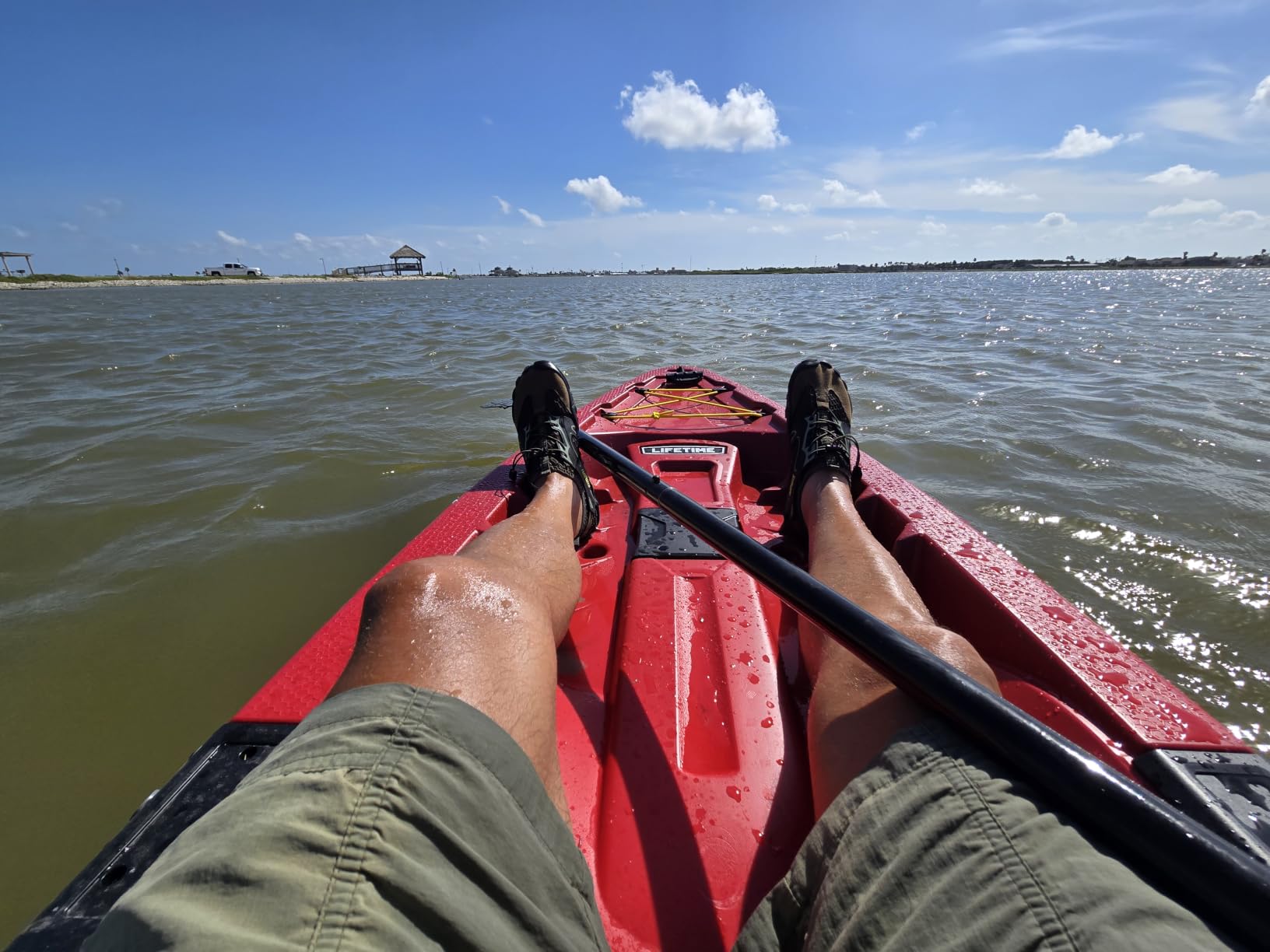
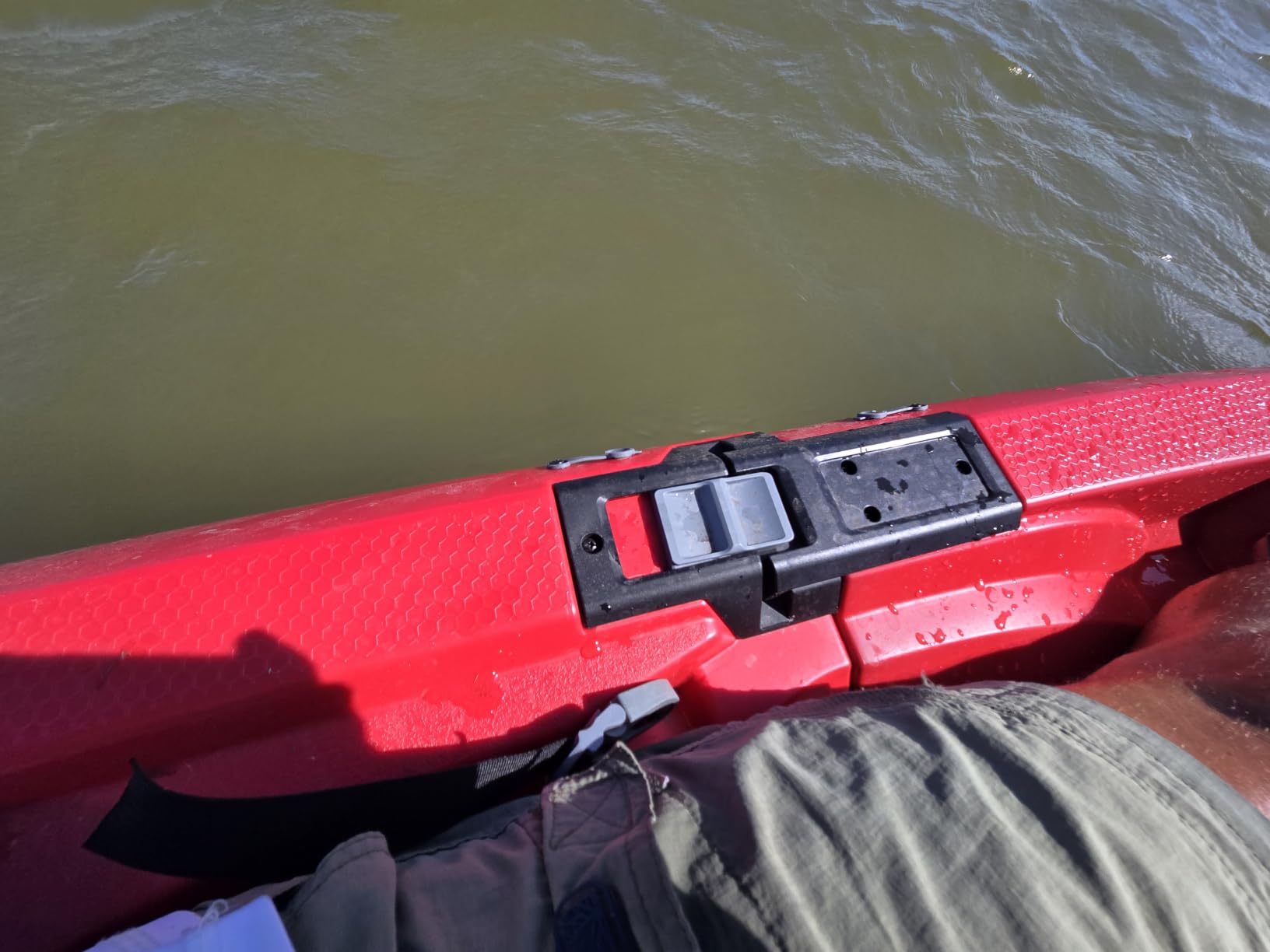
The fishing trim is real for a boat this compact: two flush-mounted rod holders, a storage tankwell with bungee lacing, a water bottle holder, a paddle keeper, an adjustable padded seat back and multiple footrest positions. There is a 5-year limited warranty, and the UV-protected HDPE construction is impact and weather resistant, which is what makes it a credible alternative to an inflatable for year-round use.
Now the trade-offs, and there are several. There is no rudder, so wind and current cause significant yaw, and that is the single most important limitation here. A 9 foot 4 inch boat with no steering mechanism needs corrective strokes or a paddle change to hold course, and on a long crossing in a breeze that is tiring work.
The molded foot braces are fixed rather than adjustable and crack under heavy use, the seat has no padding so a cushion is worth adding, and the mid-hull seam adds some drag, which reviewers note makes it not a speed boat. Capacity is 250 pounds, the lowest rating in this roundup, so this is an angler boat for a smaller paddler with a light gear load.
Who this boat is built for
Apartment anglers, RV owners and anyone with a small garage who still wants a hard shell rather than an inflatable. Each half is 24 pounds, which is a genuinely one-arm carry, and that changes the relationship with the water: you can go after work on a weekday without needing a second person to help you launch.
It is also the right answer for a household with one car and no rack, and for anglers moving between lakes who can leave the boat assembled at the far end. The tool-free joint is a genuine convenience in all three cases.
Where it is the wrong boat
No rudder is the dealbreaker in current and wind. If you fish a river, a bay, or a lake with fetch, the yaw will be constant and you will be correcting it all day. Add a 30 inch beam on top of that and standing casts are not realistic here either.
Capacity closes the door for larger anglers, and the fixed foot braces mean the fit is what it is. If your sessions are long, the unpadded seat is the first thing to upgrade. And if your water is open, the fixed geometry and the seam drag mean you will work harder per mile than in any of the solid hulls above.
12. Perception Pescador Pro – Best Recreational Angler Kayak
Perception Kayaks Pescador Pro 10 | Sit on Top Fishing Kayak with Adjustable Lawn Chair Seat | Large Front and Rear Storage | 10′ 6″ | Moss Camo
Length 126 inch
Beam 32 inch
Dry weight 57 lb
325 lb capacity
Paddle power
Pros
- Large front and rear storage areas for a full day
- Adjustable lawn chair seat balances comfort and packability
- 325 lb capacity at only 57 lb boat weight
- Made in the USA with 5 year hull warranty
- Handles well on lakes and slow rivers
Cons
- Smallest review base in the roundup at 40 ratings
- 32 inch beam is narrow for standing casts
- No rigging tracks or gear mounts as standard
The Pescador Pro is the middle of the range boat, and it is a good answer for the angler who fishes a lake, a slow river or calm coastal water once or twice a week rather than every weekend. It is a 10 foot sit-on-top polyethylene hull at 57 pounds with a 325 pound rating, made in the USA under a 5-year warranty on the hull and deck.
Storage is what reviewers mention most. There are large front and rear storage areas, so a full day of gear goes inside the boat rather than onto the deck, and the adjustable lawn chair seat folds away when you need to reach the front space. Owners describe the seat as a sensible balance between comfort and the fact that it packs flat and light.
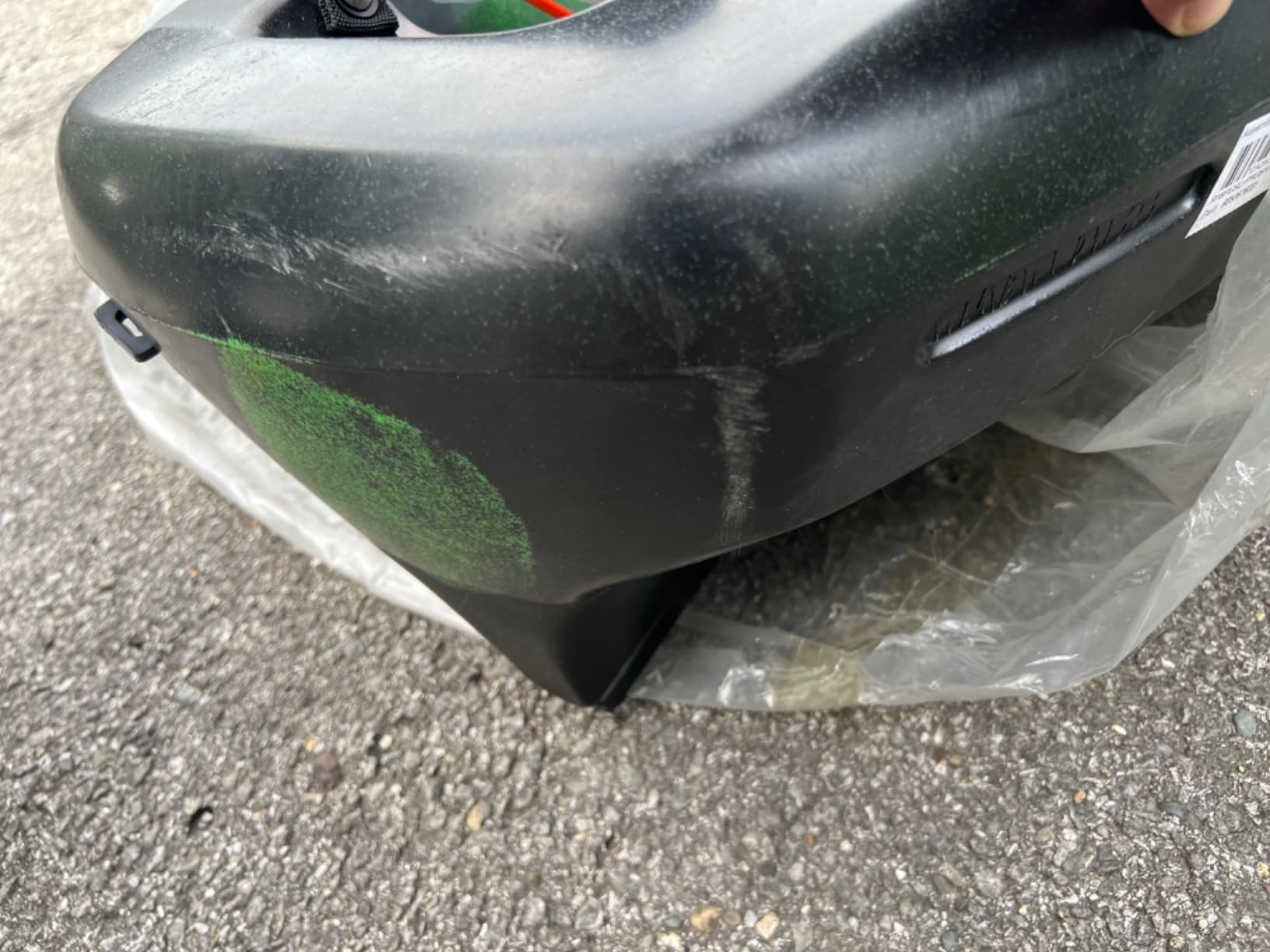
At 57 pounds carrying a 325 pound rating, it has a better capacity-to-weight relationship than most of the 10 foot boats here, and reviewers single that out. That is what makes it a realistic one-person carry without being a 9 foot boat, which is a trade you make in every class at some point.
Two things to know before you commit. The 32 inch beam is narrower than the 34 and 35 inch hulls here, so standing casts are workable but not planted, and this boat comes without rigging tracks or gear mounts, so the factory layout is storage and seat rather than rod holders and accessory rails. Budget for a track-mounted rod holder and a small tackle platform if you want a deck you can fish from standing.
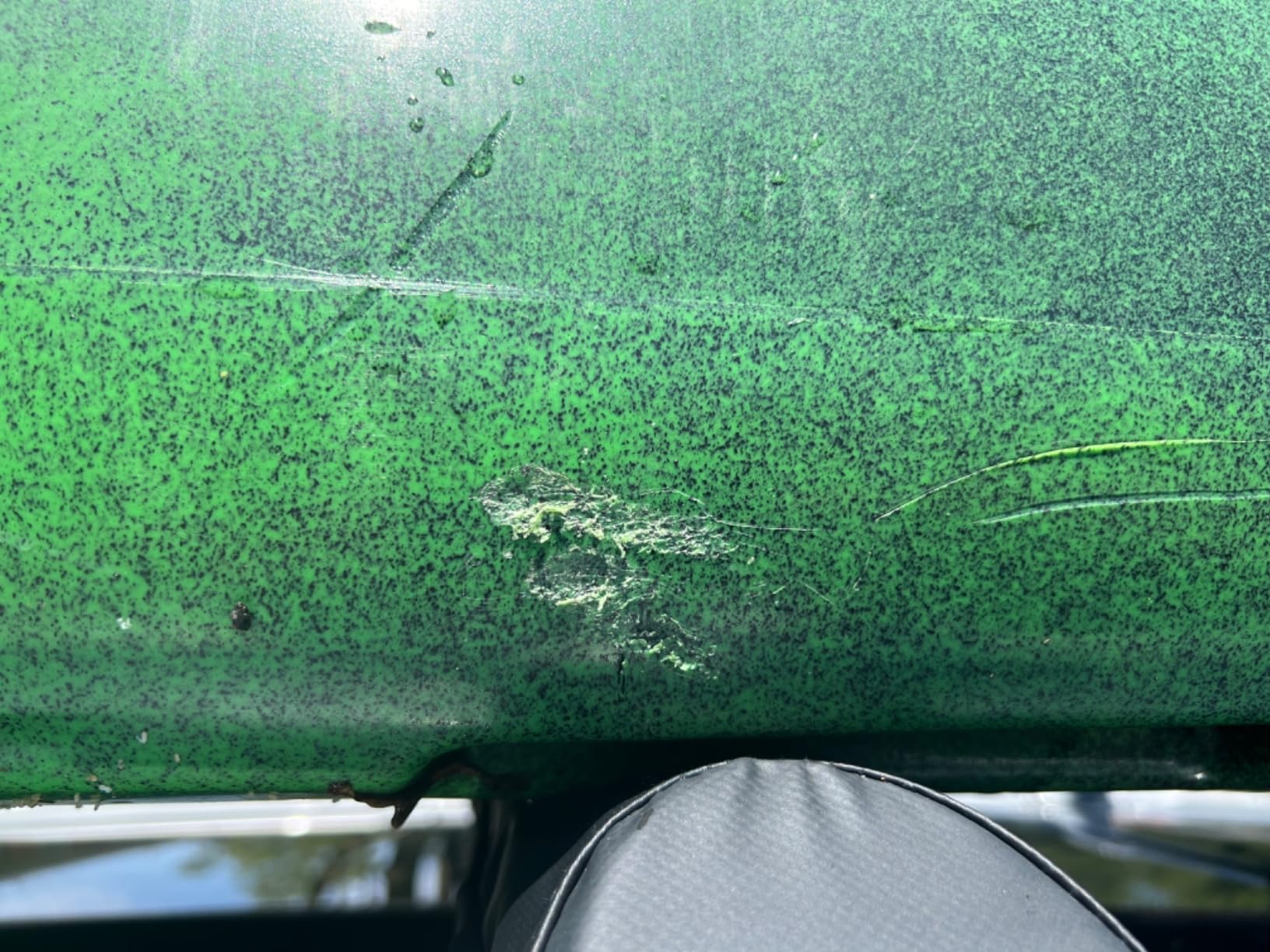
The bigger caveat is the evidence base. Forty ratings is a small sample compared with the Lifetime or Pelican listings, and about 8 percent are one-star with durability complaints that reviewers do not specify. The boat itself is well regarded, but you are buying with less field history behind it.
What kind of angler this suits
The weekend lake angler who covers water with a paddle and stores gear rather than rigging the deck. On a lake with a motor-free zone, a slow river, or sheltered coastal water, the 10 foot length tracks fine and the 57 pound weight is a manageable solo lift. It is also a reasonable first step up from a 9 foot plastic sit-on-top because the storage keeps gear off the deck.
It is a good match for a lighter gear load too, since you are not carrying the electronics, batteries and tackle that a tournament angler accumulates. Fewer things on deck means the narrower beam is more manageable than it would be on a fully loaded boat.
Where it is the wrong boat
If you want to stand and cast regularly, a 32 inch beam will not give you the margin you need, and the answer is a 34 inch hull or wider. If you want to add a motor, fishing electronics or accessory rails later, this boat has no molded mounting provisions, so you are back to drilling and wiring, which is exactly what most buyers tell us they want to avoid.
At 10 feet with a narrow beam and no skeg listed, a crosswind pushes you around. And with only 40 ratings on record, treat the durability picture as thinner than the 4.3 average suggests.
How to Choose a Fishing Kayak in 2026
Start with the water, not the boat. A sheltered pond, a river, an open lake and a bay ask completely different things of a hull, and the same boat that is ideal for one is mediocre for the others. Write down where you will actually launch in the next six months, then pick the category that matches it, and only then compare models inside that category.
Sit-on-top or sit-inside
Sit-on-tops dominate this category for good reason. The deck is open, so you can stand and cast, storage is unlimited, and getting in and out is easy. They are also harder to keep dry in chop, and at the narrow end they are less stable than they look.
Sit-insides are the opposite trade. You stay dry, wind pushes at a smaller target, and the cockpit gives a 325 pound capacity rating more practical room, but you cannot stand, you have less deck space, and the narrow beam means real tracking problems in a crosswind. If your fishing is early-morning, sheltered-water and short, a sit-inside is the right call. If you intend to cast while standing, sit-on-top is the only answer.
Stability, beam width and hull shape
Beam width is the single number to learn. Below about 32 inches you are sitting down. At 34 inches you can stand for a cast in calm water with a reasonable margin. At 35 inches and wider you can stand and move around the deck. Planing and W hulls give wide, flat primary stability, and flat-bottomed hulls are the most stable in the water but lose some secondary stability once a wave gets under the edge.
Length is about tracking and speed. Ten feet is agile and easy to turn. Twelve feet holds a line in wind. Fourteen feet is a different category of boat, and for most anglers it is more boat than they will use.
Weight capacity: use the 80 percent rule
Add your body weight, your gear, your motor and your battery, then compare that total to 80 percent of the rated capacity rather than the full rating. A 300 pound rated boat with a 200 pound angler and 40 pounds of gear is a 240 pound load against a 240 pound working limit, and the boat will track properly. Push to 300 in the same hull and you will feel the bow get heavy every time you move.
Under 200 pounds of angler, most boats here work. Between 200 and 250, look at 350 pound ratings and up. Over 250 pounds, capacity is not a preference, it is a safety margin, and the Outlaw 11.5 or the Radar 10 are the boats designed for that range.
Paddle, pedal drive or trolling motor
Match the propulsion to the water, because this is where buyers most often regret their purchase. Paddle-only is right for ponds, calm lakes, sheltered bays and any budget. It is the lightest option, the least expensive, and there is nothing on it to break. A pedal drive is right when you want to cover real distance or hold position in wind without burning your arms, and it costs weight, complexity and money. A trolling motor is right when you are fishing a large open lake alone or carrying heavy gear, and you must budget the motor, battery, wiring and switch separately.
Within pedal drives, match the type to the water. Fin drives are quiet, weed-tolerant and simpler, and they belong on lakes, ponds and slow water. Propeller drives hold speed in current, wind and open water, and they are the correct choice for rivers, bays and anything with a fetch. Every drive in this roundup needs a working battery, and the propeller drives need routine greasing to stay quiet.
Rod holders, rigging tracks and storage
Rod holders come in two types. Flush-mounted holders sit in the deck and hold a rod by the handle, which is what you want for a rod already in the water, and they are standard on better angler hulls. Deck-mounted tube holders clamp on the rail and hold a rod by the blank, which is faster to swing around but occupies deck space and snags more often.
Rigging tracks are the more important feature for a long-term owner, because they let you add a rod holder, a fish finder, a tackle platform or a light later without drilling the hull. Two 4 inch tracks give you flexibility; a boat with none means you are back to a clamp and a drilling bit. Storage follows the same logic: a dry hatch for tackle that must stay dry, and a tank well for a cooler or a wet crate.
Transport weight and where you launch from
Decide your launch point before you buy. A dock you can walk to is a different requirement from a shoreline carry of 200 yards or a parking lot 400 feet from the water. Boats over 70 pounds are a two-person or cart job, and anything over 90 pounds effectively needs a trailer. If you have no cart, put weight near the top of your list, and check whether the boat breaks into sections.
The modular designs here solve it. The Reel Yaks Raptor, Raider and Radar split into two sections for apartment, RV or car storage, and the Lifetime Lockport 94 is a 40 pound hard shell that comes apart with no tools. Those four are the only designs in this roundup that store in a car or a closet without a rack.
What each budget tier actually gets you
At the entry tier you get a rotomolded polyethylene sit-on-top, a paddle or a basic seat, a couple of rod holders and molded storage. The Catch Classic 100 and the Tamarack Angler 100 are the best of that group, and both are entirely fishable on day one.
At the mid tier you start getting comfort and rigging: an adjustable padded seat with back support, 4 inch tracks, more rod holders, a retractable skeg and better capacity. The Catch Mode 110 and the Outlaw 11.5 sit here, and this is the tier where most serious anglers should shop.
At the upper tier you are buying propulsion and modularity. The pedal-drive boats are not faster hulls, they are boats that remove paddling from the equation, and they carry a drive that will need maintenance. Buy them for the water you fish, not for the spec sheet.
Safety Before You Launch: PFD, Leash and the 120 Rule
None of the 12 kayaks above will save you if you are on the water without a personal flotation device. Every angler on every water wears a PFD, and that is not a formality in cold water. A properly fitted PFD in a fishing kayak is the difference between a cold swim and a fatality, and it is the single most important item on this page.
The 120 rule
The 120 rule is a memory aid, not a law: if the water is 60 degrees Fahrenheit or colder, wear a drysuit, because submersion time in cold water is measured in minutes rather than hours. Many anglers wear a wetsuit or neoprene bottoms in that range, which buys you a great deal more time. Above 60 degrees, standard paddling clothing is reasonable, and the PFD is still non-negotiable.
The reason it matters for anglers specifically is that a fishing kayak puts you low in the water, often in early morning air that feels mild, and often in water that is colder than the air above it. A capsize that is a nuisance in September is an emergency in March.
Leashes, currents and standing casts
Use a paddle leash in moving water so you do not lose your paddle when the current takes the bow, and know that a leash in a strong current or a shipping channel can snag and hold the boat against you. On flat water, a leash is a habit worth forming because losing a paddle in open water ends your trip.
Standing casts are the leading cause of avoidable falls. Stand only on a hull with a wide flat deck, in calm water, and only after you have practiced standing in place in a controlled setting first. Any boat in this roundup with 34 inches of beam or more is designed for it, which does not mean it is a substitute for practice.
Licensing and registration
Paddle and pedal kayaks generally need a valid fishing license, because you are still harvesting fish, and many states have separate rules for anglers fishing from a vessel rather than a shore. Powered models, including electric-drive pedal kayaks and anything with a trolling motor, may require state boating registration and a boating safety course depending on where you launch.
Check your own state boating agency rules before you attach a motor, because the requirements differ considerably and the penalties are not worth the saving. Carry your fishing license and your registration on the boat, and if you fish a lake that requires a launch permit for motorized craft, that applies to a trolling motor too.
Frequently Asked Questions
Which of these fishing kayaks is the most stable?
The Perception Outlaw 11.5 and the Reel Yaks Raider 9.5 are the widest boats here at 35 inches and 35.4 inches of beam, and the Perception is rated for 425 pounds. The Pelican Catch Mode 110 is 34.5 inches wide and rated for 375 pounds, which makes it the best combination of width and rigging. Below about 32 inches of beam you should plan on fishing seated.
What is the best fishing kayak for a beginner?
The Lifetime Tamarack Angler 100 is the usual first boat because it includes a paddle, two flush-mounted rod holders, a top-mounted holder, two storage compartments and a skeg, and it is light enough for one person to load. The Pelican Catch Classic 100 is the step up, with an adjustable dual position seat, a quick-lock front hatch and a rear tank well. Both are stable, forgiving hulls to learn on.
Is a pedal drive fishing kayak worth it?
A pedal drive is worth it when you cover real distance or hold position in wind, because it keeps your hands free for casting and takes the effort out of a long paddle. It costs weight, complexity and a drive that needs maintenance, and fins are quieter but struggle in current and wind where a propeller holds speed. On a sheltered pond, a paddle boat is the better buy.
How much weight capacity do I need in a fishing kayak?
Add your body weight to your gear, motor and battery, then stay at or under 80 percent of the rated capacity. An angler at 200 pounds with 60 pounds of gear needs a boat rated around 325 pounds or more to stay inside that guideline. Under 200 pounds of angler weight most hulls here work, and above 250 pounds you should look at 425 and 430 pound ratings.
What is the best fishing kayak for a larger angler?
The Perception Outlaw 11.5 is the widest dedicated angler hull in this roundup at 35 inches of beam and 425 pounds of capacity, and it has the largest tank well. The Reel Yaks Raider 9.5 is wider still at 35.4 inches, and the Reel Yaks Radar 10 goes to 430 pounds with a propeller pedal drive, though it is heavy at 88 pounds. The BKC Brooklyn 12.5 reaches 595 pounds but is a tandem for two to three people.
Do I need a license or registration for a fishing kayak?
Paddle and pedal kayaks need a valid fishing license, and powered models including electric-drive pedal boats and trolling motor setups may need state boating registration and a safety course. Rules vary by state and some lakes require a launch permit for motorized craft. Check your state boating agency before you attach a motor, and carry both documents on the boat.
Can you stand and cast from a fishing kayak?
Yes, on a sit-on-top with at least 34 inches of beam and a flat deck, in calm water. The boats in this roundup built for standing include the Catch Mode 110, the Outlaw 11.5, the Raider 9.5 and the Catch Classic 100. Practice standing in place in sheltered water first, wear a PFD, and remember that a wide hull still feels tippy until you trust it.
What is the best fishing kayak for the money?
In the mid tier the Pelican Catch Mode 110 leads on rating and rigging, the Perception Outlaw 11.5 wins on capacity at 425 pounds, and the Reel Yaks Raider 9.5 is the pick if you want pedal drive that handles current. The single disqualifying caveat is weight: every one of those three needs a cart or a second person, so a lighter paddle boat may suit you better.
The Best Fishing Kayak for You
The Pelican Catch Mode 110 is our single winner in 2026, and the reason is that it is the only boat in this roundup that is genuinely good on more than one kind of water. A 34.5 inch beam gives real standing-cast stability, the retractable skeg handles wind, the Ergoboost seat works for both moving and fishing, and 375 pounds of capacity covers a typical angler and a full day of gear. At 4.6 stars across 348 ratings, it also pairs the highest rating in the group with a large enough review base to trust it.
If your situation is different, the matching is quick. Fish sheltered water and want the shortest path to owning something? The Lifetime Tamarack Angler 100 needs no accessories to be fishable. Weigh more than 200 pounds, or carry a lot of gear? The Perception Outlaw 11.5. Want to store the boat in an apartment or a small garage? The Lifetime Lockport 94 or a two-piece Reel Yaks. Fishing two? The BKC Brooklyn 12.5. Want pedal drive on a lake? The Reel Yaks Raptor. Want pedal drive in current and open water? The Raider or the Radar, with the drive greasing habit built into your season from day one.
Whatever you choose, the three checks that matter most are capacity against your real loaded weight, beam width against whether you intend to stand, and dry weight against how you are getting to the water. Get those three right and the best fishing kayaks on this list will serve you for years. Get one of them wrong and no amount of feature count will fix it.