
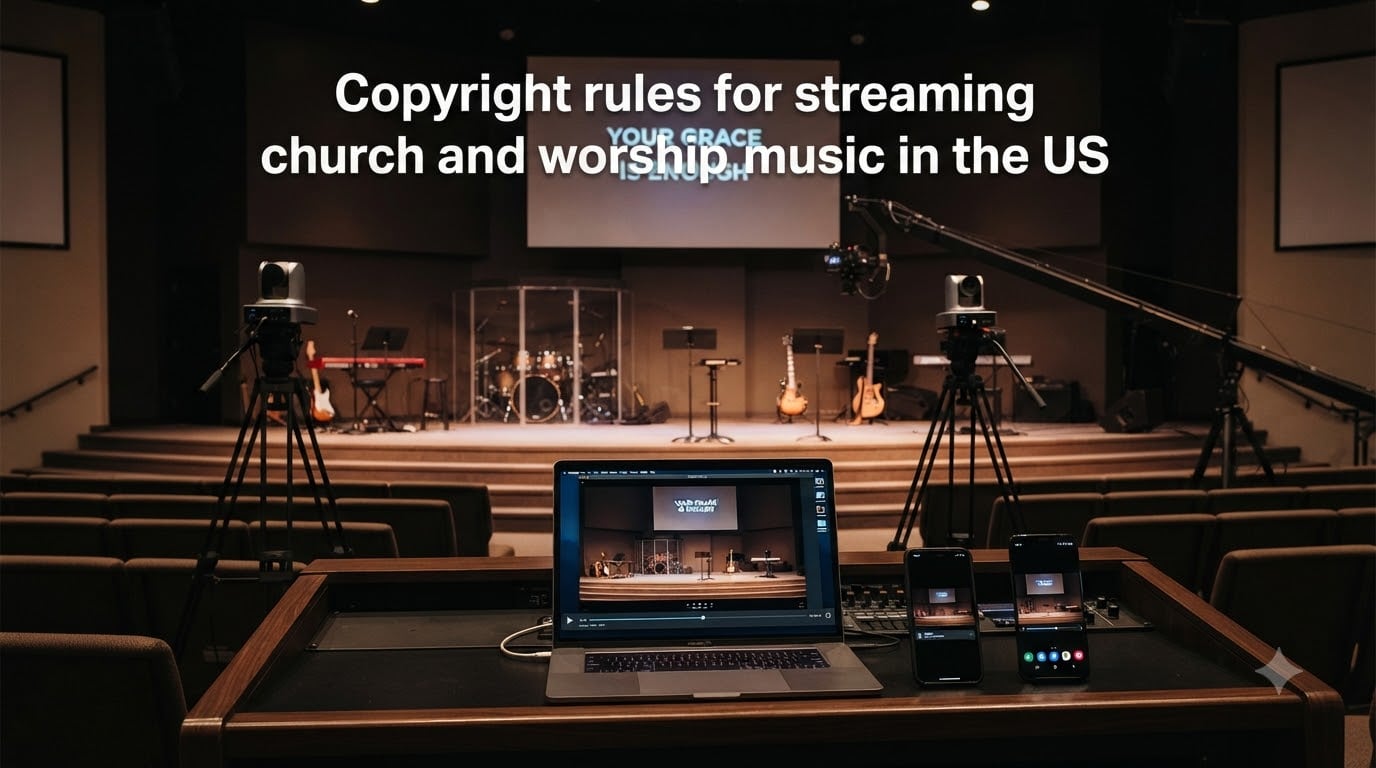
Yes, churches in the US need a license to stream worship music online. The Religious Service Exemption in US copyright law (Title 17, Section 110) covers live worship performances inside your building — but it does NOT cover live streams, recordings, projected lyrics, or rebroadcasts. If your church broadcasts copyrighted songs through YouTube, Facebook Live, your website, or any digital platform, you need proper licensing.
Understanding copyright rules for streaming church and worship music in the US matters now more than ever. More congregations live stream services than ever before, and platforms like YouTube and Facebook have automated systems that scan worship streams for copyrighted songs and issue takedowns, mute audio, or redirect monetization away from your church.
I have spent the last several years researching church streaming setups, talking with AV teams on Reddit communities like r/churchtech and r/worshipleaders, and digging into what CCLI, CCS, and other licensing organizations actually cover. The most common confusion I see is churches thinking their CCLI Church Copyright License is enough to stream online. It usually is not.
This guide breaks down everything your church needs to know: what the Religious Service Exemption actually allows, which licenses you need for streaming, how different platforms handle copyright claims, and what to do when your worship stream gets flagged.
Table of Contents
- What Is the Religious Service Exemption (and Its Limits)
- Why Churches Need Copyright Licenses to Stream Worship Music
- Types of Church Music Licenses in the US
- CCLI Church Copyright License Explained
- CCLI Streaming License vs Streaming Plus: Which Do You Need
- Other License Providers: CCS, OneLicense, and CVLI
- Platform-Specific Copyright Rules: YouTube, Facebook Live, and Vimeo
- Which Church Music Licenses Do You Actually Need? (Decision Guide)
- Common Church Copyright Myths Debunked
- What Happens If Your Church Violates Copyright Law
- Frequently Asked Questions
- Conclusion
What Is the Religious Service Exemption (and Its Limits)
The Religious Service Exemption is a specific carve-out in US copyright law that lets churches perform copyrighted music during worship services without paying performance royalties. It is written into Section 110(3) of the US Copyright Act (Title 17). The exemption covers performance of nondramatic musical or dramaticomusical works and the public display of those works during a religious service at a place of worship.
In plain English: if your worship band plays a Hillsong, Bethel, Elevation, or secular song live during a Sunday service, you do not need a performance license for that live performance. The exemption covers it. The organist, the choir, the band, even a recorded track played over the sound system during a worship service — all covered.
But the Religious Service Exemption has hard limits that catch most churches off guard. It does NOT cover:
- Live streaming or webcasting services that include copyrighted music
- Recording services for later playback or distribution
- Reproducing lyrics in bulletins, song sheets, or projected on screens
- Playing music in the lobby, parking lot, or before and after services (outside the worship service itself)
- Broadcasting services on TV, radio, or podcasts
The moment copyrighted music leaves the four walls of your sanctuary and goes through a camera, microphone, or internet connection, the Religious Service Exemption stops applying. This is where most churches get into trouble. The exemption is a performance right only — it does not grant reproduction, distribution, public display (beyond the service), or streaming rights.
The GCFA (General Council on Finance and Administration of the United Methodist Church) put it well: many churches mistakenly believe that because they are a nonprofit religious organization, copyright law does not apply to them the same way. It absolutely does.
Why Churches Need Copyright Licenses to Stream Worship Music
Streaming a worship service involves at least three separate copyright rights, and each one needs its own permission. When you live stream a service with worship music, you are simultaneously performing the song, reproducing the lyrics (often projected on screen), and broadcasting the recording publicly online. The Religious Service Exemption only handles the first one — and only for the in-person service.
Here is what your church needs licensing for when streaming:
- Reproduction rights — printing lyrics in bulletins, projecting lyrics on screens, creating chord charts for the worship team, or making custom arrangements. This is what the CCLI Church Copyright License covers.
- Streaming rights — broadcasting the performance online through YouTube, Facebook, Vimeo, your website, or any digital platform. This requires a separate CCLI Streaming License or equivalent.
- Recording rights — capturing the service for later playback, sermon archives, or distribution. The CCLI license allows recording under specific conditions.
Each of these rights is independent. Having reproduction rights does not give you streaming rights. Having streaming rights does not automatically give you reproduction rights for lyrics. You need the right license (or combination of licenses) for what your church actually does.
Here is a real-world scenario I have seen play out dozens of times in church tech forums: A church gets their CCLI Church Copyright License, starts projecting lyrics and streaming on YouTube, and three weeks later gets copyright claims muting the music portions of their worship sets. The reproduction license covers the lyrics on screen, but without the streaming add-on, YouTube’s Content ID system flags every copyrighted song. The church is confused because they “have CCLI” — but they only have part of what they need.
Types of Church Music Licenses in the US
US churches typically deal with three types of music licenses, and understanding the difference between them is the foundation of copyright compliance. Getting the wrong license (or thinking one license covers everything) is the most common mistake I see.
Performance License: This covers the right to perform copyrighted music publicly. For most churches, the Religious Service Exemption handles this during actual worship services. But if your church plays background music in the lobby, hosts concerts open to the public, or plays music at events outside worship services, you may need a performance license from ASCAP, BMI, or SESAC — or a blanket license like CCS PERFORMmusic that bundles all three.
Reproduction License: This covers copying lyrics, chord sheets, and sheet music. Any time you type out lyrics for your bulletin, project words on a screen, print song sheets for the choir, or create custom arrangements, you need reproduction rights. The CCLI Church Copyright License is the primary reproduction license used by US churches, covering over 600,000 worship songs and hymns.
Streaming License: This covers broadcasting copyrighted music online. It is separate from both performance and reproduction rights. The CCLI Streaming License (and the higher-tier CCLI Streaming Plus License) are the most common solutions for churches, but other providers like CCS also offer streaming coverage. Without a streaming license, your YouTube, Facebook, or Vimeo worship broadcasts are unlicensed — even if you have CCLI for lyrics.
There are also specialty licenses churches may need: synchronization licenses for recording music onto videos, mechanical licenses for producing recordings, and the CVLI (Church Video Licensing International) license for showing copyrighted films or movie clips. Each covers a specific use case, and none of them overlap with each other.
CCLI Church Copyright License Explained
The CCLI Church Copyright License is the most widely used reproduction license for US churches, and for good reason. It is a blanket license that covers reproduction rights for a catalog of over 600,000 worship songs and hymns from more than 250,000 publishers and songwriters. For the vast majority of contemporary worship music, a CCLI license is what your church needs.
Here is what the CCLI Church Copyright License covers:
- Projecting song lyrics on screens during services
- Printing lyrics in bulletins, song sheets, and handouts
- Recording your worship services (audio or video) for shut-ins and members who could not attend
- Creating custom arrangements of songs for your worship team
- Translating songs into other languages
- Accessing lyrics and chord sheets through SongSelect (CCLI’s song database)
What it does NOT cover is streaming or webcasting. This is the critical distinction. The Church Copyright License handles in-service reproduction, but the moment that service goes online through a stream, you need additional coverage.
CCLI offers three license tiers based on church size: Single Ministry (one campus), Multi-Site (multiple campuses sharing one license), and Traveling Ministry (for churches that meet in multiple locations). Pricing is based on your average weekly attendance, and CCLI requires churches to report song usage periodically through their online reporting system.
SongSelect is a companion tool that comes with most CCLI license tiers. It gives your worship team access to lead sheets, chord charts, hymn-style sheet music, and lyric files for songs in the CCLI catalog. If you are already paying for the Church Copyright License, SongSelect access is likely included — check your license tier to confirm.
CCLI Streaming License vs Streaming Plus: Which Do You Need
CCLI offers two streaming-specific licenses, and choosing the right one depends on where you stream and how far you want your worship services to reach online. Neither is automatically included with the standard Church Copyright License.
CCLI Streaming License: This license allows you to stream or webcast your live worship services on your own church website and social media channels. It covers the same catalog of over 600,000 songs. It is designed for churches that stream their actual worship service as it happens and keep a recording of that service available on their own platform for a limited time.
CCLI Streaming Plus License: The Plus tier expands coverage. It allows you to stream on YouTube, Facebook, your website, and other platforms, and importantly it lets you archive your recorded services online for longer periods. Streaming Plus also covers posting recorded worship content beyond just the live service itself, such as worship highlight videos or song clips shared on social media.
If your church only streams on its own website and removes recordings after a short time, the standard Streaming License may be enough. If you stream on YouTube or Facebook, archive full services, or share worship clips on social media, Streaming Plus is what you want.
One important limitation: CCLI’s streaming licenses only cover songs in the CCLI catalog. If your worship team plays a secular song not represented by CCLI — say a Coldplay cover or a Broadway show tune — that song is not covered by your CCLI Streaming License. You would need separate permission from that song’s publisher, or a license from a different organization that covers it.
Forum posts from worship leaders confirm this is a frequent frustration. A church streams a worship set that includes a popular secular cover, gets a YouTube copyright claim on that specific song, and wonders why their CCLI license did not protect them. The answer is catalog coverage — CCLI licenses only apply to CCLI-represented songs.
Other License Providers: CCS, OneLicense, and CVLI
CCLI is the dominant player in church music licensing, but it is not the only option. Depending on what your church does musically, you may need licenses from other organizations — or you may want to use an alternative provider.
CCS (Christian Copyright Solutions): CCS offers the PERFORMmusic blanket license, which bundles performance rights from ASCAP, BMI, and SESAC into a single license designed for churches. If your church plays music outside of worship services (in the lobby, at community events, at youth group gatherings), PERFORMmusic covers the performance royalties that the Religious Service Exemption does not. CCS also offers the WORSHIPcast license for streaming coverage of both religious and secular music.
OneLicense: OneLicense is the go-to license for churches that use liturgical, traditional, and Catholic worship music. If your church sings from hymnals or uses music from publishers like GIA, Augsburg Fortress, or Oxford University Press, those songs may not be in the CCLI catalog. OneLicense covers reproduction and streaming rights for thousands of songs that CCLI does not represent.
CVLI (Church Video Licensing International): CVLI covers something completely different from music. It gives churches the right to show copyrighted films and movie clips. If your church hosts movie nights, shows film clips during sermons, or uses licensed video content in services, CVLI is the license you need. It does not cover music at all.
Many larger churches end up holding multiple licenses simultaneously. A church might have CCLI for contemporary worship song reproduction and streaming, OneLicense for traditional hymn reproduction, CCS PERFORMmusic for lobby and event music, and CVLI for film screenings. It sounds expensive — and it can be — but it reflects the reality that each license covers a specific set of rights and song catalogs.
Platform-Specific Copyright Rules: YouTube, Facebook Live, and Vimeo
Each streaming platform handles copyright differently, and understanding the platform-specific behavior is something no major competitor covers in depth. I have tracked dozens of church tech forum threads about copyright claims on worship streams, and the patterns are clear.
YouTube Copyright Behavior for Church Streams
YouTube uses an automated system called Content ID that scans every uploaded video and live stream against a database of copyrighted audio and video. When your worship band plays a copyrighted song, Content ID typically flags it within minutes — sometimes while the live stream is still running.
What happens when YouTube flags your worship stream depends on the rights holder’s preference. The three most common outcomes are:
- Audio is muted during the flagged song segment
- The video remains up but the copyright holder claims monetization for that portion
- The video is blocked entirely or removed (takedown)
Having a CCLI Streaming License helps with dispute resolution, but it does not automatically prevent Content ID flags. YouTube’s system is automated and does not know you are licensed. You typically need to file a dispute through YouTube’s interface, citing your CCLI license number, and wait for the claim to be reviewed.
This is one of the biggest pain points churches raise in forums. The workaround is real but takes effort: file a dispute, reference your streaming license, and YouTube will usually release the claim if your documentation checks out. Some rights holders are faster to release claims than others.
Facebook Live Copyright Behavior for Church Streams
Facebook Live uses its own audio detection system. When copyrighted music is detected in your worship stream, Facebook typically mutes the audio for the flagged segment in the recorded version of your live broadcast. In more serious cases, Facebook may end your live stream early or restrict your page’s ability to go live.
Facebook’s appeals process is less straightforward than YouTube’s. There is no equivalent to Content ID dispute filing where you can cite a license number. The best approach is to maintain your CCLI Streaming Plus documentation and submit it through Facebook’s copyright appeal form if your stream gets restricted.
Vimeo Copyright Behavior for Church Streams
Vimeo handles copyright more conservatively than YouTube and Facebook. They use a combination of automated scanning and manual review, and their approach is generally more favorable to churches because Vimeo positions itself as a creator-friendly platform. Copyright claims on Vimeo worship content tend to be less frequent, but when they happen, the resolution process is handled through Vimeo’s support team rather than an automated dispute system.
For all three platforms, the most effective strategy is prevention: hold the right license, stream songs within your licensed catalog, and keep documentation accessible. If your church regularly streams, designate someone on your AV team to handle copyright disputes as they come in — because they will come in.
Which Church Music Licenses Do You Actually Need? (Decision Guide)
Instead of guessing, work through this decision guide based on what your church actually does. Most churches need two to three licenses to be fully compliant.
Step 1: Do you project or print song lyrics during worship?
If yes, you need a reproduction license. The CCLI Church Copyright License is the standard answer and covers most contemporary worship music. If your church also uses traditional or liturgical hymns, add OneLicense.
Step 2: Do you live stream or webcast your worship services?
If yes, you need a streaming license in addition to your reproduction license. The CCLI Streaming License covers streaming on your own website. The CCLI Streaming Plus License covers YouTube, Facebook, and social media archiving. Choose based on where you stream.
Step 3: Do you play music outside of worship services?
If your church has background music in the lobby, youth group, community events, or any non-worship-service gatherings with copyrighted music, you need a performance license. The Religious Service Exemption does not cover these. CCS PERFORMmusic is the standard blanket license.
Step 4: Do you record and distribute services?
If you post recorded services online, distribute recordings to shut-ins, or create worship highlight videos, you need recording and distribution rights. The CCLI Church Copyright License includes limited recording rights for distribution to church members. For broader distribution, check your license terms.
Step 5: Do you show movies or film clips?
If your church shows films, movie clips, or uses licensed video content, you need a CVLI license. This is separate from all music licensing.
Most contemporary churches that stream online need: CCLI Church Copyright License + CCLI Streaming Plus License. That combination handles lyric reproduction and online streaming for the majority of worship songs. Add other licenses based on your specific activities.
Common Church Copyright Myths Debunked
Copyright myths circulate widely in church circles, and they lead to real compliance problems. Here are the most common ones I encounter — and the reality behind each.
Myth 1: “The Religious Service Exemption covers our live stream.”
Reality: It does not. The exemption covers live in-person performance during a worship service only. Streaming is a broadcast, which is a separate right not covered by the exemption.
Myth 2: “We are a nonprofit, so fair use covers us.”
Reality: Fair use is a legal defense, not an exemption. Being a nonprofit does help your case in a fair use analysis, but it does not automatically qualify every use as fair use. Courts look at four factors: purpose, nature, amount, and market effect. Worship streaming typically fails the market effect test because licensing options exist specifically for that use.
Myth 3: “If we bought the sheet music or the album, we can stream it.”
Reality: Purchasing a copy of music gives you personal use rights, not public performance or streaming rights. Owning a CD or a digital download does not give your church the right to broadcast that recording.
Myth 4: “Songs in our hymnal are public domain.”
Reality: Some hymns are public domain, but many modern hymnals include copyrighted arrangements or recent compositions. The hymnal itself may be a licensed publication, and individual songs within it may still be under copyright protection. Check each song individually.
Myth 5: “If the song is on YouTube, it is free to use.”
Reality: Songs on YouTube are not free to use. They are published there by rights holders who retain all copyright. Presence on a streaming platform does not equal a license to use the song in your own broadcasts.
Myth 6: “We only need one license and it covers everything.”
Reality: No single license covers every copyright right. Reproduction, streaming, performance, and video licensing are separate. You need the combination that matches what your church actually does.
What Happens If Your Church Violates Copyright Law
The consequences of streaming copyrighted worship music without a license range from inconvenient to financially serious. Churches face three main categories of consequences.
Platform-level consequences: YouTube mutes your audio, issues copyright claims, redirects monetization, blocks videos, or issues channel strikes. Three strikes and YouTube can terminate your channel. Facebook mutes segments, restricts live streaming privileges, or removes content. These are automated and happen frequently — church AV techs report them as a weekly occurrence.
Civil penalties: Under US copyright law (Title 17, Chapter 5), copyright holders can sue for actual damages plus profits, or statutory damages ranging from $750 to $30,000 per work infringed. Willful infringement can push statutory damages up to $150,000 per work. A single worship service with five unlicensed copyrighted songs could theoretically expose a church to significant liability.
Reputational and ministry consequences: Beyond legal and financial risk, copyright infringement damages a church’s witness. Many worship leaders and pastors I have spoken with say that getting licensed is as much about integrity and honoring the songwriters who create the music churches rely on as it is about legal compliance. The songwriters, bands, and publishers who create worship music depend on licensing revenue to continue their work.
If your church receives a copyright takedown or claim, do not ignore it. Document your licensing status, file a dispute through the platform if you hold the appropriate license, and consult with a copyright attorney if you receive a formal cease and desist or legal demand. The CCLI and CCS websites both offer guidance on responding to copyright claims.
Frequently Asked Questions
Can churches live stream copyrighted music?
Churches can live stream copyrighted worship music only if they hold a streaming license that covers those songs. The Religious Service Exemption in US copyright law does not cover streaming or webcasting. You need a CCLI Streaming License or equivalent from another licensing organization to broadcast copyrighted music online.
Does a church have to have a license to stream words of a song?
Yes. Streaming song lyrics requires both a reproduction license (such as the CCLI Church Copyright License for projecting and displaying lyrics) and a streaming license (such as the CCLI Streaming License for broadcasting those lyrics online). Displaying lyrics in a stream is a reproduction right, and broadcasting it is a separate streaming right.
How do you avoid being copyrighted during worship?
To avoid copyright claims during worship streaming: 1) Obtain a CCLI Church Copyright License for lyric reproduction. 2) Add a CCLI Streaming License or Streaming Plus License for online broadcasting. 3) Only stream songs within your licensed catalog. 4) Avoid secular songs not covered by your license. 5) Keep license documentation accessible to dispute any automated platform claims.
Do I need a CCLI streaming license?
You need a CCLI Streaming License (or equivalent from another provider) if your church live streams or webcasts worship services that include copyrighted music from the CCLI catalog. The standard CCLI Church Copyright License covers lyric reproduction but does not include streaming rights. Streaming rights require a separate license purchase.
Conclusion
Copyright rules for streaming church and worship music in the US come down to one core principle: the Religious Service Exemption covers live in-person worship only, and everything that goes online needs its own licensing. Most churches that stream need a CCLI Church Copyright License plus a CCLI Streaming or Streaming Plus License at minimum.
Your next step is simple. Audit what your church currently does — projecting lyrics, streaming online, recording services, playing music outside worship — and match each activity to the licenses above. If you are already streaming without a streaming license, prioritize adding one this week before your next service goes live.