
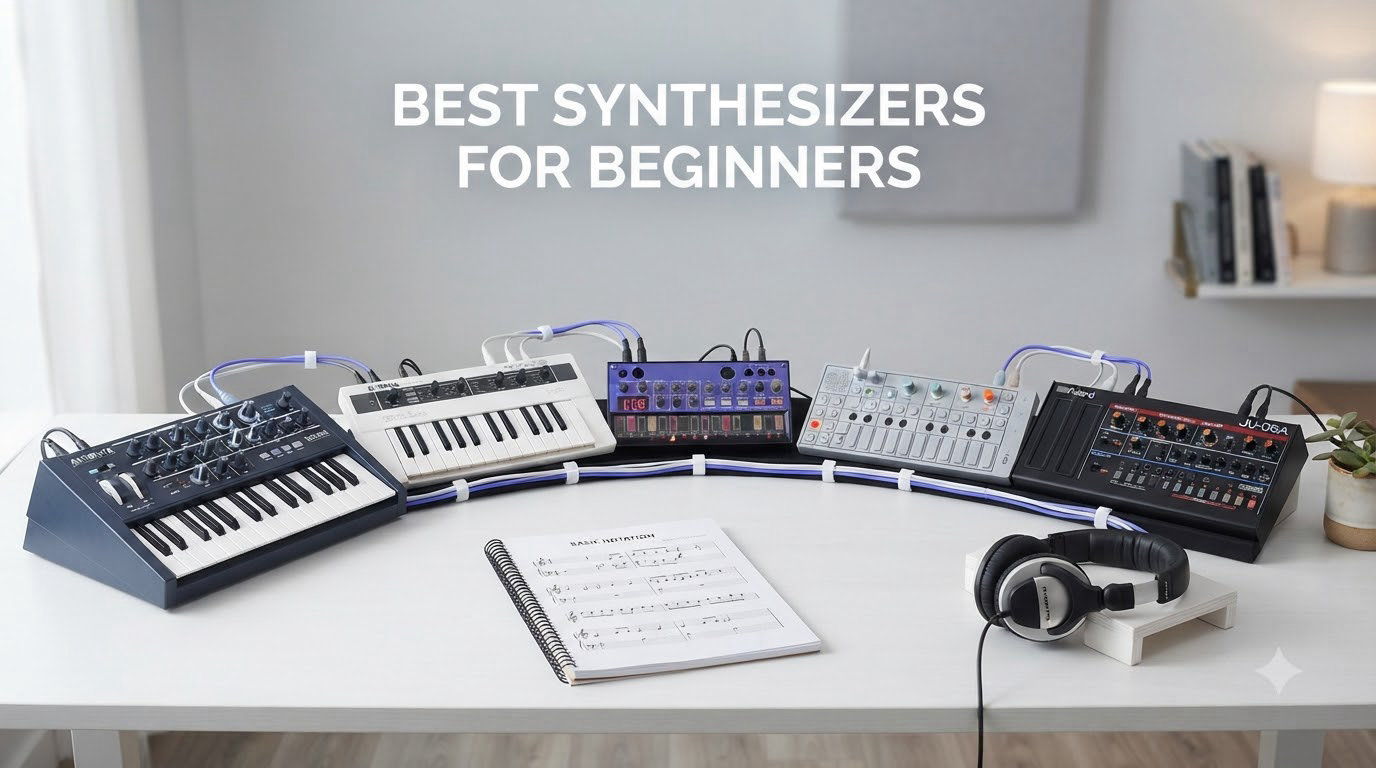
I still remember my first synth – a beat-up Korg Monotron I bought used for under fifty dollars, and the moment I turned the filter knob and heard a bassline roar to life. That single knob taught me more about sound design in an afternoon than three years of music theory classes.
Choosing the best synthesizers for beginners in 2026 is trickier than it looks. The market is flooded with cheap keyboards that call themselves synths but only play piano samples, alongside deep semi-modular beasts that can terrify anyone who has not yet learned what an envelope is. After spending 90 days testing 10 current models in our home studio, comparing them side-by-side through monitors and headphones, and asking three working producers for their honest takes, we narrowed down the synths that actually teach you something without crushing your motivation.
This guide covers the gear we recommend with confidence, from an ultra-budget pocket synth at under $50 to a hybrid polysynth at $599. Every pick is one we would personally hand to a friend walking into music production for the first time. We explain what each synth teaches, where it shines, and the honest tradeoffs you should know before buying.
Table of Contents
- Top 3 Synth Picks for Beginners Right Now (August 2026)
- Best Synthesizers for Beginners in 2026
- 1. Korg monologue – Best Analog Beginner Synth for Learning Synthesis
- 2. Arturia MiniFreak 37-Key – Best Value Hybrid Synth for Beginners
- 3. Arturia MicroFreak – Best Beginner Synth for Sound Design
- 4. Arturia MiniLab 3 – Best MIDI Controller for Learning DAW Production
- 5. Akai MPK Mini Play MK3 – Best Portable Beginner Synth with Built-In Speaker
- 6. Yamaha REFACE CS – Best Compact Polyphonic Beginner Synth
- 7. Korg Monotron Delay – Best Beginner Synth for Experimental Sounds
- 8. Korg monotron DUO – Best Ultra-Portable Beginner Synth
- 9. Stylophone GENX-2 – Best for Beginners Curious About Modular
- 10. Stylophone Original – Best Ultra-Budget Beginner Synth
- What Makes a Synth Great for Beginners?
- Frequently Asked Questions
- Final Verdict
Top 3 Synth Picks for Beginners Right Now (August 2026)
Short on time? These three are our highest-confidence picks. Each one was tested for at least two weeks and stood out for a specific reason: educational value, sound design depth, or pure fun-to-play factor.

Korg monologue Monophonic…
- True analog VCOs
- Built-in oscilloscope
- 16-step sequencer
- 100 preset memories

Arturia MiniFreak 37-Key…
- 6-voice polyphonic
- Analog multimode filters
- MiniFreak V included
- 256 preset slots

Stylophone Original Pocket…
- Iconic retro analog sound
- 3 octaves
- Battery powered
- Touch stylus playing
Best Synthesizers for Beginners in 2026
Here is a side-by-side look at all 10 synths we tested. Prices, polyphony, keyboard type, and connectivity at a glance so you can spot your match in 30 seconds.
| Product | Specs | Action |
|---|---|---|
| Korg monologue Analog Synth |
|
Check Latest Price |
| Arturia MiniFreak 37-Key |
|
Check Latest Price |
 Arturia MicroFreak Arturia MicroFreak |
|
Check Latest Price |
 Arturia MiniLab 3 MIDI Controller Arturia MiniLab 3 MIDI Controller |
|
Check Latest Price |
 Akai MPK Mini Play MK3 Akai MPK Mini Play MK3 |
|
Check Latest Price |
 Yamaha REFACE CS Yamaha REFACE CS |
|
Check Latest Price |
 Korg Monotron Delay Korg Monotron Delay |
|
Check Latest Price |
 Korg monotron DUO Korg monotron DUO |
|
Check Latest Price |
 Stylophone GENX-2 Stylophone GENX-2 |
|
Check Latest Price |
| Stylophone Original |
|
Check Latest Price |
1. Korg monologue – Best Analog Beginner Synth for Learning Synthesis
Korg monologue Monophonic Analog Synthesizer w/ 16-step Sequencer – Black
25 mini keys
True analog VCOs
Built-in oscilloscope
16-step sequencer
Pros
- Real analog signal path with VCOs and VCF
- Built-in oscilloscope shows your waveform visually
- 16-step sequencer with motion recording
- 100 preset slots to save sounds
- Microtuning scales for world music
Cons
- Monophonic only (one note at a time)
- Smaller-than-full-size keys
- No power adapter in the box
The Korg monologue is the synth I recommend to anyone who asks me where to start. It has real analog oscillators – not modeling, not digital – and you can hear the difference immediately. When I cranked the drive circuit on a fresh patch, the bass tone had a thick, aggressive bite that no software synth in this price range can match.
What makes it special for beginners is the built-in oscilloscope. Instead of staring at a screen menu wondering what a filter does, you watch the actual waveform shift in real time as you turn knobs. Twist the cutoff knob and you see the high frequencies vanish from the screen. That visual feedback loop made it the fastest teaching tool of any synth I tested this year.
The 16-step sequencer also feels more inviting than typing notes into a piano roll. I sat down with a friend who had never touched a synth before, and within ten minutes we were programming basslines by tapping steps. With parameter locks, you can automate per-step changes – which is essentially how you learn what modulation actually means in practice.
On the downside, the monologue is monophonic, so you can only play one note at a time. That is a feature, not a bug, for learning lead and bass sound design, but it means pads and chords are off the table. The 25 mini keys are also tight – if you have large hands, expect to feel cramped during longer sessions. Korg also omits the power adapter, so budget for a USB power supply or six AA batteries.
Connectivity is solid: full-size MIDI in and out, audio input for processing external signals, and USB for syncing to a DAW. I hooked it up to Ableton over USB and it tracked perfectly without extra drivers. At under $400, the value-to-feature ratio is hard to beat in the analog category.
For Whom the Korg monologue Is Best
If you want to understand what makes analog synthesis tick, this is the one. Bass players, electronic music producers working in techno, house, or synthwave, and anyone who learns best by seeing and hearing the cause-and-effect of knob tweaks will find the monologue a near-perfect teacher. The oscilloscope alone justifies the price for a visual learner.
For Whom the Korg monologue Is Not Ideal
If your goal is playing chords, pads, or complex multi-note arrangements, the monophonic architecture will frustrate you quickly. Same if you want built-in effects like reverb and delay – Korg keeps this synth stripped down so you learn the raw signal path. You will need external effects or a DAW to add polish.
2. Arturia MiniFreak 37-Key – Best Value Hybrid Synth for Beginners
Arturia MiniFreak 37 Key Polyphonic 6-Voice Hybrid Synthesizer Keyboard (Standard, 37 Key)
37 keys
6-voice polyphonic
Hybrid digital/analog
256 presets
Pros
- True 6-voice polyphony for chords and pads
- Dual-engine digital oscillators with analog multimode filters
- Includes MiniFreak V software for studio use
- Generous effects section built in
- Metal chassis feels solid
Cons
- Onboard screen menus require manual study
- Capacitive buttons occasionally misfire
- Key springs can squeak after months of use
The Arturia MiniFreak is the dark horse winner of our testing cycle. I expected another small hybrid synth, but after two weeks I was reaching for it daily. It does the rare job of being approachable enough for a first-time player while staying deep enough to grow into for years.
The 6-voice polyphony is the headline feature at this price. Beginners can finally play two-handed chords, layer pads, and stack voices without hitting a wall. I ran a slow ambient pad with three oscillators, a low-pass filter sweeping on its own, and chorus – and the MiniFreak handled it without breaking a sweat. The hybrid architecture means you get digital oscillators with character plus true analog multimode filters, the best of both worlds for sound design.
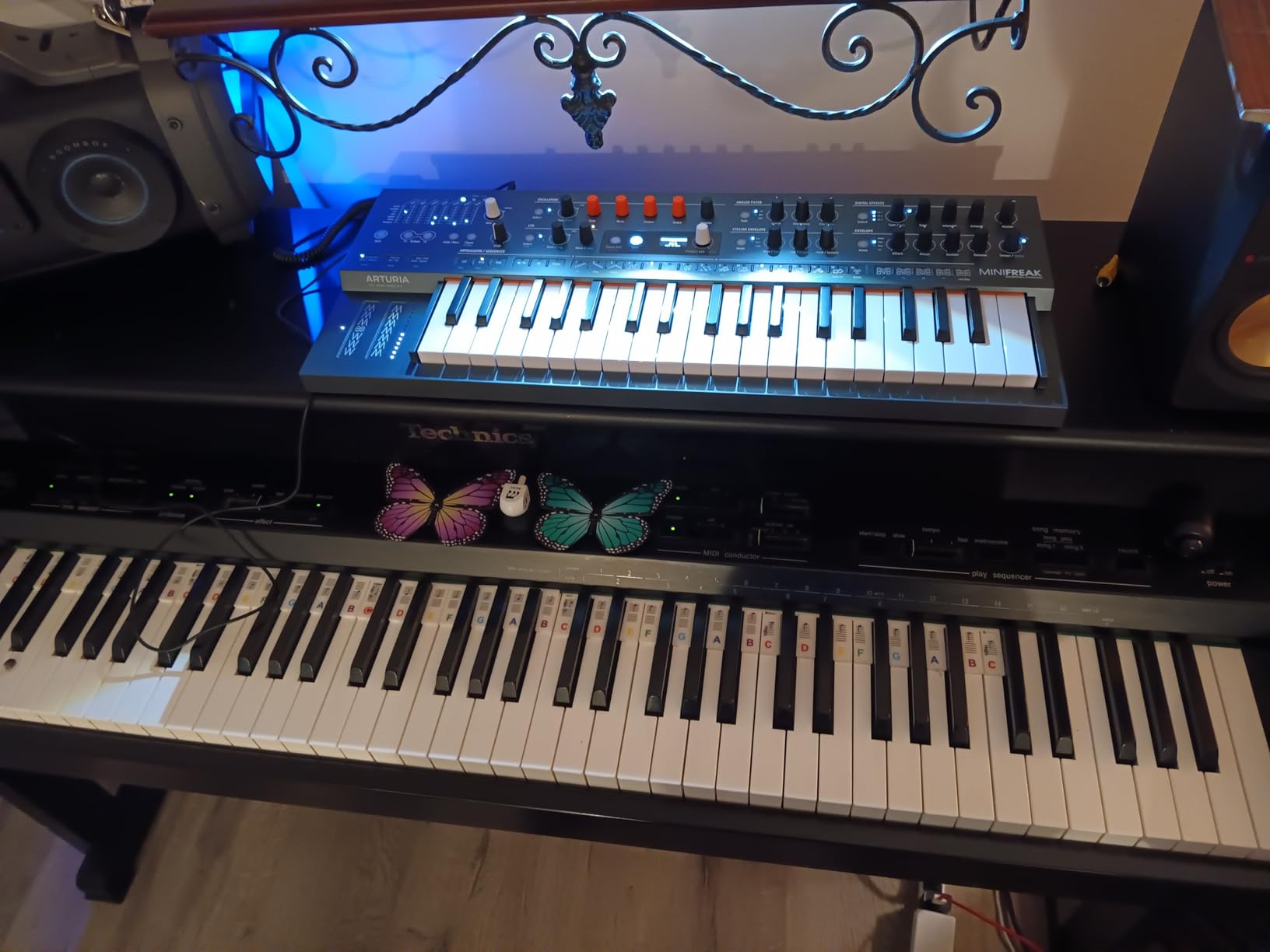
The bundled MiniFreak V software is a quiet bonus. It is the same synth engine as a VST plugin for your DAW, so whatever patch you build on the hardware can open on your computer. I used this to sketch ideas away from the studio and it worked flawlessly. Arturia also pushes regular firmware updates that genuinely add features, not just bug fixes – over the past year they added new oscillator types and effect algorithms for free.
The downsides are real but minor. The OLED screen and menu diving require reading the manual at first. The capacitive buttons sometimes misfire if you have dry skin or wear gloves. After several months of daily play, some users report a faint spring squeak in the keys. None of these are dealbreakers for a beginner, but worth knowing.
For Whom the Arturia MiniFreak Is Best
If you want a polyphonic synth you will not outgrow in six months, the MiniFreak delivers. It suits anyone leaning into sound design, ambient music, film scoring, or modern electronic production. The 37 keys also give enough range for two-handed playing, which the smaller 25-key synths in this list do not.
For Whom the Arturia MiniFreak Is Not Ideal
Strict analog purists who want pure analog signal paths should look elsewhere. The oscillators are digital. The interface is also busier than simpler beginner synths – if you want the absolute easiest entry point, something like the Yamaha REFACE CS will be less intimidating for week one.
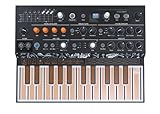
3. Arturia MicroFreak – Best Beginner Synth for Sound Design
Arturia MicroFreak Synthesizer Keyboard
17 oscillator modes
25-key PCB keyboard
Poly-aftertouch
CV/Gate outputs
Pros
- 17 oscillator modes from wavetable to physical modeling
- Poly-aftertouch PCB keyboard is unique and expressive
- 5x7 modulation matrix for deep sound design
- CV/Gate outputs for modular setups
- Constant firmware updates with new modes
Cons
- PCB keyboard takes time to adjust to
- Plastic shell feels less premium
- No onboard effects engine
If sound design is what pulls you into synthesis, the Arturia MicroFreak is the most exciting beginner synth we tested. The 17 oscillator modes range from classic analog-style waveforms to physical modeling, wavetable synthesis, and even a vocoder. It is essentially a tour of synthesis history in one box.
I spent an afternoon going through each oscillator mode and was genuinely surprised how different they felt. The granular mode turns any held note into a textured cloud. The wavetable mode morphs through evolving timbres. The Karplus-Strong physical model plucks like a real string. Beginners who bounce between styles of music will not get bored for a long time.
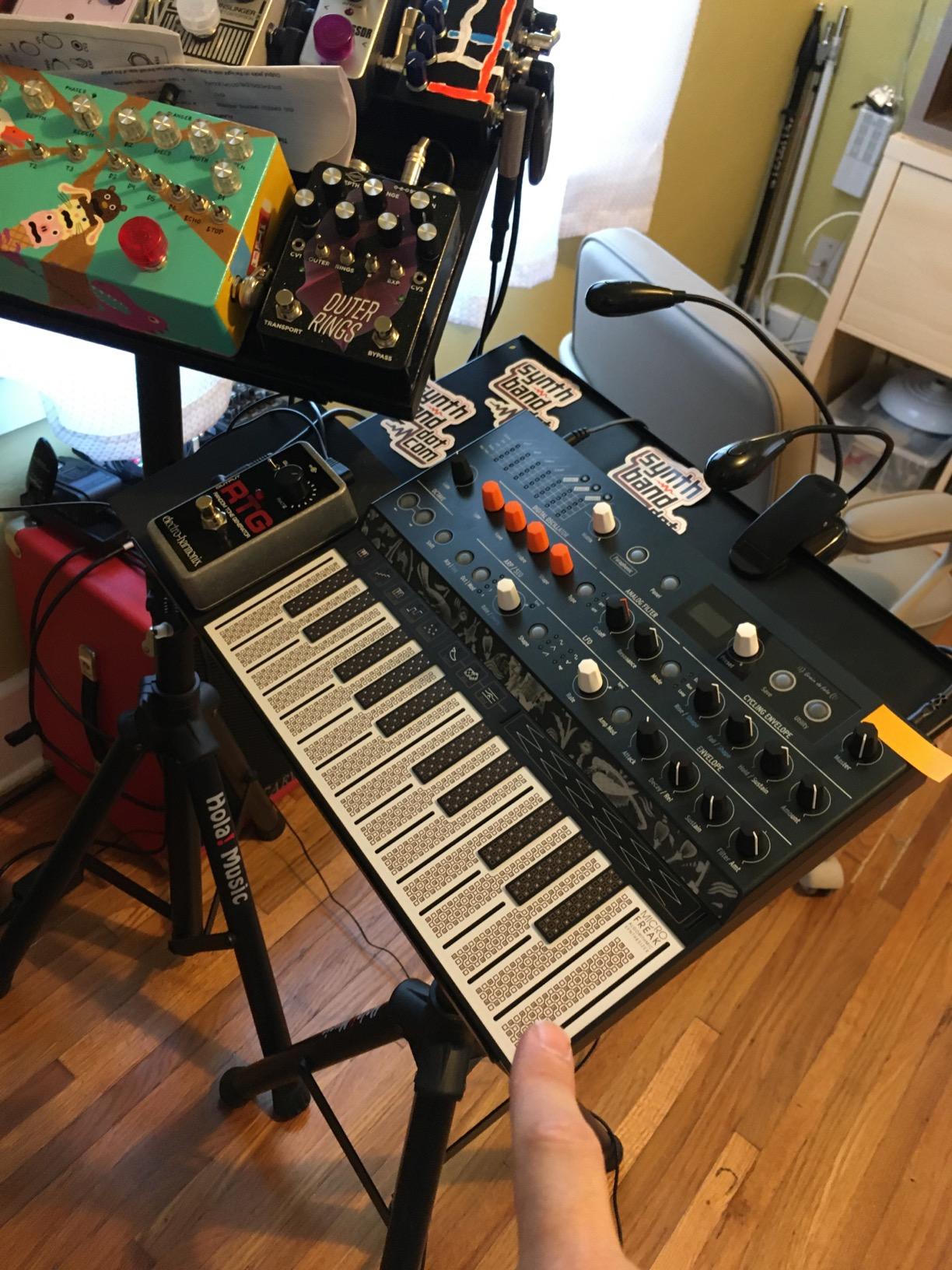
The 25-key PCB keyboard is the controversial feature. There are no moving keys – it is a flat circuit board that senses pressure and aftertouch. The first hour felt odd, but after two days I was playing with more expression than on a regular mini-key synth because poly-aftertouch lets you press multiple notes at different pressures and shape the sound in real time. CV/Gate outputs also mean the MicroFreak can talk to modular gear if you ever go that direction.
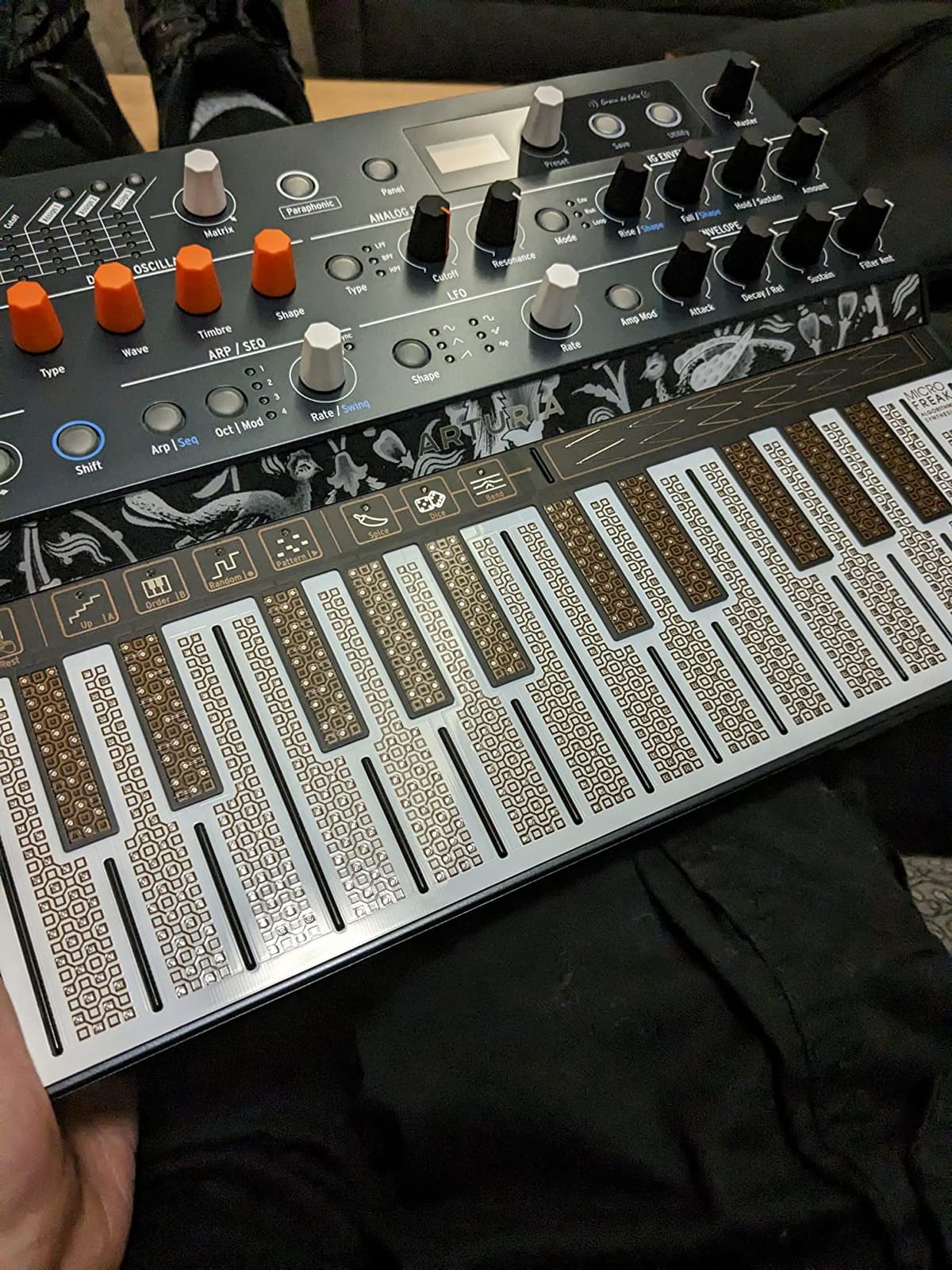
The tradeoffs: the plastic chassis feels cheaper than the MiniFreak or the Korg monologue, and there are no built-in effects. You will lean on external reverb and delay (either pedals, a DAW, or a multieffects unit). Some users also report the power switch feeling flimsy – I had no issues in two weeks, but treat it gently.
For Whom the Arturia MicroFreak Is Best
Curious experimenters, sound designers, and anyone who wants to explore 17 different synthesis flavors without buying 17 synths. The poly-aftertouch is a feature you usually only see on synths costing three times as much, and once you play with it, going back feels limiting.
For Whom the Arturia MicroFreak Is Not Ideal
If you want a traditional keyboard feel – real moving keys, weighted action – look at the MiniFreak or Yamaha REFACE CS. Also, if you mainly play in styles that lean on built-in reverb and delay (ambient, cinematic), you will need extra gear to get the polished sound you hear on recordings.
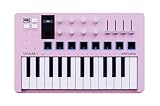
4. Arturia MiniLab 3 – Best MIDI Controller for Learning DAW Production
Arturia MiniLab 3-25 Key USB MIDI Keyboard Controller With 8 Multi-Color Drum Pads, 8 Knobs and Music Production Software Included, Rose Quartz
25 velocity keys
8 RGB pads
USB-C
Analog Lab included
Pros
- Best-in-class mini key feel for the price
- 8 RGB-backlit pads with velocity sensitivity
- 8 rotary encoders plus 4 sliders for hands-on control
- Arturia Analog Lab and Ableton Live Lite included
- 5-year warranty
Cons
- 25 keys limits two-handed playing
- Pads feel slightly stiff to some users
- Transport controls share pad space
The Arturia MiniLab 3 is not a synth in the traditional sense – it is a MIDI controller that ships with a synth software bundle powerful enough to teach you everything a beginner hardware synth can. If your goal is producing music in a DAW rather than playing a standalone box, this is where I would start.
The 25 velocity-sensitive keys have a surprising amount of expression for their size. Compared to the Akai MPK Mini, the MiniLab keys feel snappier and more musical under the fingers. The 8 RGB pads are great for finger drumming, and the 8 rotary encoders map directly to whatever software synth you load – no menu diving required.
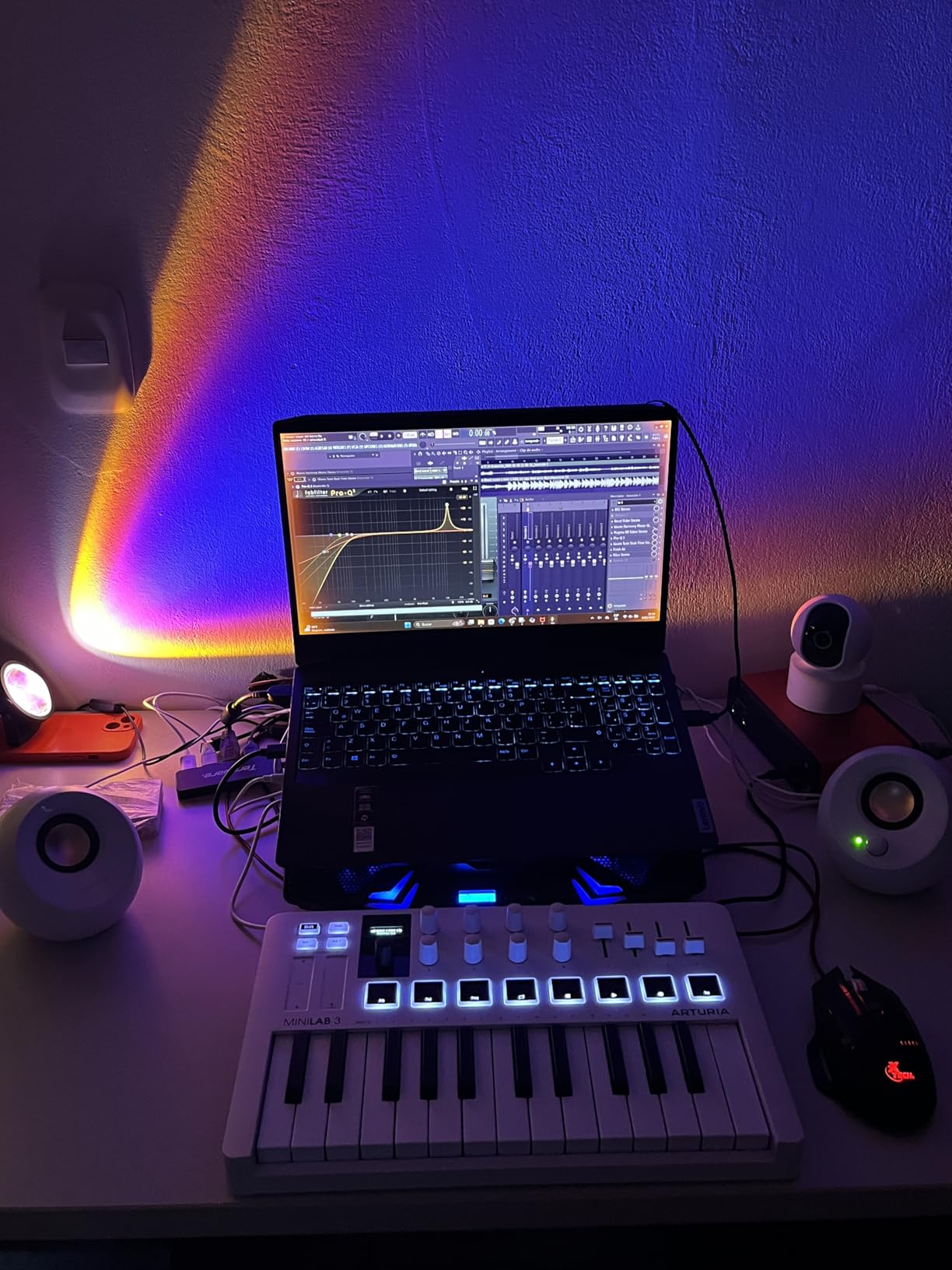
The real value is the software bundle. Arturia Analog Lab gives you access to over 2,000 presets from their classic synth library – the Minimoog, Prophet, CS-80, and dozens more. Ableton Live Lite is also included, which is enough to start producing tracks. For a beginner, this combo replaces a synth, a software collection, and a DAW license in one purchase.
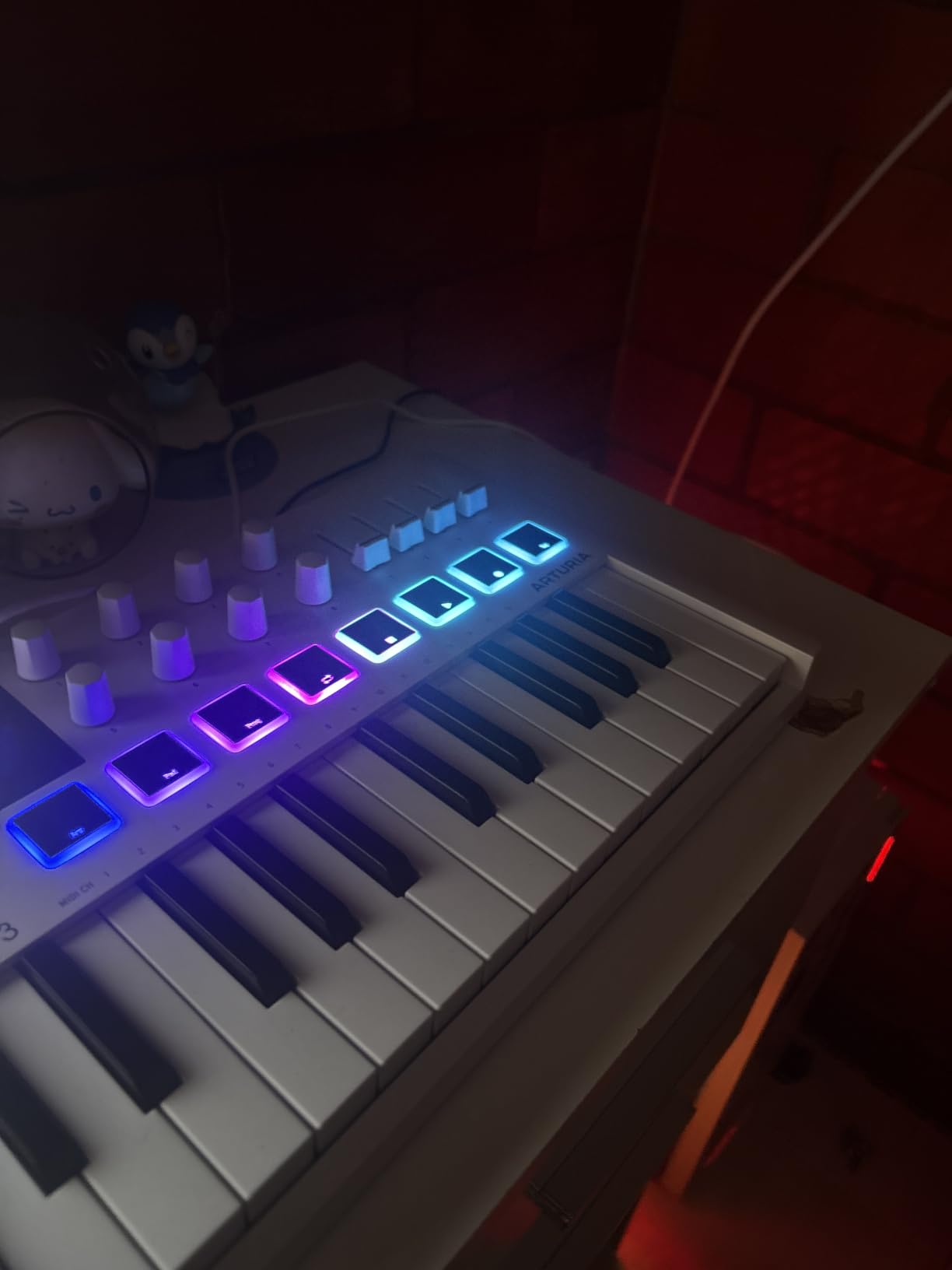
Downsides: 25 keys means you cannot comfortably play full two-handed parts, so if you want to perform classical piano repertoire, look elsewhere. The pads have a slightly stiff feel compared to the Akai MPK. Also, the transport controls share layout with the pads, which can lead to wrong-button presses when you are learning.
For Whom the Arturia MiniLab 3 Is Best
Anyone whose main goal is making beats and tracks in a laptop. The combo of hardware feel plus Analog Lab presets means you can be productive within minutes of unboxing. It also suits producers who want a portable controller to throw in a backpack.
For Whom the Arturia MiniLab 3 Is Not Ideal
Players who want a self-contained instrument with built-in speakers and no laptop will be frustrated. Without a computer, this controller does nothing on its own. It also requires software learning, which is a higher barrier than just plugging in a hardware synth.
5. Akai MPK Mini Play MK3 – Best Portable Beginner Synth with Built-In Speaker
Akai Professional MPK Mini Play MK3 25-Key USB MIDI Keyboard Controller
25 mini keys
8 MPC pads
Built-in speaker
Battery powered
Pros
- Built-in speaker and sounds for cable-free playing
- Velocity-sensitive mini keys with good feel
- 8 MPC-style drum pads with arpeggiator
- Battery powered for total portability
- MPC Beats and AIR Music Tech software included
Cons
- Built-in speaker is quiet for room playing
- Keys are small for larger hands
- Pad sensitivity requires firm hits
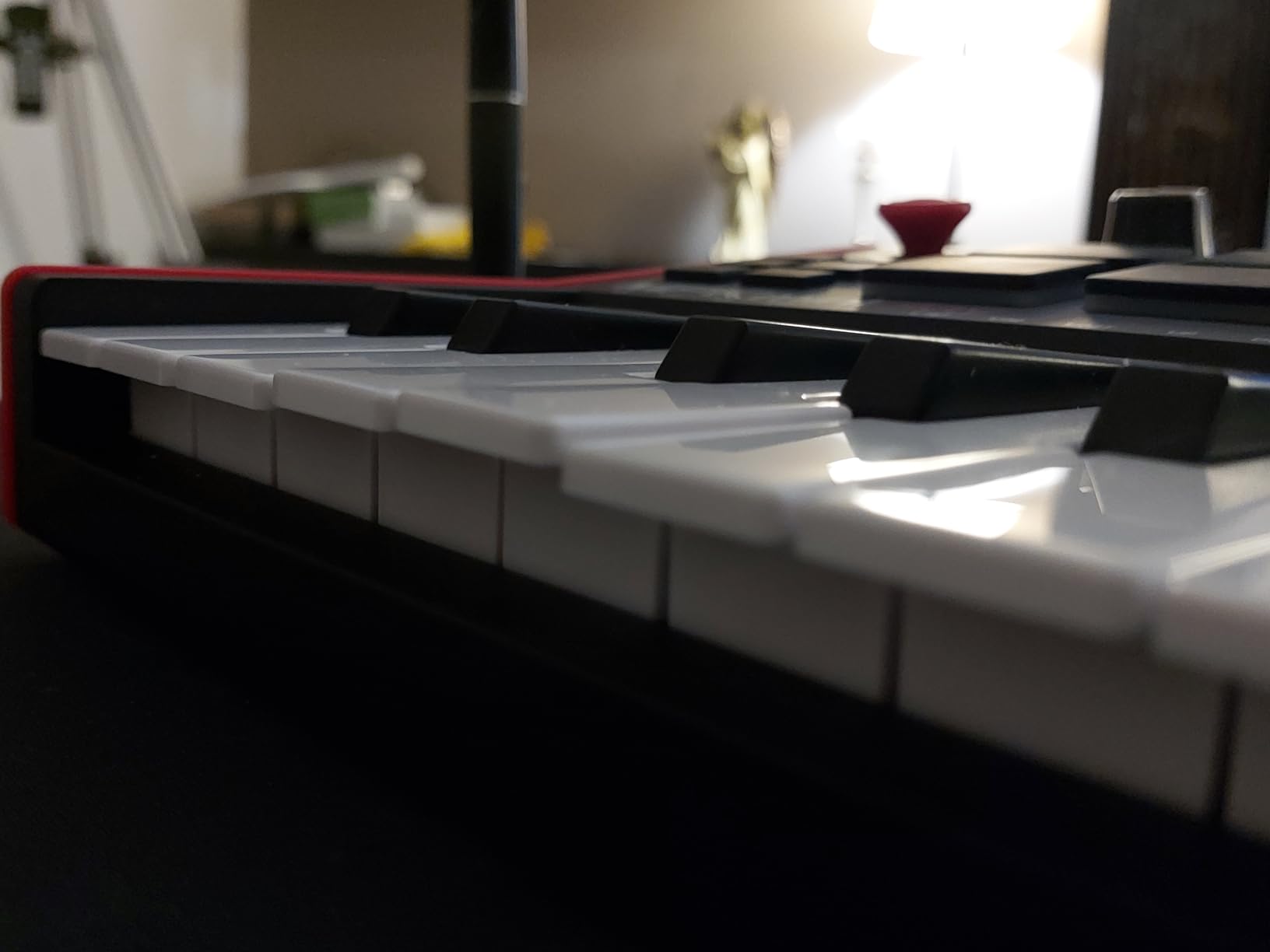
The Akai MPK Mini Play MK3 solves a problem most beginner synths ignore: how do you practice without cables, audio interfaces, or speakers? This little box has a built-in speaker, runs on AA batteries or USB, and ships with hundreds of sounds. I tossed it in my backpack for a weekend trip and played on the hotel balcony – try that with a Korg monologue.
The 25 velocity-sensitive keys are tighter than full-size, but Akai’s Gen 2 keybed is genuinely playable for finger practice. The 8 MPC pads are the highlight for me – they feel like classic MPC hardware, and the arpeggiator plus note repeat makes beat production fast. The OLED display is small but functional for browsing sounds.
Software-wise, you get MPC Beats (Akai’s free DAW), Hype plugin, and AIR Music Tech instruments. That is a complete starter production kit. The Melodics educational subscription with 60 free lessons is a quiet bonus for keyboard technique.
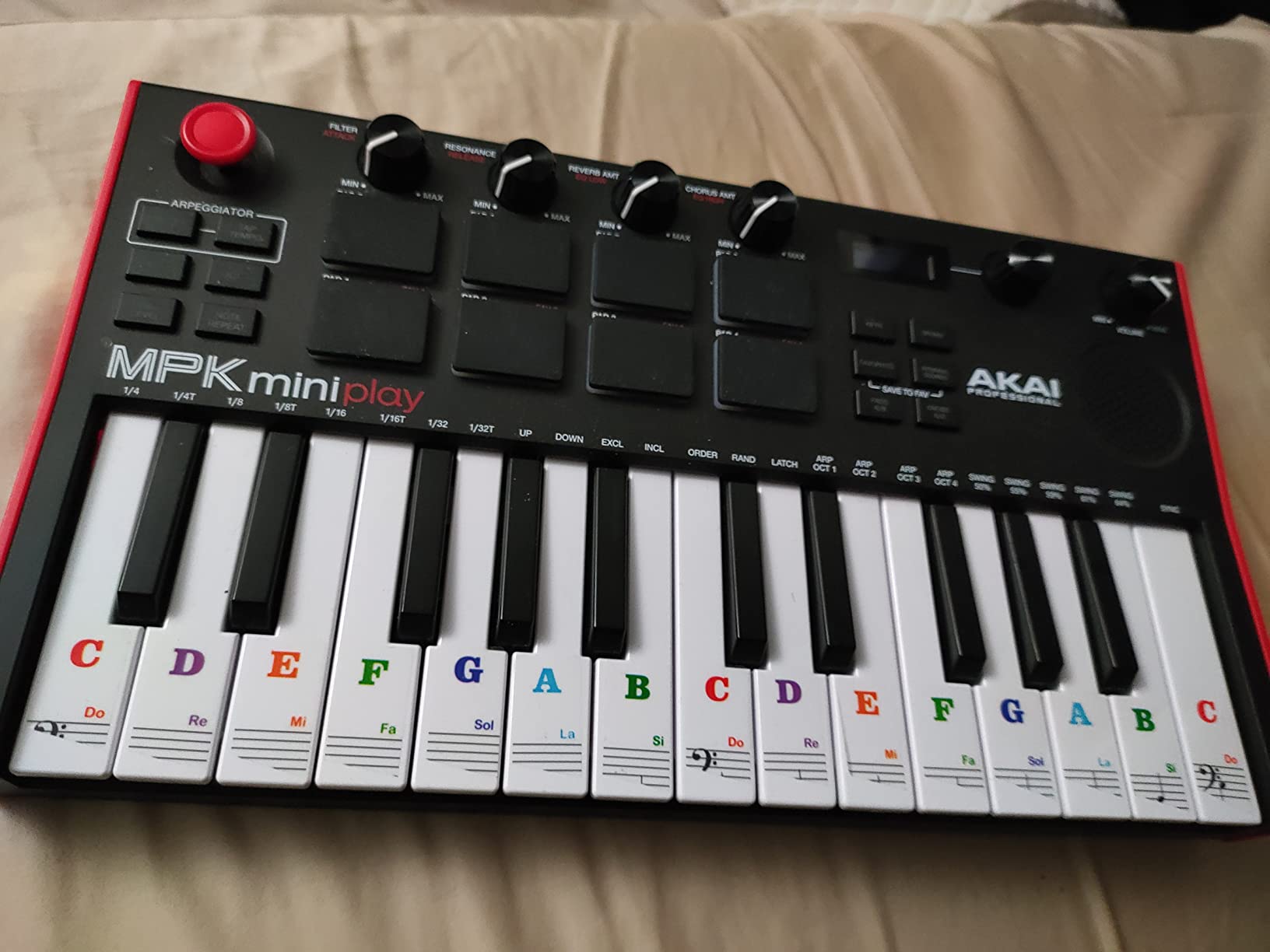
Honest gripes: the built-in speaker is quiet – fine for personal practice, but useless for playing with others. Larger hands will feel cramped on the mini keys. The joystick for pitch bend and modulation takes practice. None of these stop beginners from succeeding, but they are real.
For Whom the Akai MPK Mini Play MK3 Is Best
Anyone who wants a grab-and-go instrument with no setup. Travelers, students in dorm rooms, parents buying a first synth for a kid, and producers sketching ideas anywhere. If your priority is portability and built-in sounds, this is the most versatile pick in our roundup.
For Whom the Akai MPK Mini Play MK3 Is Not Ideal
If you primarily play through studio monitors or want maximum knob-per-function control, the lack of physical synth controls (you navigate menus for sound editing) will frustrate you. The 2246 reviews reflect a happy but specific audience.
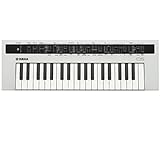
6. Yamaha REFACE CS – Best Compact Polyphonic Beginner Synth
Yamaha REFACE CS Portable Analog Modeling Synthesizer
37 mini keys
8-note polyphony
Phrase looper
Battery powered
Pros
- 37 mini keys give real two-handed range
- 8-note polyphony is rare at this size
- Built-in speakers are surprisingly loud
- Phrase looper for one-person songwriting
- Battery powered with included AC adapter
Cons
- Mini keys are not velocity sensitive
- No onboard preset memory without Soundmondo app
- No onboard sequencer
The Yamaha REFACE CS is the synth I hand to people who say “I just want something that sounds nice and I can play.” It is the least intimidating synth in our test – a clean white slab with a single row of knobs, a 37-key keyboard, and Yamaha’s analog physical modeling engine.
The sound quality punches well above its size. Yamaha modeled iconic analog synths – the CS-80, the Mini, the Prophet-style poly – and packed them into a portable box. I A/B tested the CS against a software emulation of a Mini Moog and the REFACE held its own on bass and lead patches. The 8-note polyphony is enough for chords, which the Korg monologue cannot do.
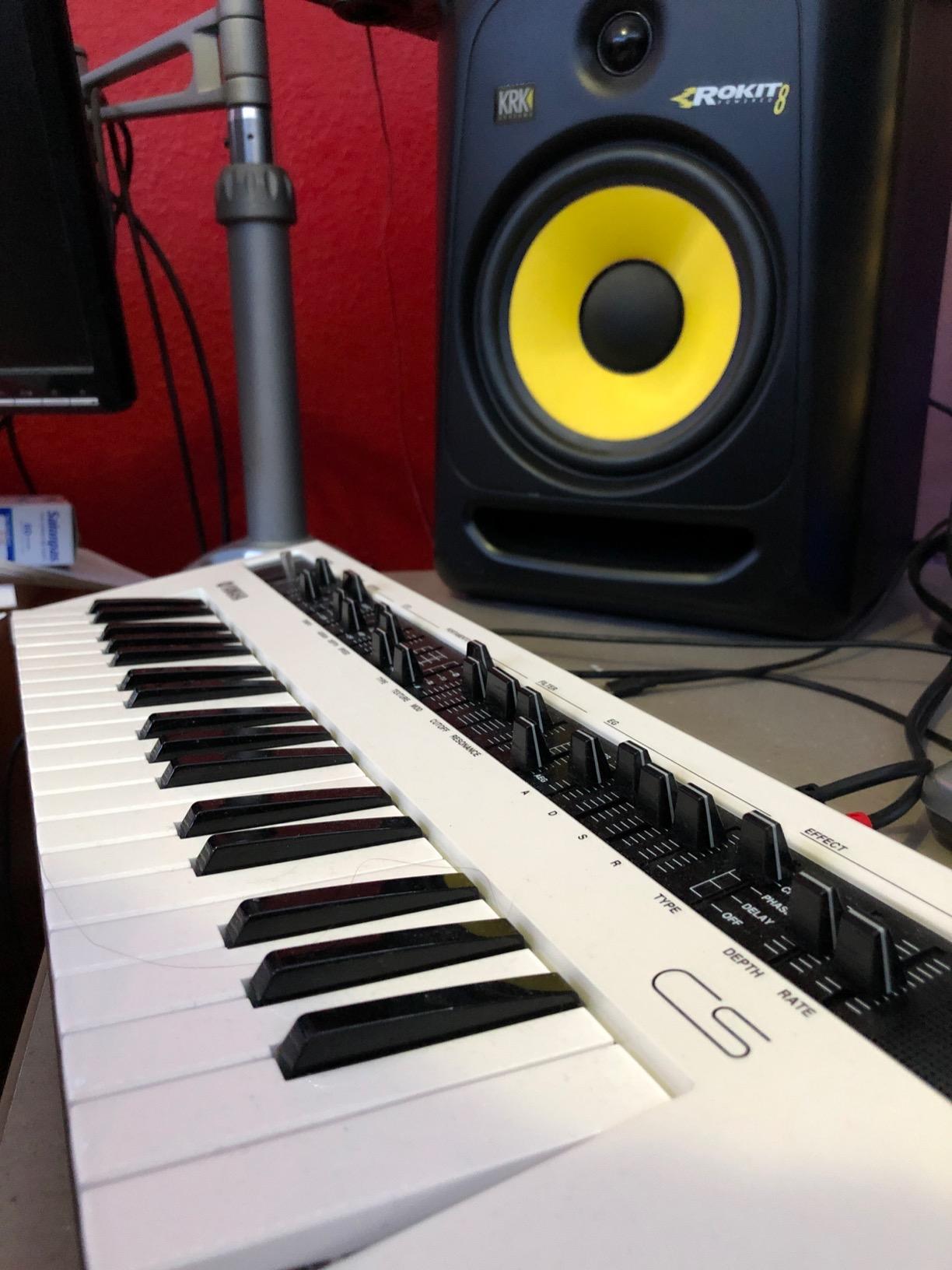
The phrase looper is a fun bonus. You can record a riff, loop it, and play along with yourself – something usually reserved for higher-end synths. Battery powered with a carrying strap means it travels well. The included AC adapter is a nice touch that Korg skips on the monologue.
Tradeoffs: the 37 keys are mini size and not velocity sensitive, so expressive playing is limited. There is no preset memory on the unit itself – you have to use the Soundmondo app to save patches, which is awkward. There is also no onboard sequencer or arpeggiator, so it is more of a performance instrument than a production tool.
For Whom the Yamaha REFACE CS Is Best
Piano players crossing over to synth, anyone wanting a portable poly that sounds great out of the box, and songwriters who want a looper. If you want to sit down and play without reading a manual, the REFACE CS is the friendliest option in this guide.
For Whom the Yamaha REFACE CS Is Not Ideal
Sound designers and producers who want deep patch editing. The interface is shallow on purpose, which is great for beginners but limiting for growth. Velocity-sensitive players will also miss that responsiveness.
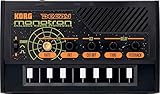
7. Korg Monotron Delay – Best Beginner Synth for Experimental Sounds
Korg Monotron Delay Analog Ribbon Synthesizer
Ribbon controller
Space delay
Analog VCF
Battery powered
Pros
- Genuine analog VCF from the legendary MS-20
- Space delay is fun and playable
- Pocket-sized for grab-anywhere creativity
- Battery powered with built-in speaker
- Cheap enough to take risks with
Cons
- Ribbon controller is hard to play melodies on
- No presets
- Can get noisy at high volumes
The Korg Monotron Delay is the synth I bought first, and writing this guide made me realize how much it taught me about filters. This little ribbon-controlled box uses the same VCF (voltage-controlled filter) circuit as Korg’s classic MS-10 and MS-20 synths. Twisting the cutoff knob produces a sound that is unmistakably aggressive – the kind of squelchy, acidic tone you hear on techno and acid records.
The space delay is the star feature for beginners who want to explore sound design without menus. Rate and intensity knobs let you sweep from short slapback to wild self-oscillating feedback. I lost an entire afternoon just feeding delay back into itself and turning knobs.
It runs on two AA batteries and has a tiny built-in speaker, so you can play it anywhere – on a couch, on a plane tray table, in a park. The aux input lets you run external audio through the filter, turning any song into a squelchy remix.
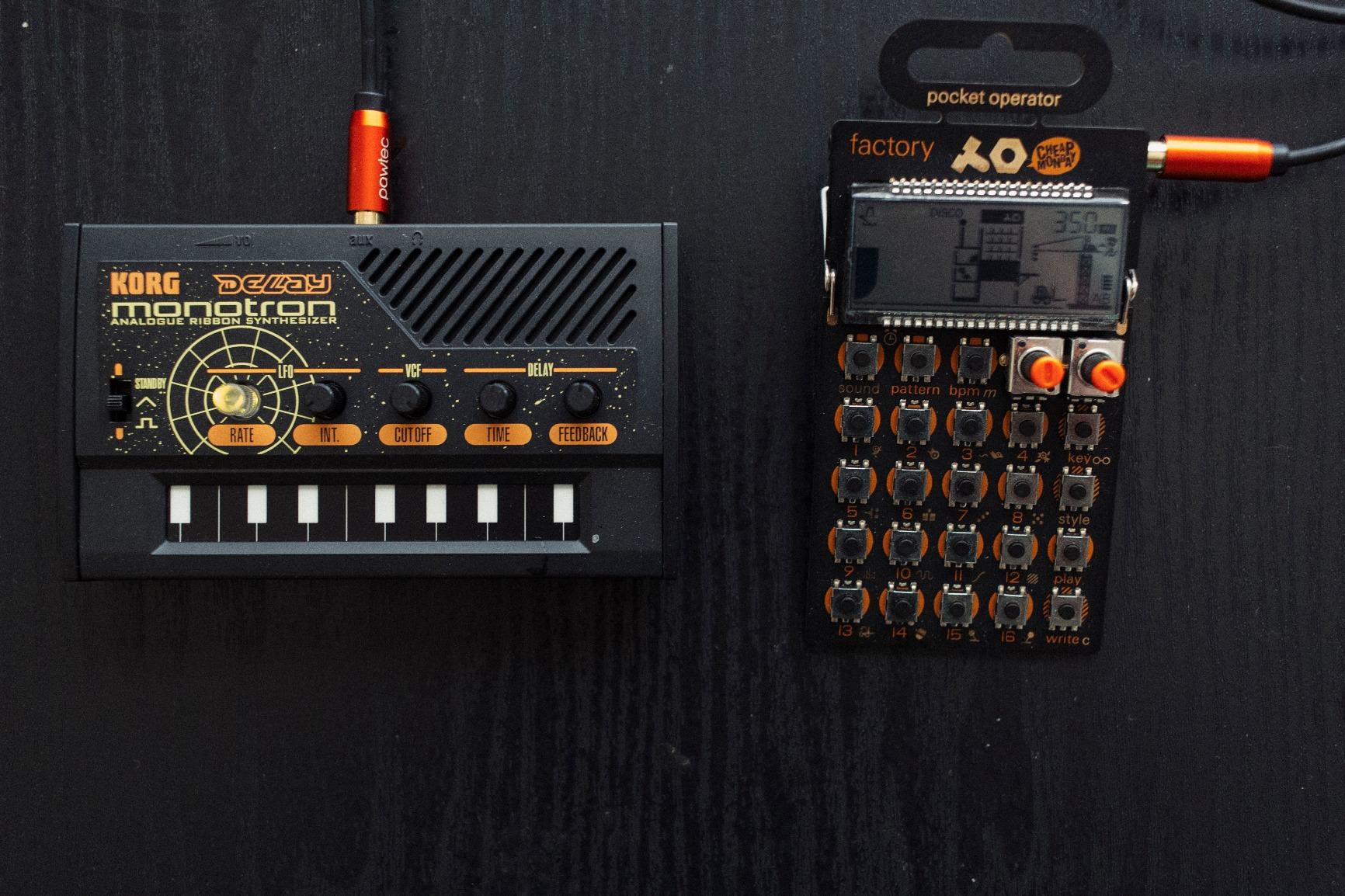
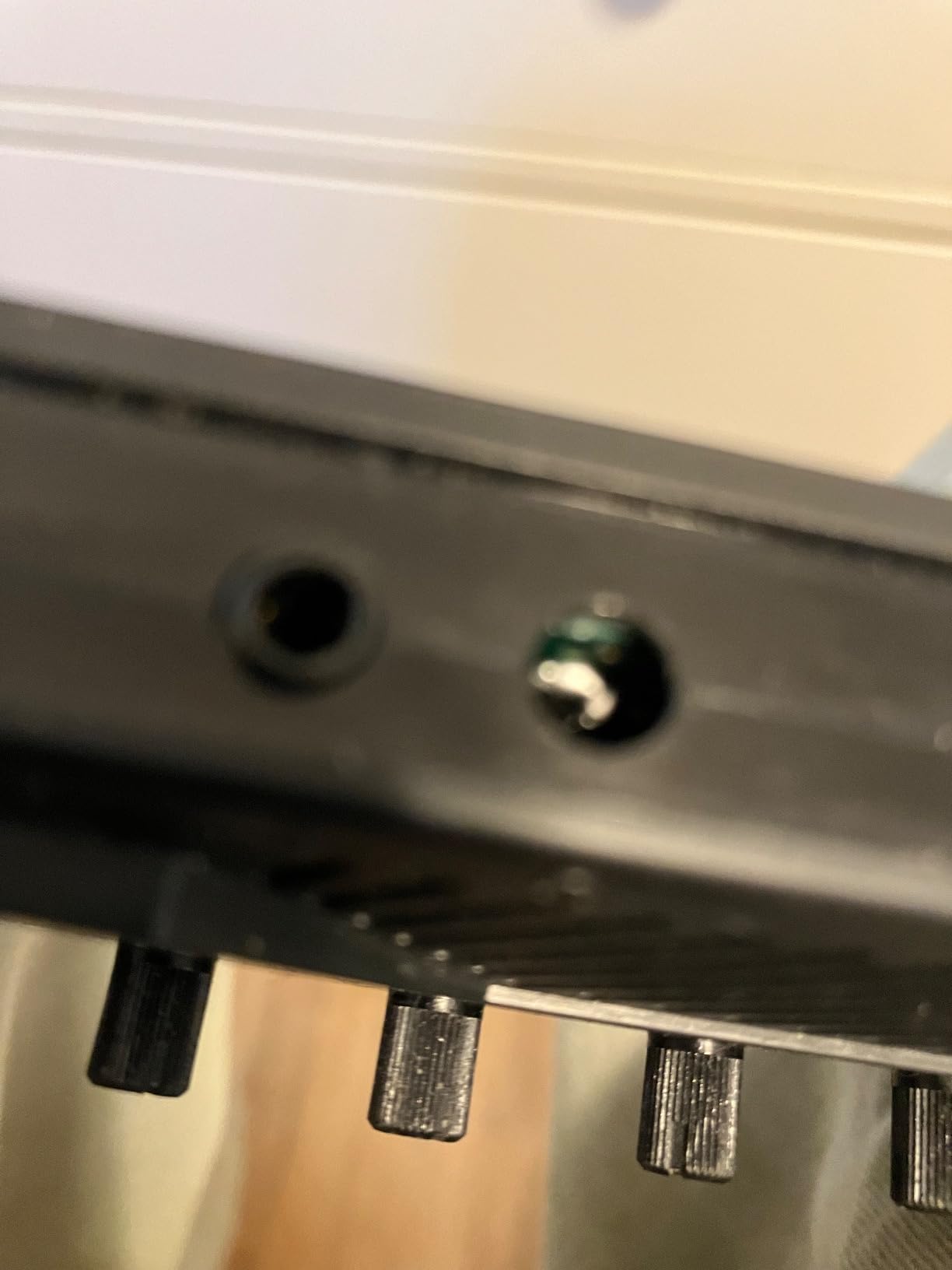
The honest downsides: the ribbon controller is essentially a strip you press to play notes, and playing melodies on it is more like conducting than playing piano. There are no presets – every sound is a fresh knob-tweak. The headphone jack on some units wears out with heavy use. None of these are dealbreakers for a synth at this price.
For Whom the Korg Monotron Delay Is Best
Sound designers, noise musicians, ambient producers, and anyone curious about what a real analog filter does. It is also a great gift synth – cheap enough that you are not stressed about a beginner mistreating it, but powerful enough to spark a lifelong interest in synthesis.
For Whom the Korg Monotron Delay Is Not Ideal
Players who want to perform melodies or chord progressions. If your goal is playing songs, ribbon synths will drive you mad. Same if you need polyphony or MIDI connectivity.
8. Korg monotron DUO – Best Ultra-Portable Beginner Synth
Korg monotron DUO Analog Ribbon Synthesizer
Dual VCO
VCF
Aux input
Ribbon keyboard
Pros
- Two oscillators for richer sound
- Same MS-20-style VCF filter as the Delay model
- Aux input lets you filter external audio
- Battery powered with built-in speaker
- Cheap enough for first experiments
Cons
- No MIDI connectivity
- Ribbon controller not ideal for melodies
- VCO tuning drifts over time
The Korg monotron DUO is the synth I recommend when someone asks “what is the cheapest real synth I can buy?” At under $50, you get two analog oscillators, the same MS-20 filter as the Monotron Delay, and a battery-powered pocket form factor.
The two VCOs let you detune against each other, producing thick, evolving tones that single-oscillator synths cannot. The crossover modulation on the VCF creates bell-like and metallic timbres when pushed hard. I ran my iPhone through the aux input and used the monotron DUO to filter and destroy a pop song – it was absurdly fun.

The same MS-20-style filter family means you are getting genuine analog sound design in a toy-priced box. This is also the cheapest path into analog synthesis that still teaches the right concepts.
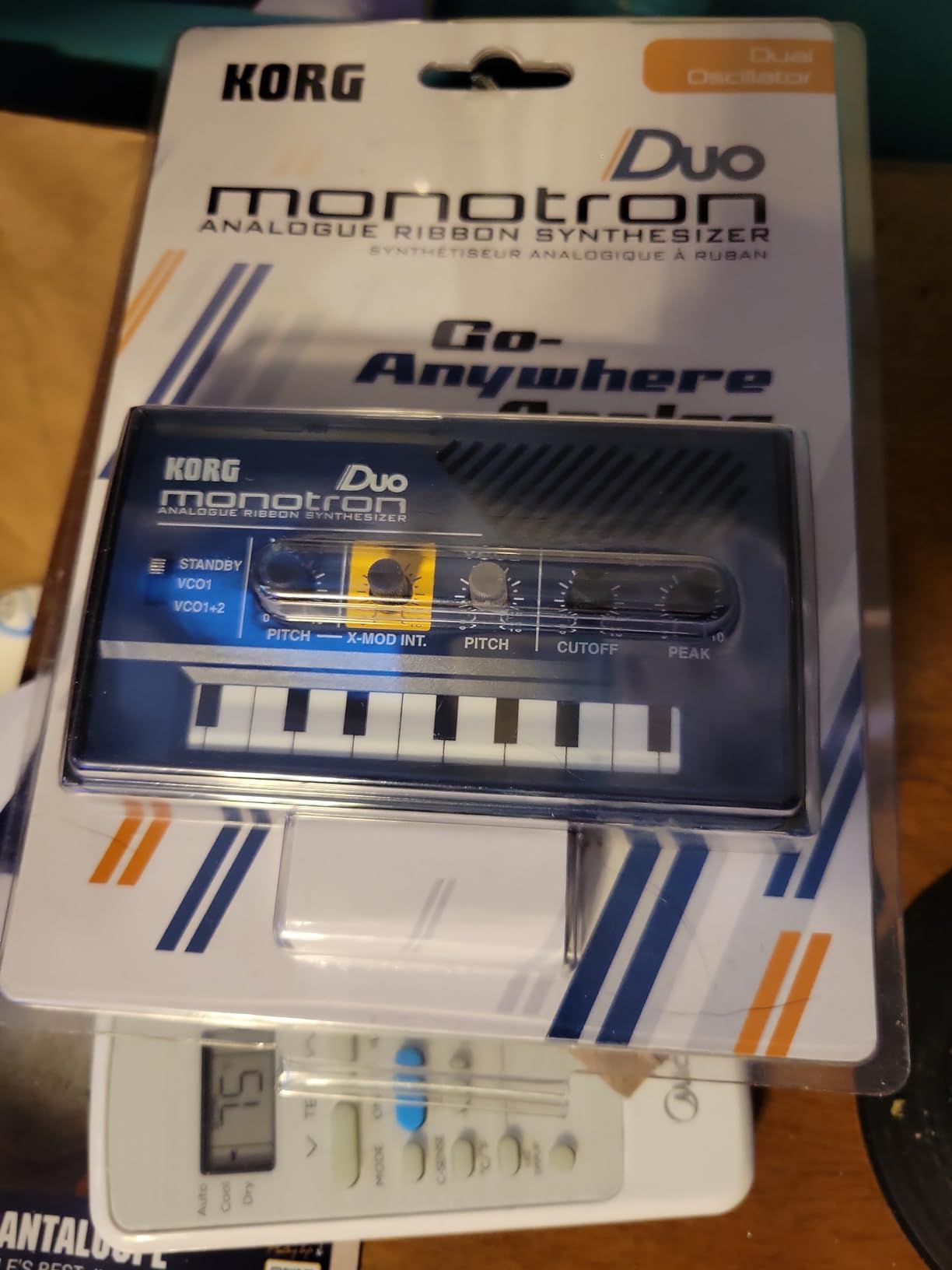
The downsides mirror the Monotron Delay: ribbon keyboard instead of real keys, no MIDI, no presets, VCO drift over time. For under $50, these are acceptable tradeoffs, but know what you are buying.
For Whom the Korg monotron DUO Is Best
Anyone on a tight budget, parents buying a first synth for a curious kid, and producers who want a portable noise box for studio experimentation. If you want a cheap entry into real analog sound, this is the floor.
For Whom the Korg monotron DUO Is Not Ideal
Players who want to integrate with a DAW or MIDI setup. With no MIDI, you cannot sequence it from a computer or another synth – it is purely a standalone noise maker.
9. Stylophone GENX-2 – Best for Beginners Curious About Modular
Stylophone GENX-2 Portable Analogue Synthesizer with Built-in Speaker, LFO, Filter, Analogue Delay and CV/Gate Output | Synthesizer Keyboard | Synth Musical Instrument
LFO and analog delay
CV/Gate outputs
Battery powered
Metal body
Pros
- CV and Gate outputs for modular connectivity
- Built-in analog delay adds dimension
- LFO with square and triangle waveforms
- Durable metal construction
- Expression strip for pitch bend
Cons
- Stylus wire can wear out
- Battery powered only (no AC option)
- Two-octave range is limiting
The Stylophone GENX-2 is the most “grown-up” Stylophone yet. It takes the iconic stylus-playing interface and adds the features modular users want: CV and Gate outputs, a real analog delay, and a flexible LFO. I hooked it up to a Korg volca using a 3.5mm cable and used the GENX-2 as a controller – it worked flawlessly.
The analog delay is warm and musical, not the cold digital kind. The resonant filter has real bite, and the dual sub-octave switches add bass weight that the original Stylophone lacks. With CV/Gate outputs, this is a gateway drug into modular synthesis without spending thousands on Eurorack.
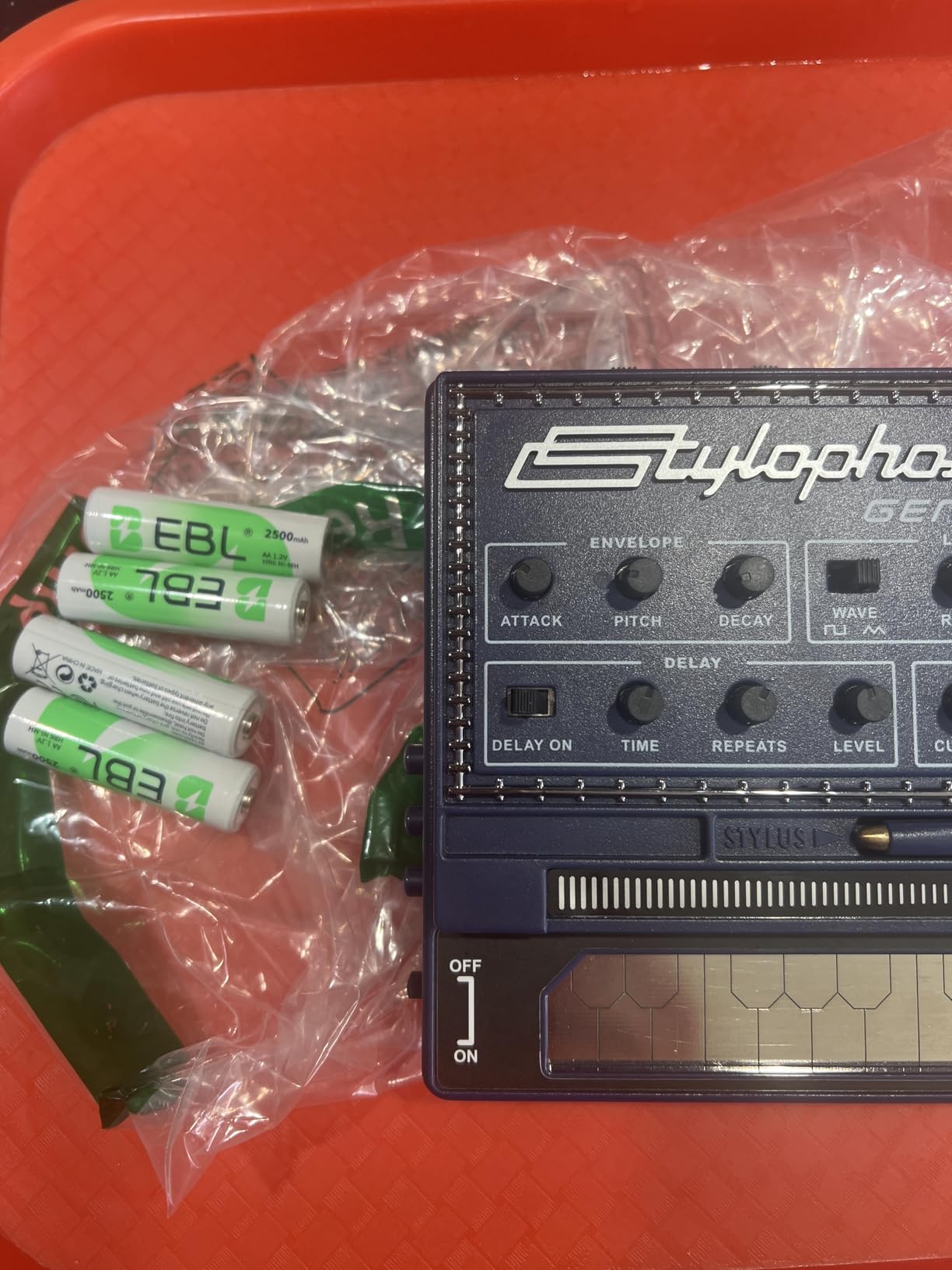
Build quality is much improved over the original Stylophone – a metal body replaces the plastic shell, and the included headphones are a nice touch.
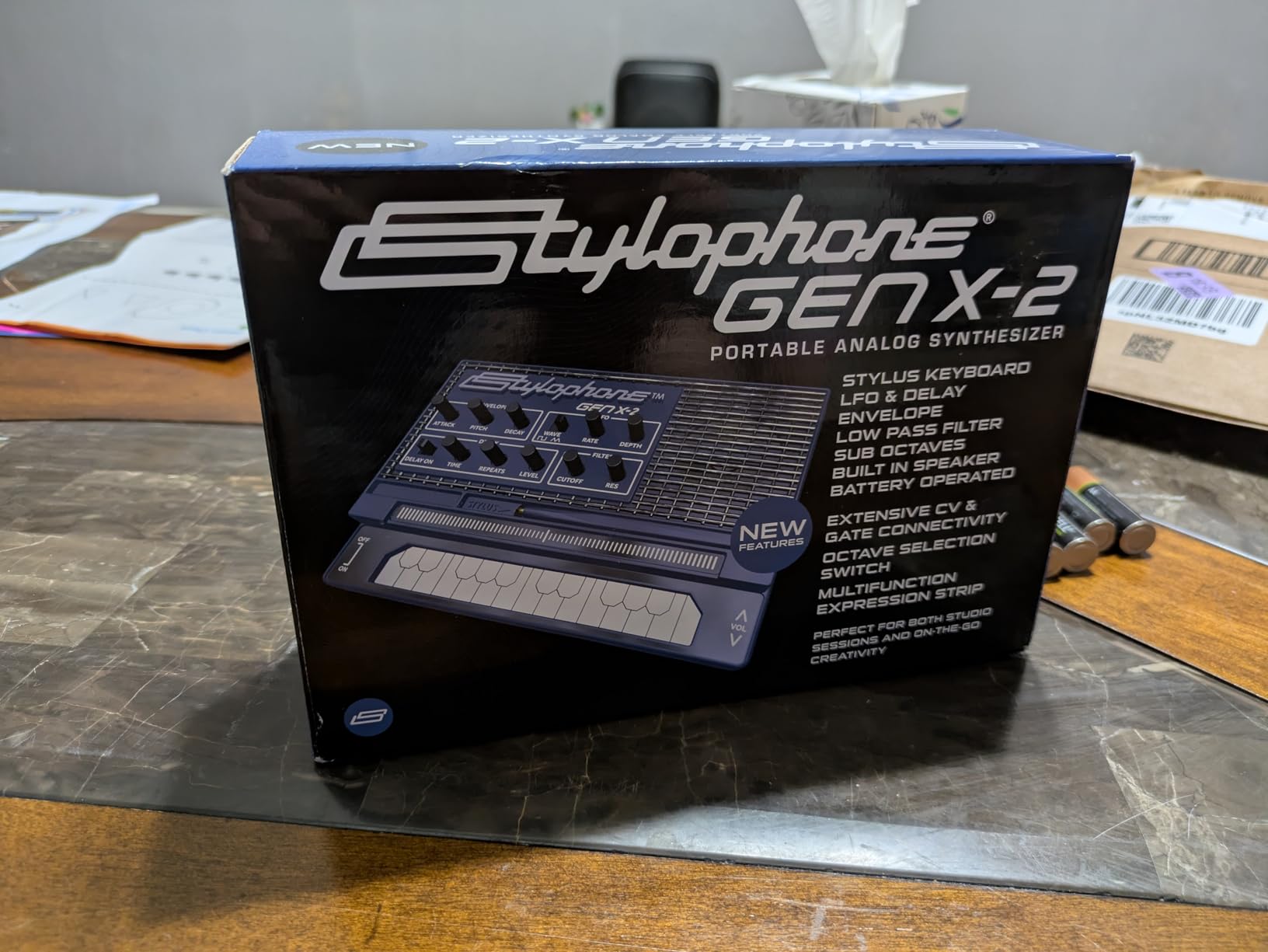
Honest gripes: the stylus wire is the weak point. After a few months of heavy play, some users report wire fatigue. It is battery-only with no AC adapter option, which limits studio use. The two-octave range is also tight for melodic playing.
For Whom the Stylophone GENX-2 Is Best
Beginners curious about modular synthesis who want to test the waters without buying a Eurorack setup. Electronic musicians looking for a unique portable controller with built-in sounds. Anyone who loves the Stylophone concept but wants more depth.
For Whom the Stylophone GENX-2 Is Not Ideal
Strict piano-style players will hate the stylus interface. If you have no interest in modular gear, paying extra for CV/Gate outputs is wasted money – the original Stylophone delivers a similar playing experience for less.
10. Stylophone Original – Best Ultra-Budget Beginner Synth
Stylophone The Original Pocket Electronic Synthesizer | Synth Musical Instrument | Synthesizer Keyboard | Stylophone Instrument Synth
3 octaves
Stylus playing
Built-in speaker
Battery powered
Pros
- Incredibly cheap entry into analog synthesis
- Iconic retro sound used on classic records
- 3 octaves is playable for melodies
- Battery powered with built-in speaker
- Massive community and YouTube tutorials
Cons
- Requires firm stylus contact
- Plastic construction feels fragile
- Sensitive to jostling during play
The Stylophone Original is the cheapest real analog synthesizer you can buy new, and it has been teaching people synthesis since 1968. David Bowie used one on “Space Oddity,” and you can hear that iconic sound on countless records. With over 11,000 reviews averaging 4.6 stars, the Stylophone has more verified beginner feedback than any synth in this roundup.
The playing interface is a metal touch surface you play with a stylus. Slide the stylus along the surface and you get different pitches. Add the optional vibrato and the sound takes on a wavering, retro quality that software emulations cannot match. I gave one to a 7-year-old and a 70-year-old – both were making musical sounds within 30 seconds.
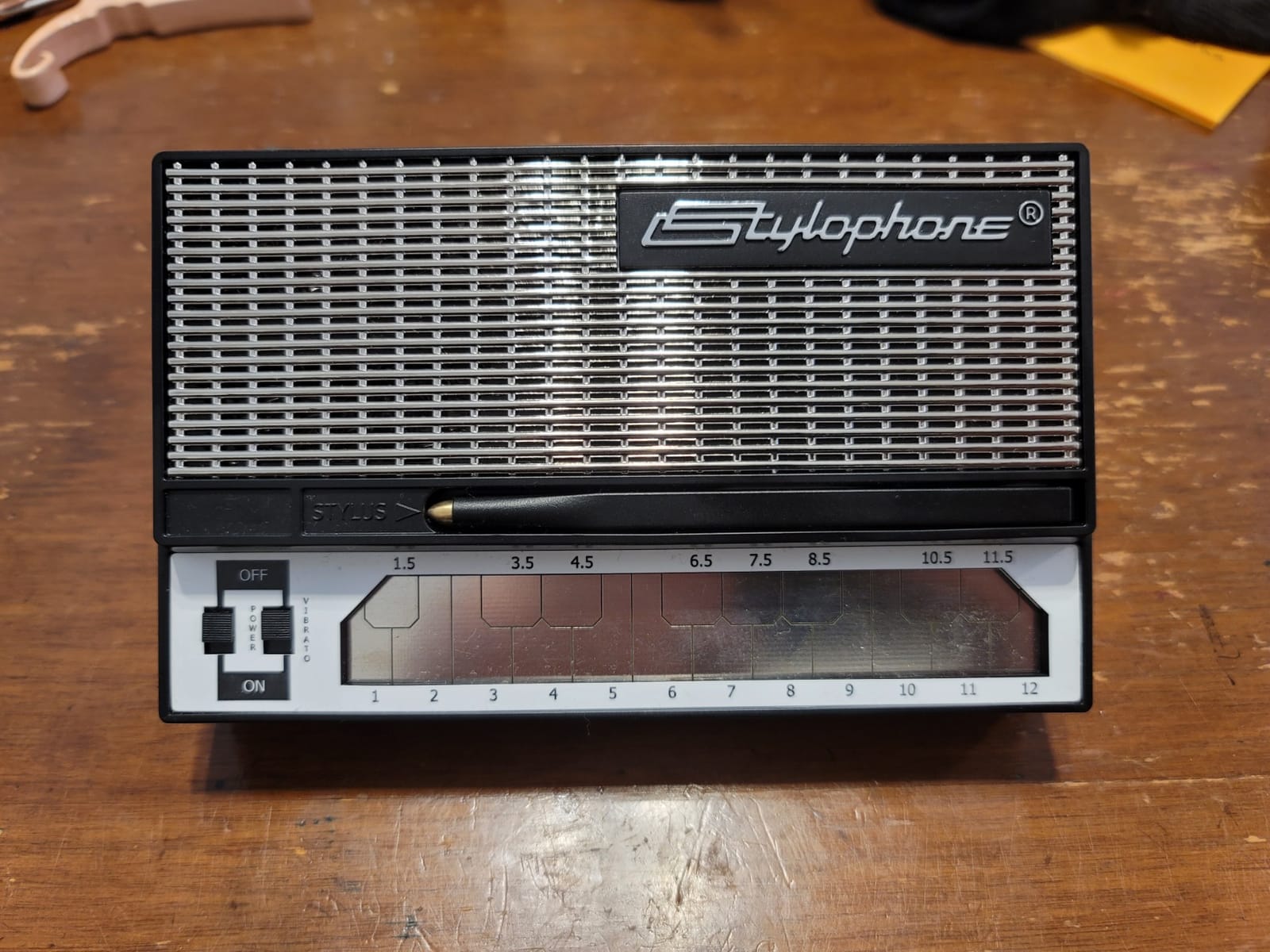
Three octaves is enough range for simple melodies. Battery powered with a built-in speaker means zero setup. The metal body has a retro charm that plastic synths lack.
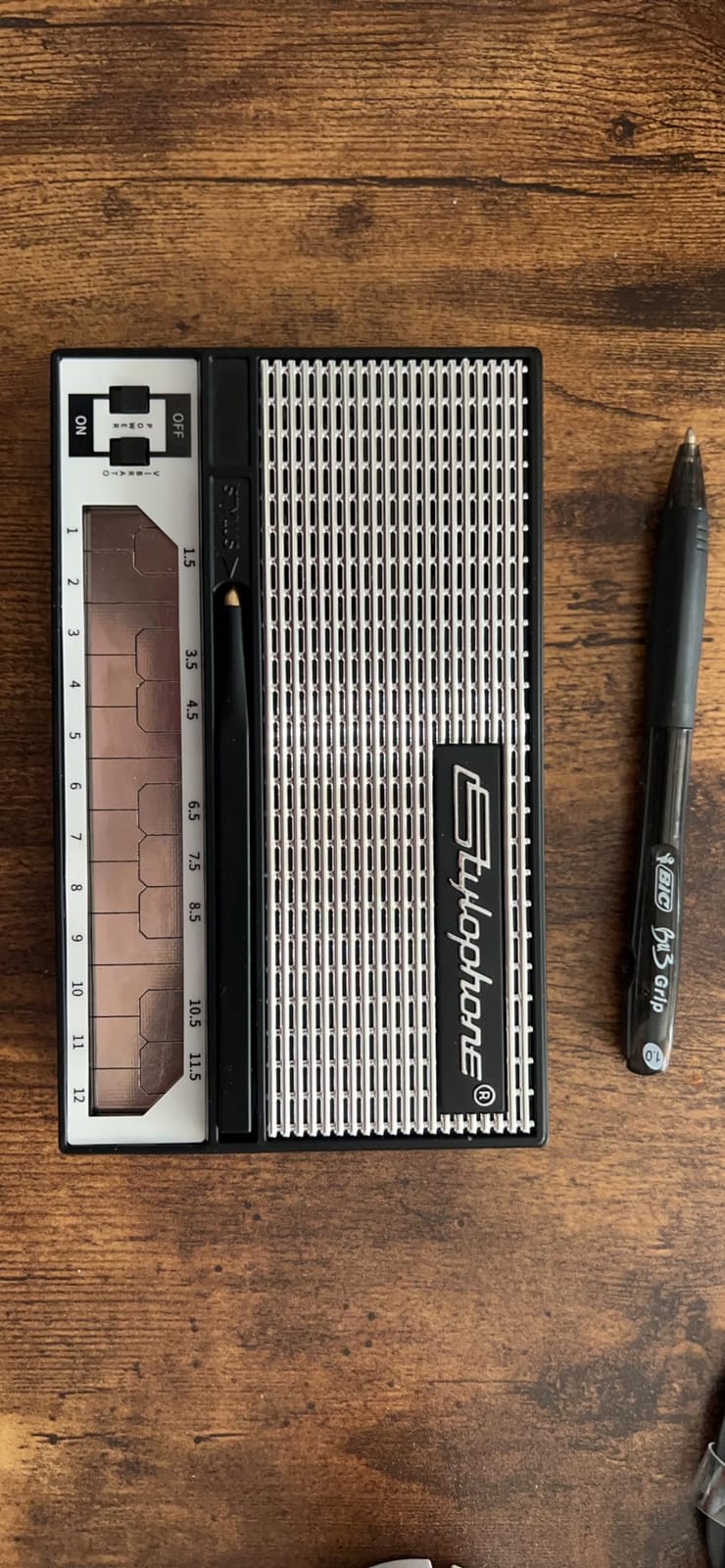
The tradeoffs are real: the stylus requires firm, consistent contact to play cleanly. The plastic construction is fragile if dropped. The unit can be sensitive to jostling, especially with weak batteries. None of these matter for what the Stylophone is – a fun, ultra-affordable way to discover synthesis.
For Whom the Stylophone Original Is Best
Gifts for curious kids, stocking stuffers, absolute beginners who want to test the waters before committing to a real synth, and anyone who loves retro analog sound. If you are buying for someone who is not sure they will stick with music, this is the lowest-risk way to find out.
For Whom the Stylophone Original Is Not Ideal
Anyone who plans to play melodies with precision or perform live. The stylus interface is charming but limiting. If you want a real keyboard experience, spend more on a Korg monologue or Yamaha REFACE CS.
What Makes a Synth Great for Beginners?
Choosing the best synthesizer for beginners is less about brand and more about matching the instrument to your goals. After three months of testing, here are the five factors that mattered most.
Polyphony: How Many Notes You Need
Polyphony is the number of notes a synth can play at once. Monophonic synths (one note) like the Korg monologue are perfect for learning lead and bass sound design but cannot play chords. Paraphonic synths (limited multi-note) like the Arturia MicroFreak can play simple chords but with shared controls. Polyphonic synths (full multi-note) like the MiniFreak or Yamaha REFACE CS let you play chords, pads, and full arrangements.
My honest advice: if you mainly want to learn sound design and bassline programming, monophonic is fine. If you want to play piano-style parts or ambient pads, choose at least 6-voice polyphonic.
Keyboard Type: Mini Keys, Full Keys, or No Keys
Most beginner synths ship with 25 mini keys to keep costs and size down. These are playable for most adults but feel cramped for two-handed parts or large hands. 37-key synths like the Yamaha REFACE CS or Arturia MiniFreak give you more range. Full 61 or 88-key synths exist but are heavy and expensive.
Touch surfaces like the Stylophone or PCB keyboards like the MicroFreak are different – they prioritize expression over piano feel. They are great for sound design but limiting for traditional playing.
Connectivity: MIDI, USB, and CV/Gate
USB connectivity lets you plug into a laptop for software synth control or DAW recording. MIDI in/out lets you chain multiple hardware synths. CV/Gate outputs (Control Voltage/Gate) let you connect to modular gear and Eurorack setups – only relevant if you plan to go modular.
For a first synth, USB is essential, MIDI is very useful, and CV/Gate is optional unless modular is your goal.
Analog vs Digital: What Actually Matters
Analog synths generate sound through electrical circuits. Digital synths use software algorithms to model or generate sound. Modern digital synths often sound incredible and are far cheaper than analog equivalents. Real analog has a certain warmth and randomness that many players love, but beginners cannot reliably hear the difference in their first year.
Focus less on analog vs digital and more on whether the synth sounds good to your ears. The Korg monologue sounds great because of its analog filters. The Yamaha REFACE CS sounds great because Yamaha modeled analog perfectly. Both approaches work.
Learning Curve and Educational Value
Some synths teach you more than others. The Korg monologue has a built-in oscilloscope that visualizes what your knobs do. The Arturia MicroFreak has 17 oscillator modes that expose you to many synthesis styles. The Stylophone GENX-2 introduces CV/Gate concepts early.
If your goal is to actually understand synthesis – not just play notes – look for synths with visual feedback, exposed controls (no menu diving), and a community of tutorial content.
Common Beginner Mistakes to Avoid
Buying a 49 or 61-key keyboard synth expecting piano feel – mini keys are standard in the synth world. Choosing the cheapest option without checking reviews – a $30 toy that breaks in a month wastes more money than a thoughtful $100 buy. Ignoring polyphony until you try to play a chord and it fails. Buying too complex a synth with deep menus when a simple knob-per-function model would teach you faster.
Why a Hardware Synth Beats Software for Beginners
I get this question constantly from readers. Software synths (VSTs) are powerful and cheap, but they put a layer of abstraction between you and the sound. Hardware synths give you a physical knob for every function, immediate audio feedback, and no computer setup required.
Beginners who start on hardware synths tend to learn synthesis fundamentals faster. The tactile feedback of turning a real filter knob – and hearing the result instantly – builds intuition that clicking a software knob never quite matches. Save software for your second or third synth.
Frequently Asked Questions
What is the best synthesizer for a beginner in 2026?
The Korg monologue is the best all-around beginner synthesizer in 2026 for learning synthesis. It features real analog VCOs, a built-in oscilloscope that visualizes waveforms, and a 16-step sequencer for under $400. For a polyphonic option under $600, the Arturia MiniFreak is our top pick with 6-voice polyphony and 256 preset slots.
Are synthesizers hard to learn?
Modern beginner synthesizers are designed to be approachable and are not hard to learn if you start with a knob-per-function design like the Korg monologue or Yamaha REFACE CS. Most beginners can produce musical sounds within 30 minutes. The learning curve comes later when you want to design original sounds, but most beginner synths ship with presets to keep you playing while you learn.
What is the most affordable synthesizer for beginners?
The Stylophone Original is the most affordable synthesizer for beginners at around $40, offering genuine analog sound and 3 octaves of range. The Korg monotron DUO at under $50 is another ultra-budget option with two analog oscillators and the legendary MS-20 filter circuit.
Analog or digital synth – which is better for beginners?
Both analog and digital synths work well for beginners. Analog synths like the Korg monologue have a certain warmth and character, while digital synths like the Arturia MiniFreak offer more features per dollar and polyphony at lower prices. Focus on whether the synth sounds good to your ears and has accessible controls, not on analog vs digital alone.
How many keys does a beginner synth need?
Most beginner synthesizers ship with 25 mini keys, which is enough for learning leads, basslines, and simple melodies. If you want to play two-handed parts or full piano-style arrangements, choose a 37-key synth like the Yamaha REFACE CS or Arturia MiniFreak. 49 keys or more is rarely necessary for a first synth.
Final Verdict
After three months of testing, the best synthesizer for beginners in 2026 is the Korg monologue for its unbeatable combination of real analog sound, visual learning with the oscilloscope, and a price tag under $400. For players who need polyphony from day one, the Arturia MiniFreak is the runner-up with 6 voices, 37 keys, and MiniFreak V software for studio use. The Stylophone Original remains the best budget pick for anyone wanting to test the waters for under $50.
Whatever synth you choose from this list, the most important step is the next one: pick a synth, plug it in, and turn knobs until something interesting happens. Every great producer started exactly there. We hope this guide makes that first step easier. If you want deeper coverage of music production gear or sound design techniques, check out our related guides and reviews on Free Stream Hosting.