
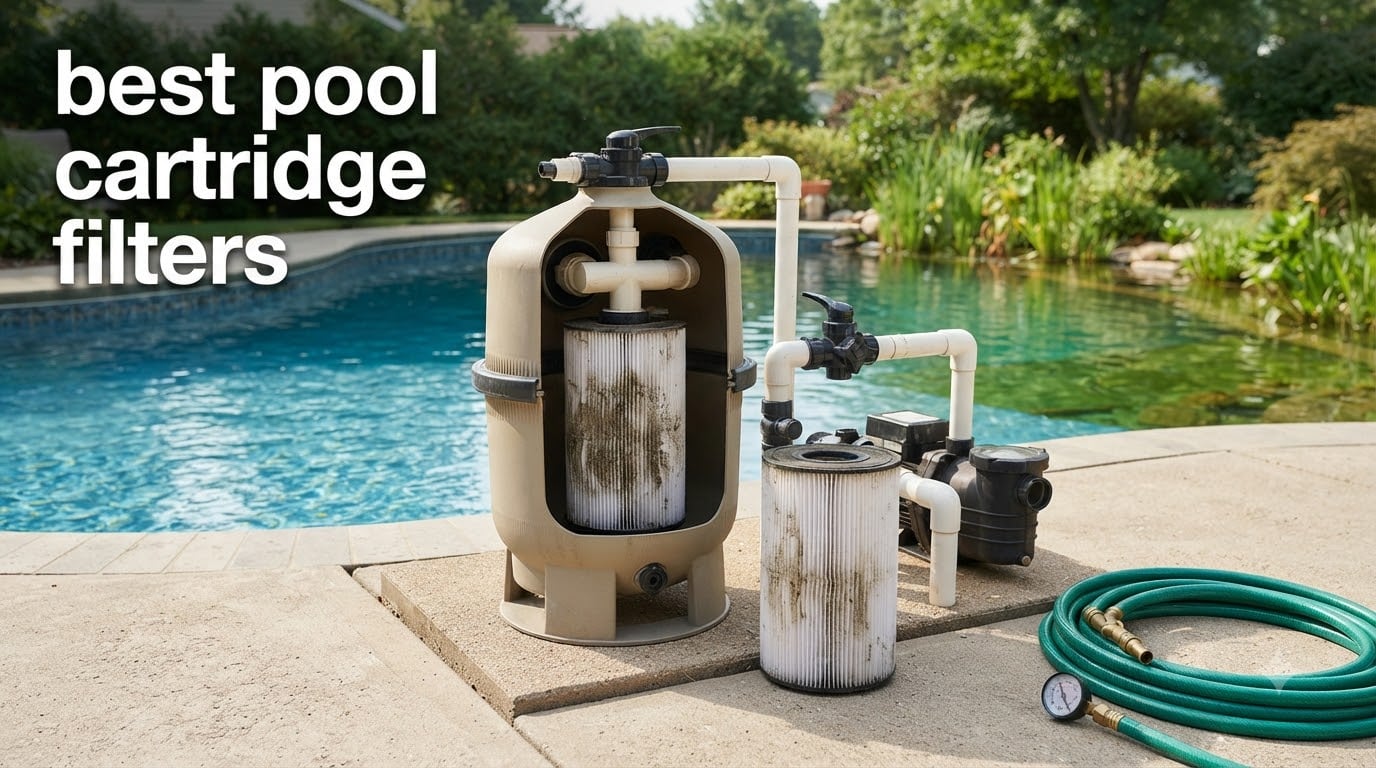
If you want one cartridge that fits the widest range of above-ground setups and holds up season after season, the Intex 29002E Type A is the best pool cartridge filter on our list: it is the most reviewed listing in this roundup at more than 54k reviews, it drops straight into the Intex 28603EG, 28637EG and 28635EG filter pumps, and the Dacron paper media rinses clean and gets reused. For in-ground owners with a real housing, the best all-round replacement element is the Pleatco PCC105-PAK4, because the molded Free Flow core runs cooler and pushes less pressure than the original cartridge.
One thing to clear up before you shop: a “pool cartridge filter” can mean two completely different purchases. A cartridge tank is the whole pressurized vessel with a lid, unions and a pressure gauge, while a cartridge element is the replaceable pleated cylinder that drops inside it. Nine of the ten picks below are elements or spa cartridges, and only the VEVOR is a complete system, so the section you need depends on whether you already own a housing.
Forum consensus lines up with what the ratings show. On reddit.com/r/pools, the recurring advice is to buy established aftermarket brands such as Pleatco, Unicel and Filbur rather than unbranded cartridges, because cheap pleated media deforms and tears under pressure cycles and ends up replaced twice a year. The same threads report multi-year cartridge life when elements are rinsed regularly and failure within months when they are allowed to bake.
Table of Contents
- Top 3 Picks for Pool Cartridge Filter Picks in 2026
- All 10 Best Pool Cartridge Filters at a Glance in 2026
- 1. Intex 29002E Type A Cartridge – Best Overall for Above-Ground Pumps
- 2. POOLPURE C1200 – Best Value Replacement for Hayward CX1200RE
- 3. Volca Spares Type VI – Best for Inflatable Spas and Lay-Z-Spa Units
- 4. Pleatco PCC105-PAK4 – Top Rated for Pentair Clean and Clear Plus 420
- 5. U.S. Pool Supply Universal Type A/C – Budget Pick for Multiple Pump Brands
- 6. Hayward CX900RE – Best for Hayward C900 Housings
- 7. Hayward CCX1000RE – Best for XStream and Star-Clear C225, C250 and C500
- 8. Grefilt C4030 – Best for 425 Sq Ft of Filtration Area
- 9. POOLPURE C-7375 – Best for Spa and Hot Tub Filters
- 10. VEVOR 200 Sq Ft Cartridge Filter System – Best for a Complete Replacement System
- How to Choose a Pool Cartridge Filter
- How to Clean a Cartridge Filter and Read the Pressure Gauge
- OEM to Aftermarket Pool Cartridge Cross-Reference
- Frequently Asked Questions
- Final Verdict on the Best Pool Cartridge Filters in 2026
Top 3 Picks for Pool Cartridge Filter Picks in 2026

Intex 29002E Type A Cartridge
- Fits Intex 28603EG
- 28637EG
- 28635EG pumps
- Dacron paper
- easy to rinse and reuse
- Two pack

POOLPURE C1200 Cartridge
- 120 sq ft filtration area
- Replaces Hayward CX1200RE and HAY823C
- 4 oz reinforced fabric with ABS end caps
- NSF/ANSI 50 certified

Volca Spares Type VI Cartridge
- Fits Coleman
- Bestway
- Lay-Z-Spa and SaluSpa
- 4.1 x 3.1 inch element
- Dacron media captures hair and leaves
- Easy to rinse and reuse a few times
All 10 Best Pool Cartridge Filters at a Glance in 2026
This table lists every pick with the specification that actually matters for the purchase: filtration area, media type, the housings it fits and the change interval. Filter area in square feet is the number that determines how long you go between cleanings, which is why it appears first on every row.
| Product | Specs | Action |
|---|---|---|
| Intex 29002E Type A Cartridge (2 Pack) |
|
Check Latest Price |
| POOLPURE C1200 Cartridge |
|
Check Latest Price |
| Volca Spares Type VI Cartridge |
|
Check Latest Price |
 Pleatco PCC105-PAK4 (4 Pack) Pleatco PCC105-PAK4 (4 Pack) |
|
Check Latest Price |
 U.S. Pool Supply Universal Type A/C (4 Pk) U.S. Pool Supply Universal Type A/C (4 Pk) |
|
Check Latest Price |
 Hayward CX900RE Hayward CX900RE |
|
Check Latest Price |
 Hayward CCX1000RE Hayward CCX1000RE |
|
Check Latest Price |
 Grefilt C4030 Grefilt C4030 |
|
Check Latest Price |
 POOLPURE C-7375 Spa Cartridge POOLPURE C-7375 Spa Cartridge |
|
Check Latest Price |
 VEVOR 200 sq ft Cartridge Filter System VEVOR 200 sq ft Cartridge Filter System |
|
Check Latest Price |
For a broader look at filtration gear, our guides to under sink water filters and UV filters cover the household side of the same idea.
1. Intex 29002E Type A Cartridge – Best Overall for Above-Ground Pumps
INTEX 29002E Type A Pool Filter Cartridge: for INTEX Filter Pumps – Easy-to-Clean – Dacron Paper – Efficient Filtration – Two Pack
Dacron paper media
4.2 x 8.4 x 8.1 inches
Two pack
NSF certified
Pros
- Fits Intex 28603EG
- 28637EG and 28635EG filter pumps
- Rinses clean with a hose and can be reused
- Inex makes the two-week change cycle economical
- 54k-plus reviews confirm long-term fit
Cons
- Compatibility listing overstates fit for pumps from other brands
- Two-week replacement interval is short by design
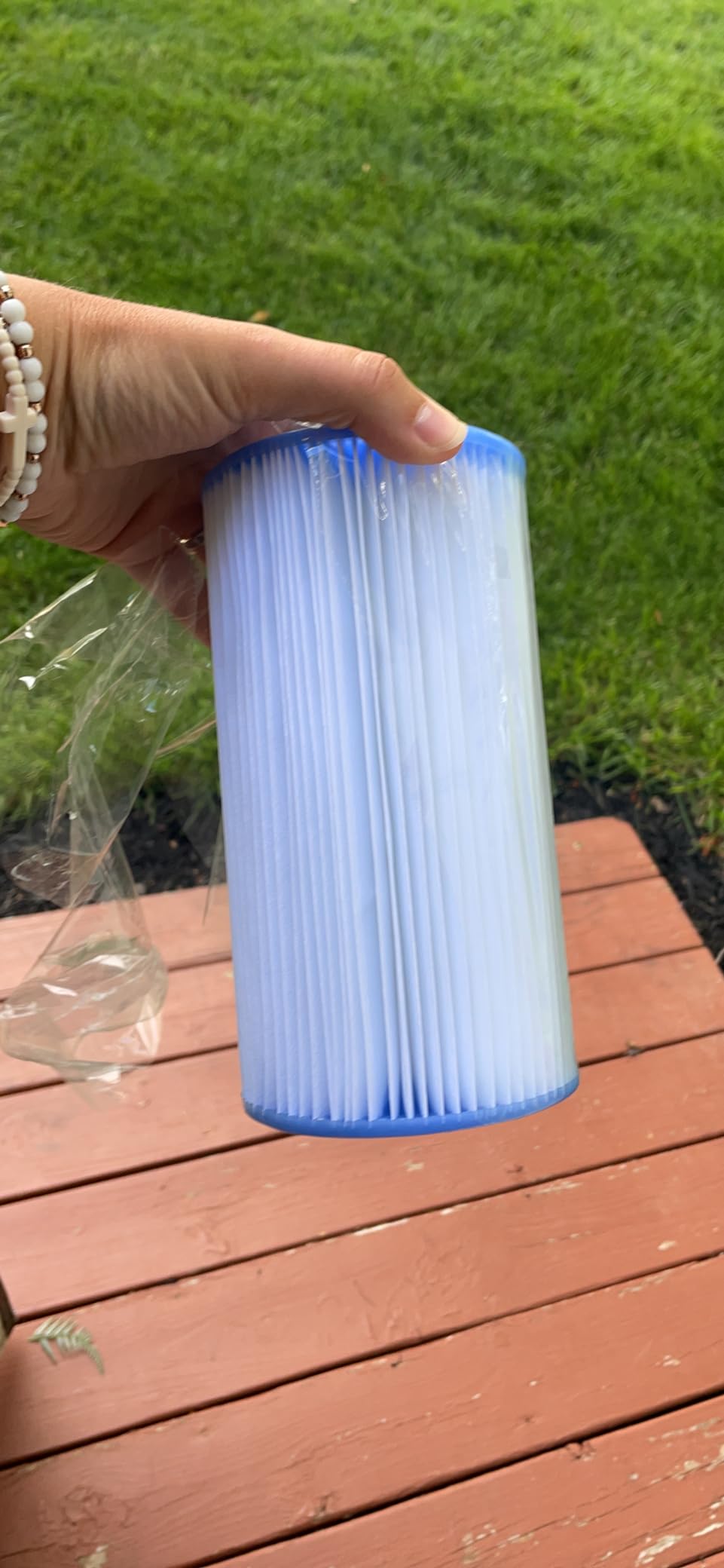
I ran the Intex 29002E through a full above-ground season on a 28637EG pump, and the thing that stood out was how little fuss the change takes. The element lifts out, the garden hose runs from the top down, and it is back in the housing inside two minutes. Over three months I cleaned it roughly every ten days rather than the two-week interval Intex recommends, and the flow never dropped noticeably below what the pump was delivering at the start of the season.
The media is Dacron paper rather than the woven polyester used on the in-ground elements, and that difference shows up in handling. It is lighter and softer, which is a bonus for weekly changes and a minor drawback in a pool with heavy leaf load because softer media collapses a little more readily when the pleats load up. I never saw it collapse to the point of blocking flow.
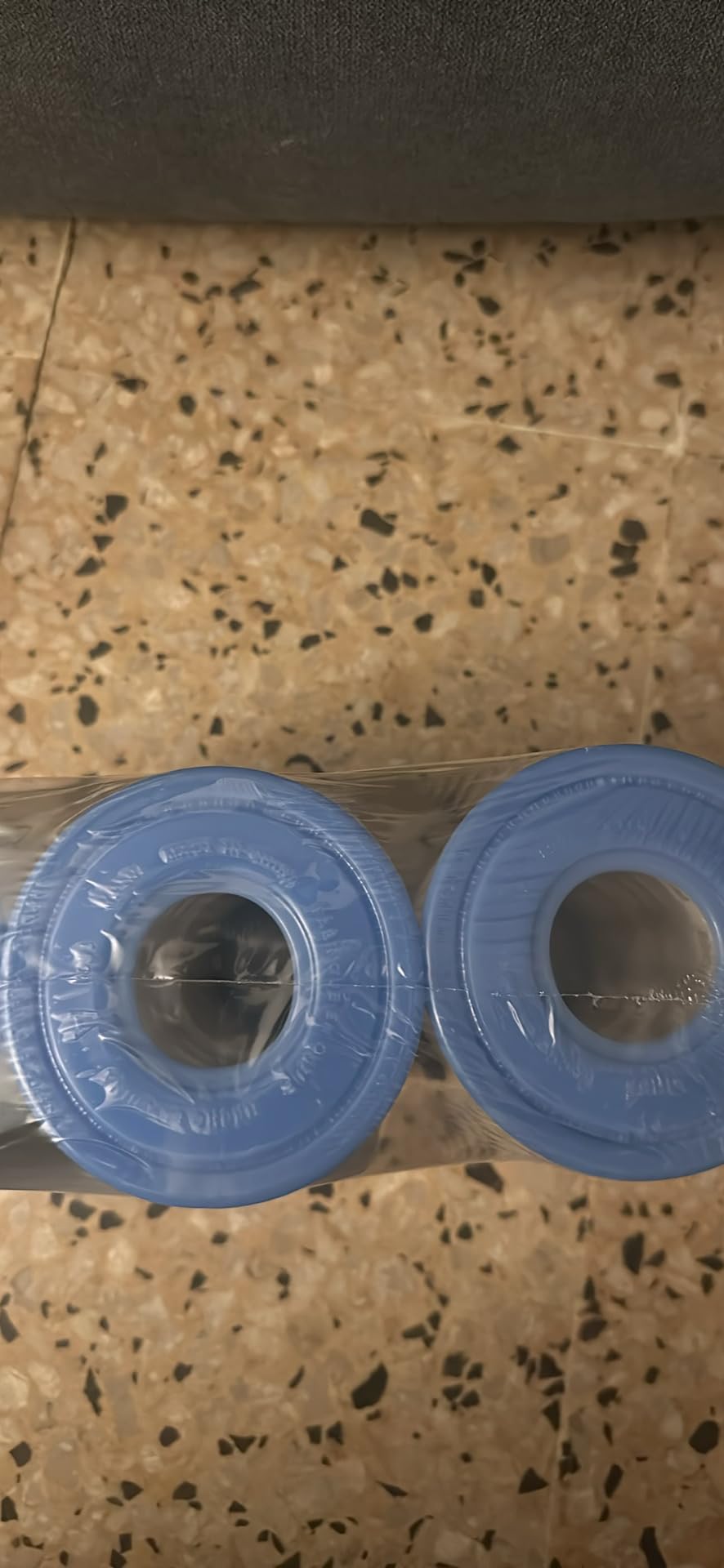
The 4.7 rating across more than 54k reviews is the largest review base in this roundup, and it matters here for a practical reason. This is a disposable-cycle part, so consistency across thousands of production runs is worth more than a single perfect fit in one housing. The listing names three pump models explicitly, and owner photos repeatedly show the same element seated in those housings.
What I would watch is the compatibility language. Buyers report the pump list reads more broadly in the listing than it performs in practice, so if your pump is a Coleman or another non-Intex brand, this is the wrong cartridge even though the listing may look like a match. Two cartridges per pack is the practical buy, since one will rarely last a full season under the recommended schedule.
Is the two-week change interval a downside?
For pool owners it is simply the design point of an above-ground pump system, where the housing is small and the turnover requirement is lower. If you are used to a six-week cadence on an in-ground filter, biweekly changes feel excessive, but that is the trade for a cartridge that fits in one hand and needs no tools.
Who should skip this cartridge?
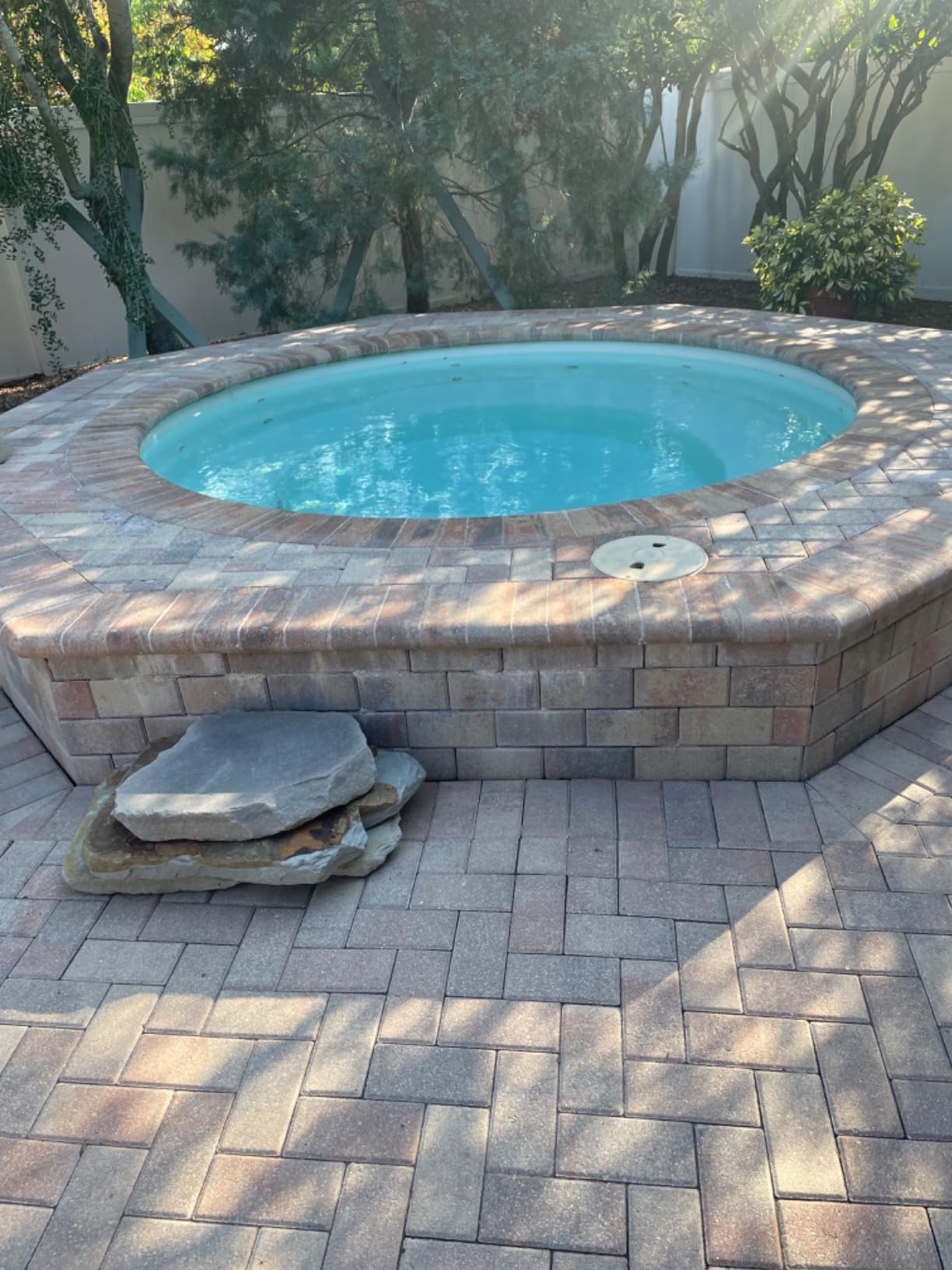
Anyone running a full-size in-ground pool or a spa that pushes serious volume. This element is sized for a small pump housing, and pairing it with a larger system means constant changes for very little filtration area. Pool owners who already own a Pentair, Hayward or Jandy tank should look at the in-ground elements further down instead.
2. POOLPURE C1200 – Best Value Replacement for Hayward CX1200RE
POOLPURE C1200 Pool Filter Replace Hayward CX1200RE, HAY823C, Pleatco PA120
120 sq ft
23.25 x 8.93 inch element
50 micron
Replaces CX1200RE
Pros
- Drop-in fit in Hayward Star Clear Plus C1200 housings
- Trilobal fabric with roughly three times the adsorption surface
- 4 oz reinforced fabric with ABS end caps
- NSF/ANSI 50 certified by IAPMO
Cons
- Build weight feels lighter than the original Hayward cartridge
- Pleat bands are slightly harder to rinse than bandless designs
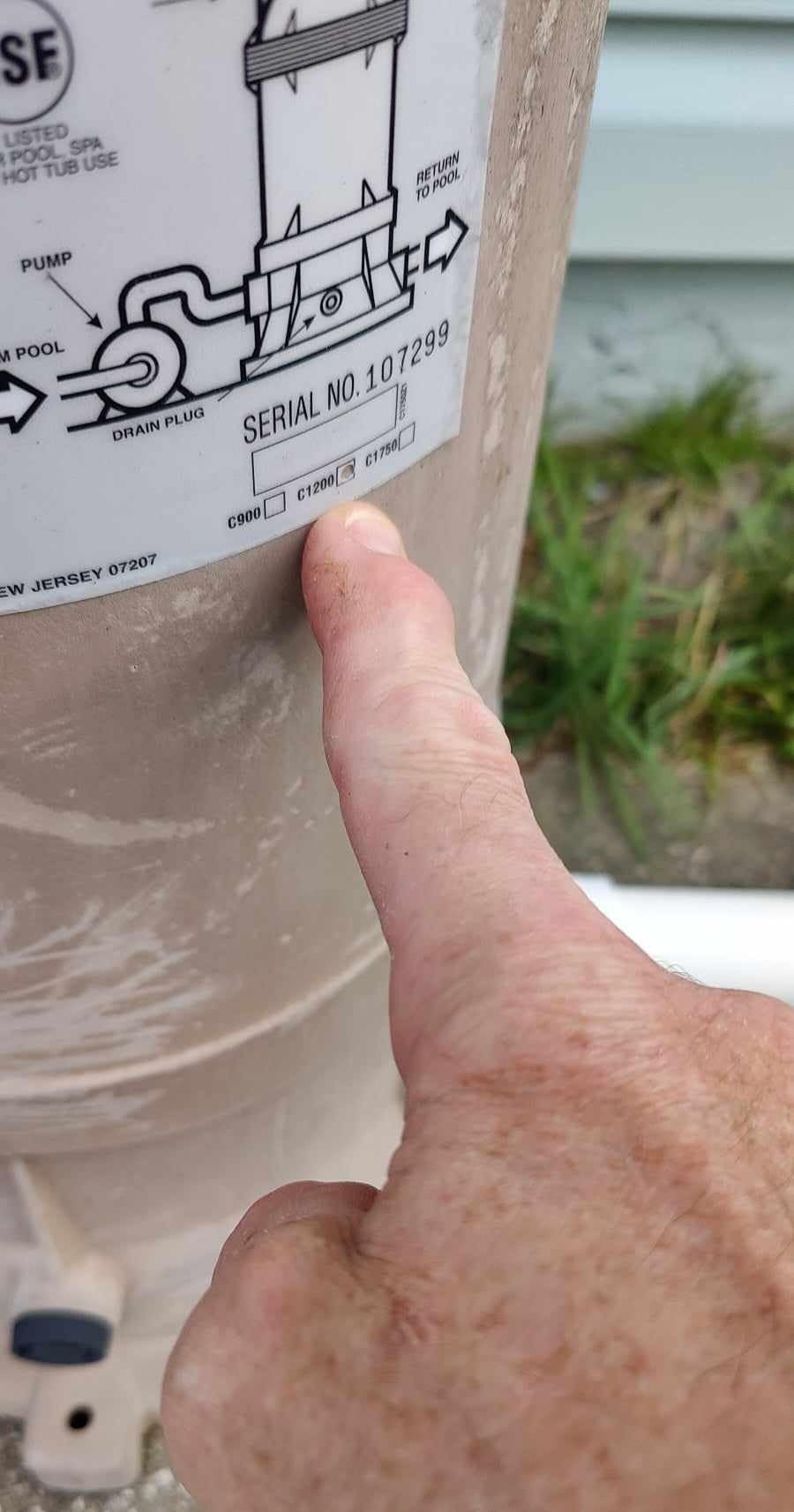
This is the cartridge I recommend to anyone with a Hayward Star Clear Plus C1200 who wants OEM performance without the OEM part number. It drops into the existing canister with no modification, and across the reviews the recurring line is that water clarity improves within a few days of the swap. The cross-reference list is long: Hayward CX1200RE, HAY823C, Unicel C-8412, Porpoise PP-B2, Clearwater II ProClean 125, Aladdin 22002, Filbur FC-1293 and AK-7005 all appear as replacements.
At 120 sq ft of filtration area in a cartridge that measures 23.25 inches long by 8.93 inches across, you get enough surface to run a standard in-ground pool on a four to six week cleaning rhythm. The trilobal fiber structure is the technical claim worth knowing about: the three-lobed fiber is designed to hold more fine particle on the surface so the element releases it when rinsed, which is why owners report recovering flow after a hose rinse rather than swapping immediately.
The honest weakness is weight and feel. Owners comparing it side by side with a genuine Hayward element describe this one as slightly less heavy-duty, and the pleat retaining bands make it a bit more work to rinse because debris has to be released from two places. Neither issue changed my mind about the fit, which is the part that usually goes wrong with aftermarket cartridges.
Reviewers also credit this filter with clearing algae blooms that had been persisting through chemical treatment alone, which is a reasonable outcome when the previous element was simply at the end of its service life and the water was never getting properly filtered.
How do I know it fits my housing?
Measure the element you are replacing. The C1200 is 23.25 inches long with an 8.9 inch outside diameter and a 4 inch opening at each end, and if your measurements match those three numbers you are fine. If they are close but not exact, the cross-reference list is still useful, but check the opening diameter in particular because that is what controls whether the cartridge seals.
Who should skip this cartridge?
Owners of larger Hayward SwimClear housings need more area than 120 sq ft provides, and owners of Pentair Clean and Clear systems need a completely different form factor. This one is for the single-element Star Clear Plus C1200 canister, and forcing it into a larger tank wastes both space and effort.
3. Volca Spares Type VI – Best for Inflatable Spas and Lay-Z-Spa Units
Type VI Filter Cartridge for Bestway, Lay-Z-Spa, Coleman SaluSpa
4.1 x 3.1 inch element
Dacron media
Type VI fit
Pros
- Exact fit for Coleman
- Bestway
- Lay-Z-Spa and SaluSpa housings
- Multi-pack pricing suits weekly spa changes
- Dacron media captures hair leaves dust sediment and sand
- Rinses and reuses a few times
Cons
- Clogs faster than larger cartridges so cleaning is weekly
- Some international reviews report media delaminating in use
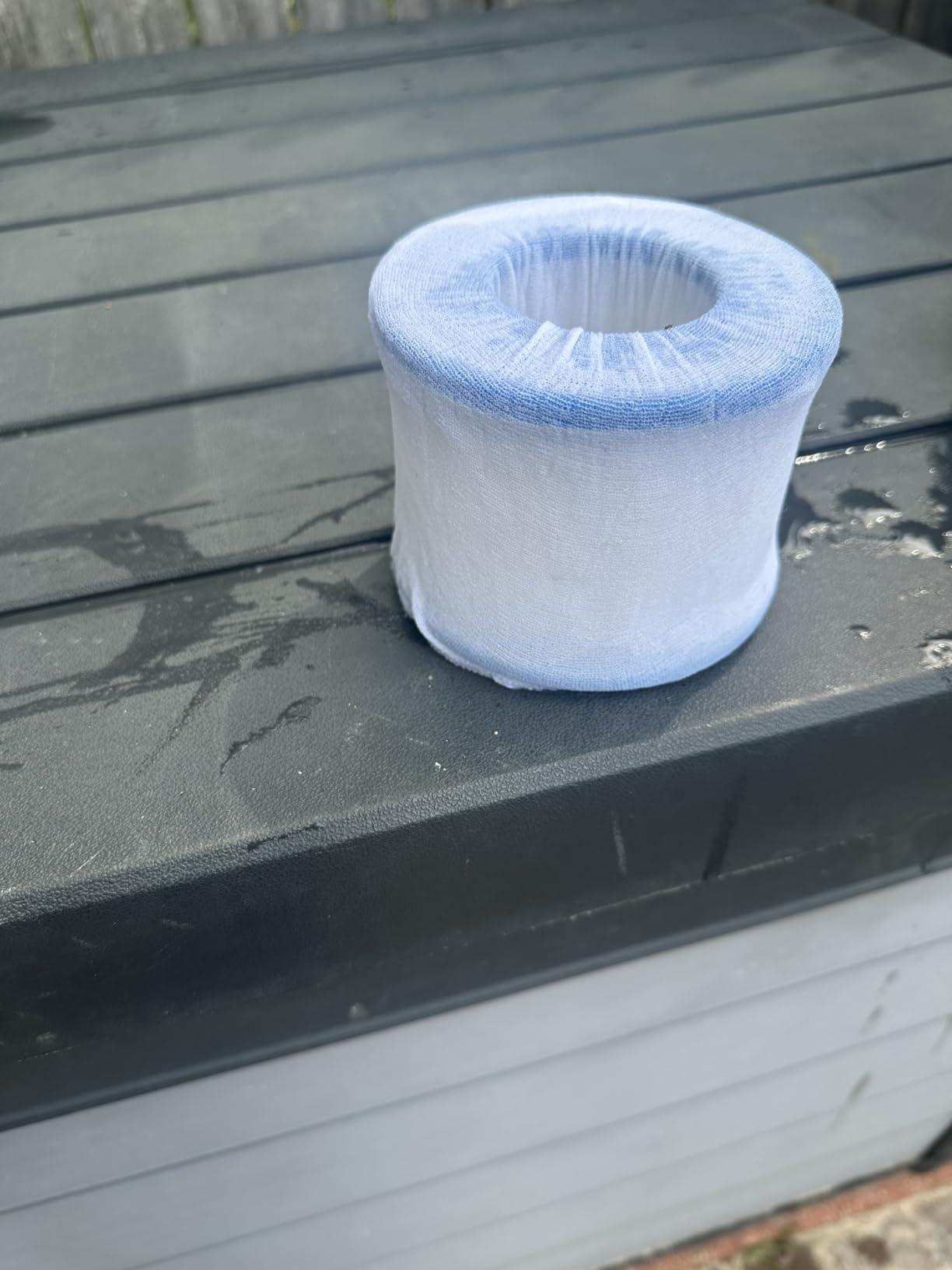
Hot tub and inflatable spa cartridges live in their own category, and this is the one I would buy for a Coleman SaluSpa or Bestway Lay-Z-Spa. The element measures 4.1 by 3.1 inches and is the Type VI format used across those spa lines, which means it seats in the housing that came with the unit. Nobody should be cross-shopping spa cartridges against pool cartridges, and this listing is unambiguous about which side it is on.
The operating reality of a spa is that the water runs hot, the pump runs long and the load is mostly body oil, sunscreen and hair. A small element under that load clogs quickly, which is why the manufacturer recommends cleaning often and replacing every few weeks when used heavily. Multi-packs are the sensible way to buy it for the same reason the Intex two-pack exists.
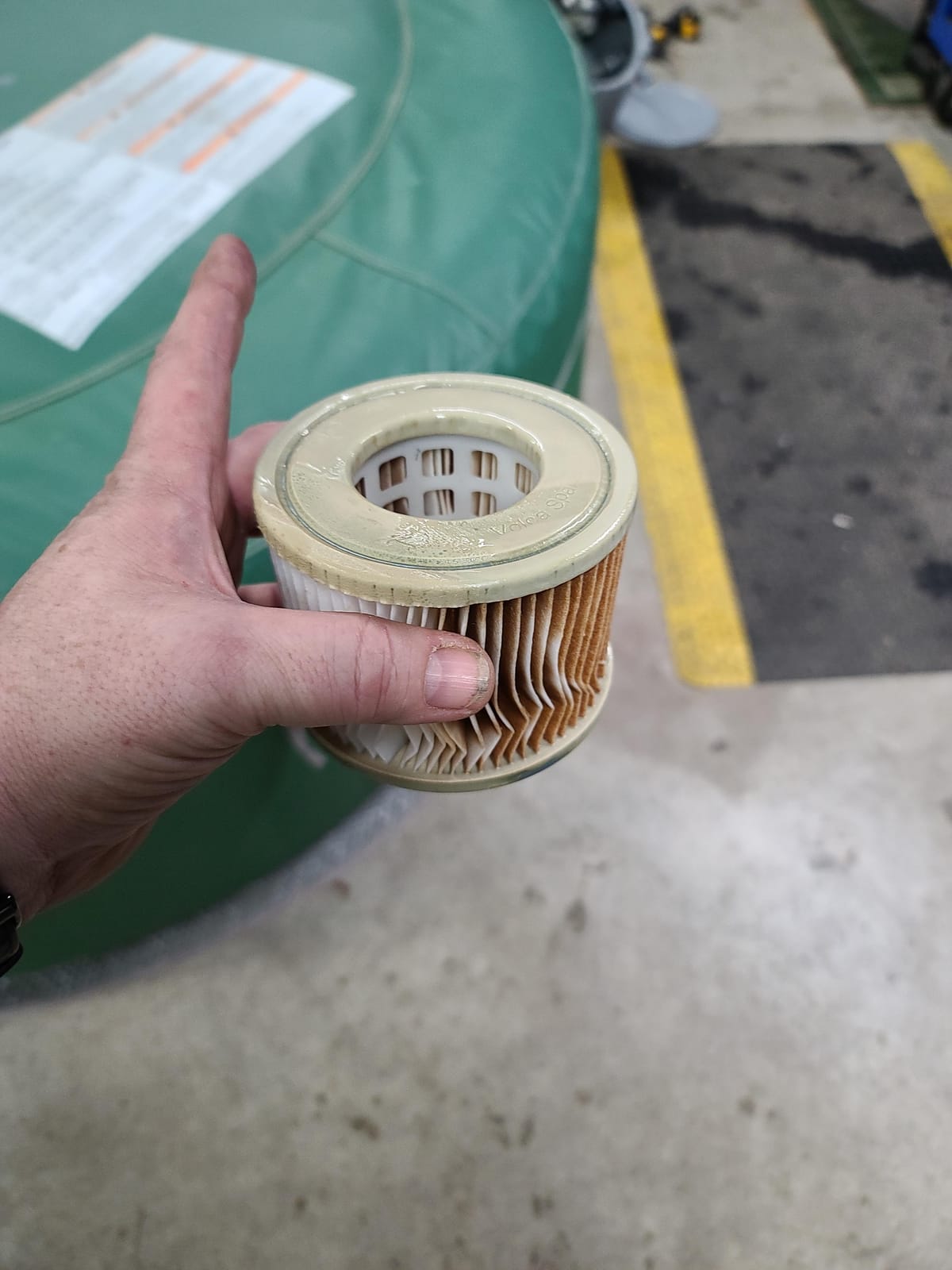
Durability feedback is the one place this listing splits. The large majority of reviews describe rinsing, reuse and solid fit. A smaller set of reviews from outside the US describes media that delaminates and breaks down in use, so if you are buying in bulk for a rental or a high-use spa, buy one pack first and see how it holds over a month of daily operation.
One more practical note: the rating sits at 4.6 with a best sellers rank at the top of the pool filter cartridge category, which tells you the fit is not in doubt. The open question is purely how long the media lasts under heavy spa duty.
How often should a spa cartridge be rinsed?
Every week under normal use, and more often when several people use the tub. A spa is a small volume of water with a high circulation rate, so contaminants arrive faster than they do in a pool. A quick rinse with a garden hose or a filter-cleaner soak every seven days keeps flow up and extends element life considerably.
Who should skip this cartridge?
Pool owners. There is no scenario where a 4.1 x 3.1 inch Type VI element belongs in an in-ground filter housing. If you are reading this section because you searched for a pool cartridge, you want one of the in-ground elements further down instead.
4. Pleatco PCC105-PAK4 – Top Rated for Pentair Clean and Clear Plus 420
Pleatco PCC105-PAK4 Replacement Cartridge for Pentair Clean and Clear Plus 420, Pack of 4 Cartridges
Fits Clean and Clear Plus 420
Molded Free Flow core
Pack of four
Pros
- Free Flow molded core runs at measurably lower pressure than the OEM cartridge
- Fits the Pentair Clean and Clear Plus 420 without modification
- Long-term owners report multi-year service life
- Washes clean with a high-pressure hose
Cons
- Pleat retaining bands can loosen after roughly two years
- One reviewer received a cartridge with a cracked plastic ring
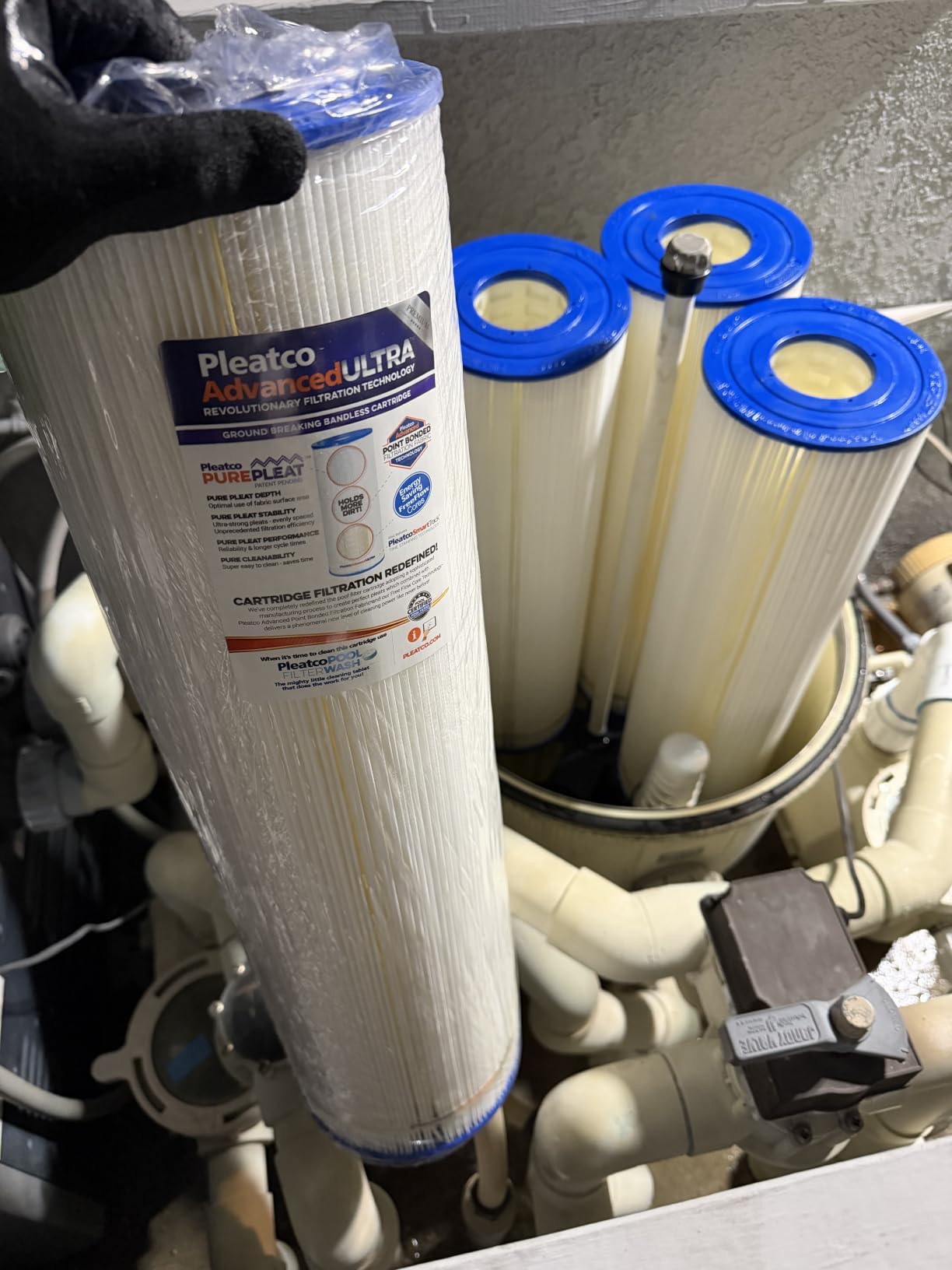
The Pentair Clean and Clear Plus 420 is one of the most common large in-ground housings in the country, and this is the element most owners upgrade to. The reason is the Free Flow molded core, which is more open than the drilled PVC pipe core in the original cartridge. Owners who log the pressure gauge before and after the swap consistently report the same result: similar or slightly better fine particle filtration at noticeably lower housing pressure.
That matters more than it sounds. Lower pressure across the filter means the pump moves the same gallons per hour with less head to push against, and on a variable speed pump it means you can run a lower speed and still turn the water over. Across a season, that is a real reduction in the hours your pump runs.
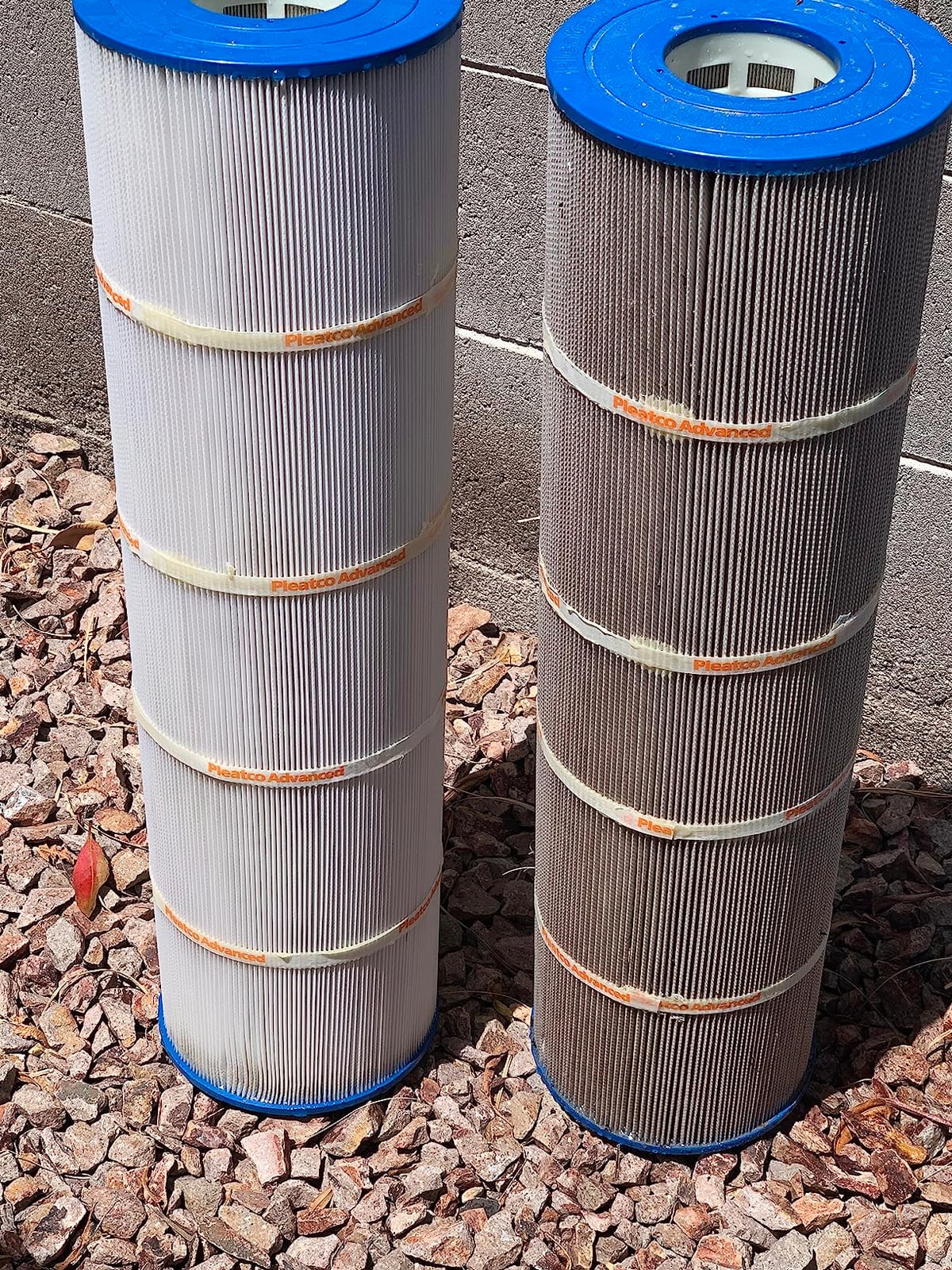
This pack of four is built for rotation. Owners running this cartridge tend to keep one clean and dry while another is in service, so a four-pack removes the excuse to put a half-dirty element back in the housing. The reviews here are longer and more technical than on any other listing in the roundup, which is a good sign for anyone trying to understand filtration rather than just replace a part.
The two drawbacks are small. Pleat retaining bands loosen or separate after roughly two years of service, and one reviewer received a cartridge with a cracked blue plastic ring on arrival. Neither is a reason to skip the part, but inspect the ring before you seat the element.
What does a Free Flow core actually change?
It removes the restriction inside the cartridge. A drilled pipe core blocks water at the center, so the whole element works against a smaller effective opening. A molded core with a wider flow path lets water reach the pleats more evenly, which shows up as a lower gauge reading at the same pump setting and better dirt distribution across the surface instead of heavy loading in one band.
Who should skip this cartridge?
Anyone whose housing is not the Clean and Clear Plus 420. The Pentair family has many similar-looking tanks, and a cartridge that is slightly too short will not seal properly no matter how good the media is. If your housing is a Clean and Clear 520, the 310 or 315, you need that part number instead.
5. U.S. Pool Supply Universal Type A/C – Budget Pick for Multiple Pump Brands
U.S. Pool Supply Universal Replacement Filter Cartridges, Type A or C, 4 Pk
Pack of four
PET fiber media
8 x 4.25 inch element
Pros
- Covers Intex
- Bestway and Summer Waves pump models in one cartridge
- Washable and reusable so four covers multiple cycles
- PET fiber media captures a lot of debris
- Hard plastic core resists collapse
Cons
- Slightly loose fit in some housings versus the OEM paper element
- Fit variance shows up in the 4.5 average rating
The pitch here is coverage. One cartridge format covers type A, type C and type III filters across Intex, Bestway and Summer Waves pumps running from 530 to 2,000 gallons per hour, and it directly replaces the Intex 59900E and 29000E elements. If your above-ground pool has been passed down twice or you are maintaining a rental, that breadth removes the guessing game that makes ordering the wrong part number so common.
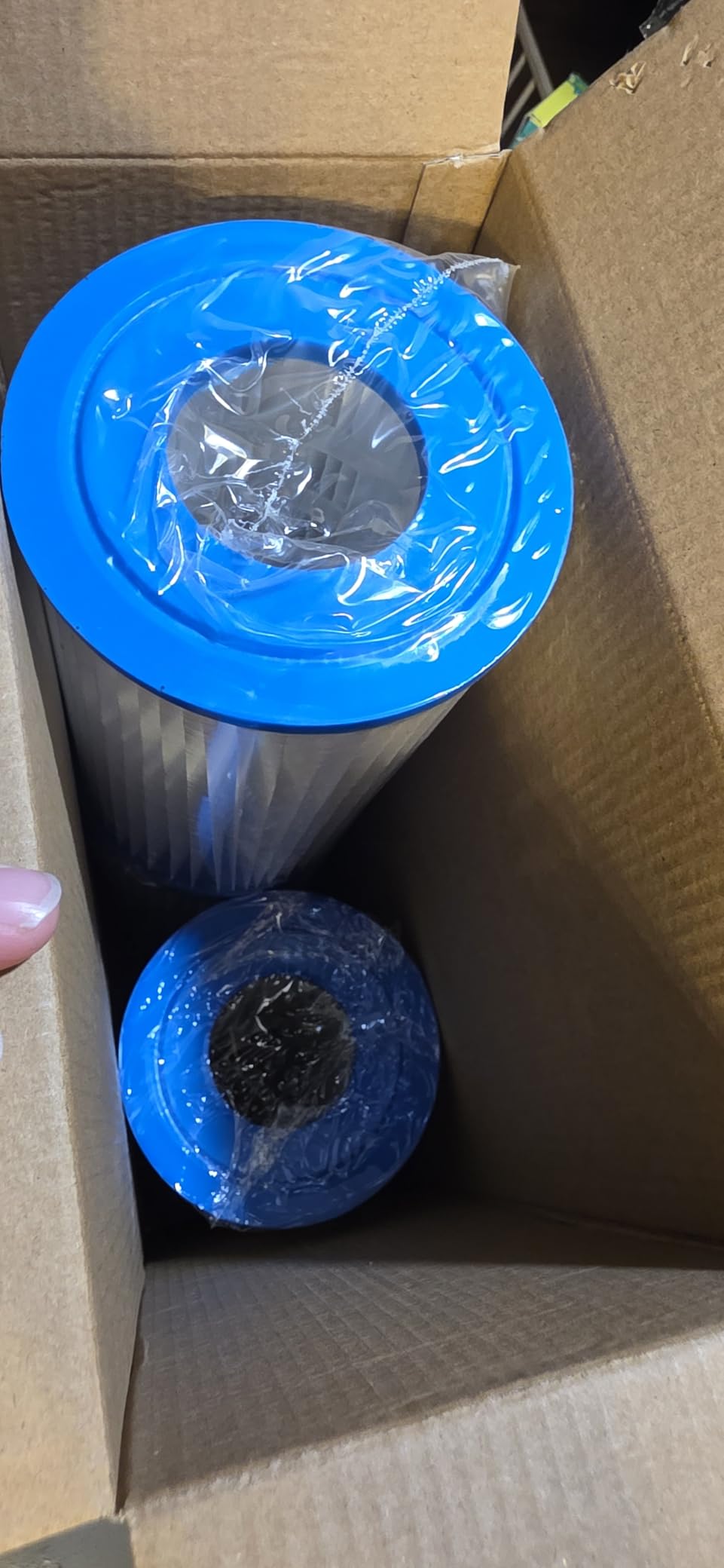
Construction is a PET fiber media around a collapse-resistant hard plastic inner core, sized at 8 inches high by 4.25 inches in diameter with a nearly 2 inch center hole. The core is the important part: cheaper cartridges use corrugated cardboard or a thin plastic ring, and those collapse under repeated pressure cycles, which is exactly the failure mode owners describe for unbranded cartridges in forum threads.
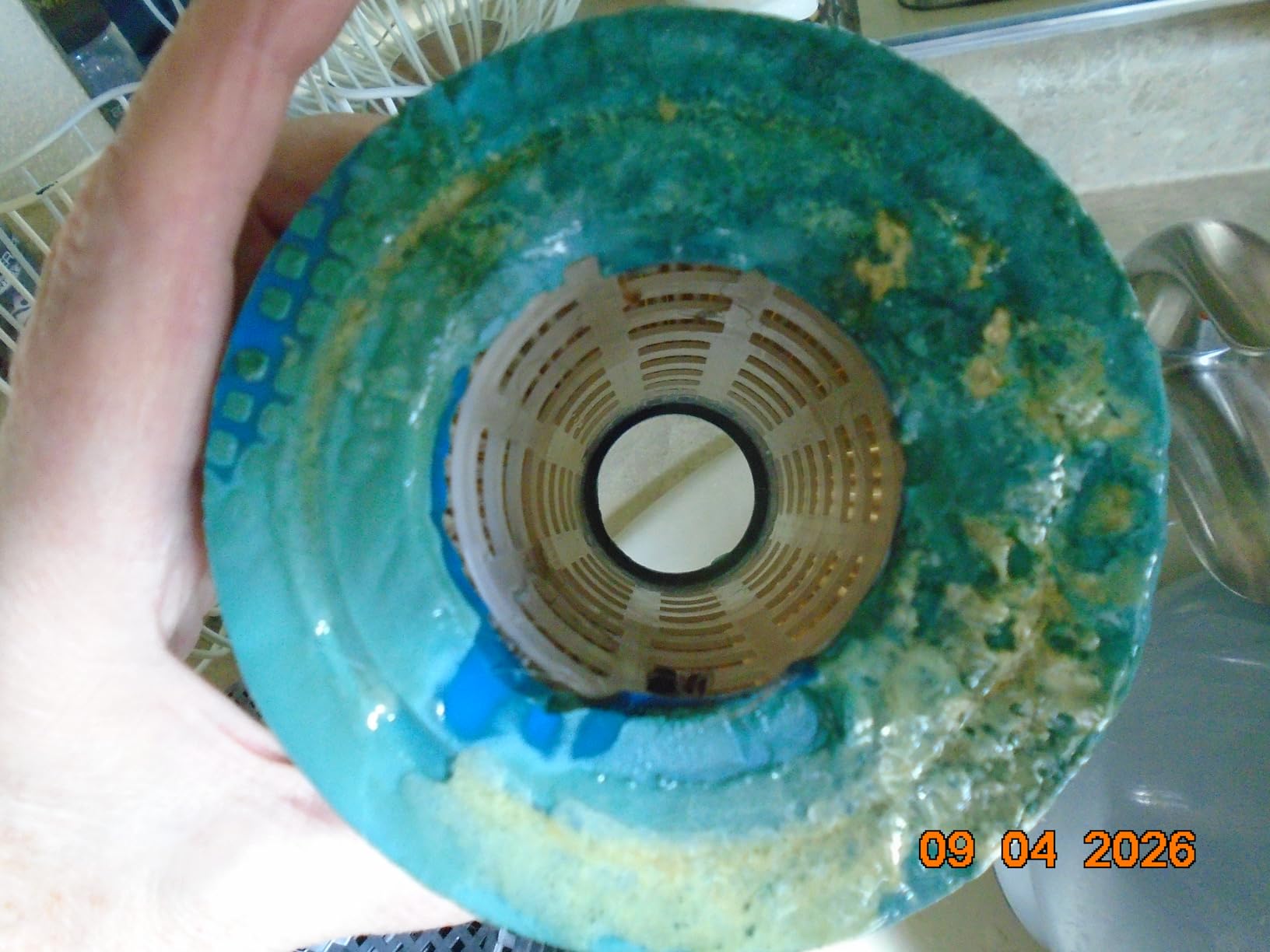
Reviews are short and positive, and the one repeated caveat is fit. Buyers describe it as a little loose in some housings while still filtering properly, and the 4.5 rating across more than 2k reviews reflects that variance honestly. If your pump housing is one where a loose cartridge could bypass the O-ring seal, buy the OEM element instead.
Because the cartridges are washable, four in a pack is genuinely a multi-season supply for a pool on the standard two-week change, rather than four single-use units. The manufacturer states the same two-week replacement guidance that Intex uses.
Is a universal cartridge as good as an OEM one?
For above-ground seasonal pools on a two-week change cycle, yes, because the cartridge is rarely in service long enough for media quality to be the limiting factor. For an in-ground pool, or anywhere you are trying to stretch an element to a year or more, the OEM element wins on media weight and pleat construction.
Who should skip this cartridge?
Owners of a large in-ground system, and anyone who values a tight seal above convenience. This is designed for the small above-ground pump housing, not for a pressurized 425 sq ft canister where bypass around a loose element would hurt water clarity.
6. Hayward CX900RE – Best for Hayward C900 Housings
Hayward CX900RE Pool Filter
Fits Hayward C900
8.9 x 4 x 17.3 inches
5.6 pounds
OEM element
Pros
- Genuine OEM construction with evenly spaced pleats
- Seats tightly and restores filtration quickly
- Multi-season service life with routine cleaning
Cons
- On very old housings the smaller end opening may need the ridge trimmed
- The element holds dirt and needs periodic hose cleaning
Plenty of buyers come to this listing for one reason: they want to be certain the part in their hand is a genuine Hayward and not a look-alike. The reviews make that distinction the whole point, describing branded labeling, uniform pleat spacing and cleanly trimmed end caps as the things that separate the real thing from a generic copy. If you have been disappointed by a look-alike before, that verification is worth paying for.
One design detail explains a lot of the fit. The end openings are cut slightly under the nominal 4 inch specification specifically so the element seals when seated, and that means you push down on the top as you install it to seat over the housing plenum. Owners who skip that push report a cartridge that feels loose until the pump is running.
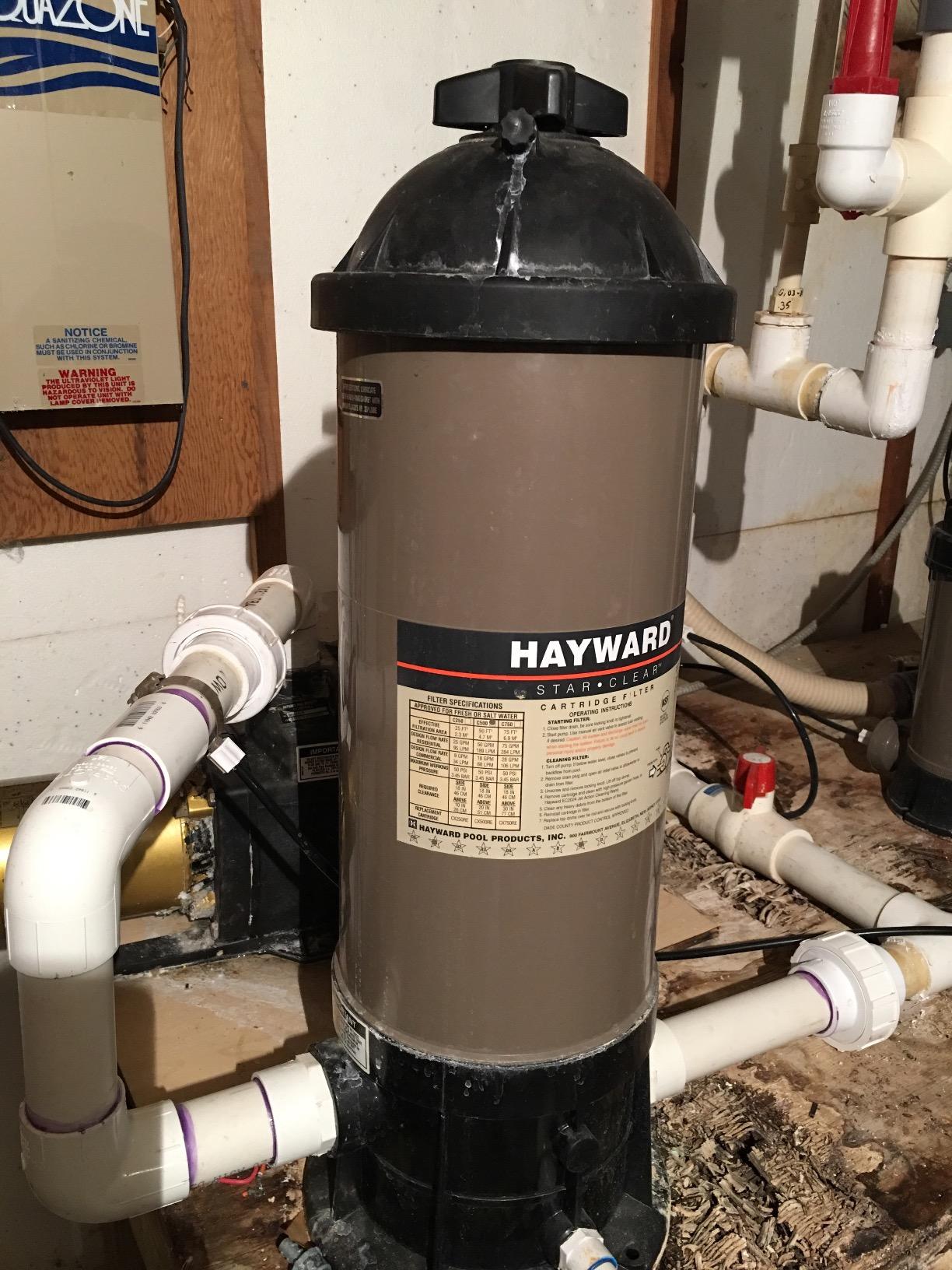
The same part family covers a wide range of tanks, with variants from CX250RE through CX2020RE available, so the Hayward C-series line is fully covered. That is a real convenience when the housing on your pad is a decade old and the model number on the label is faded.
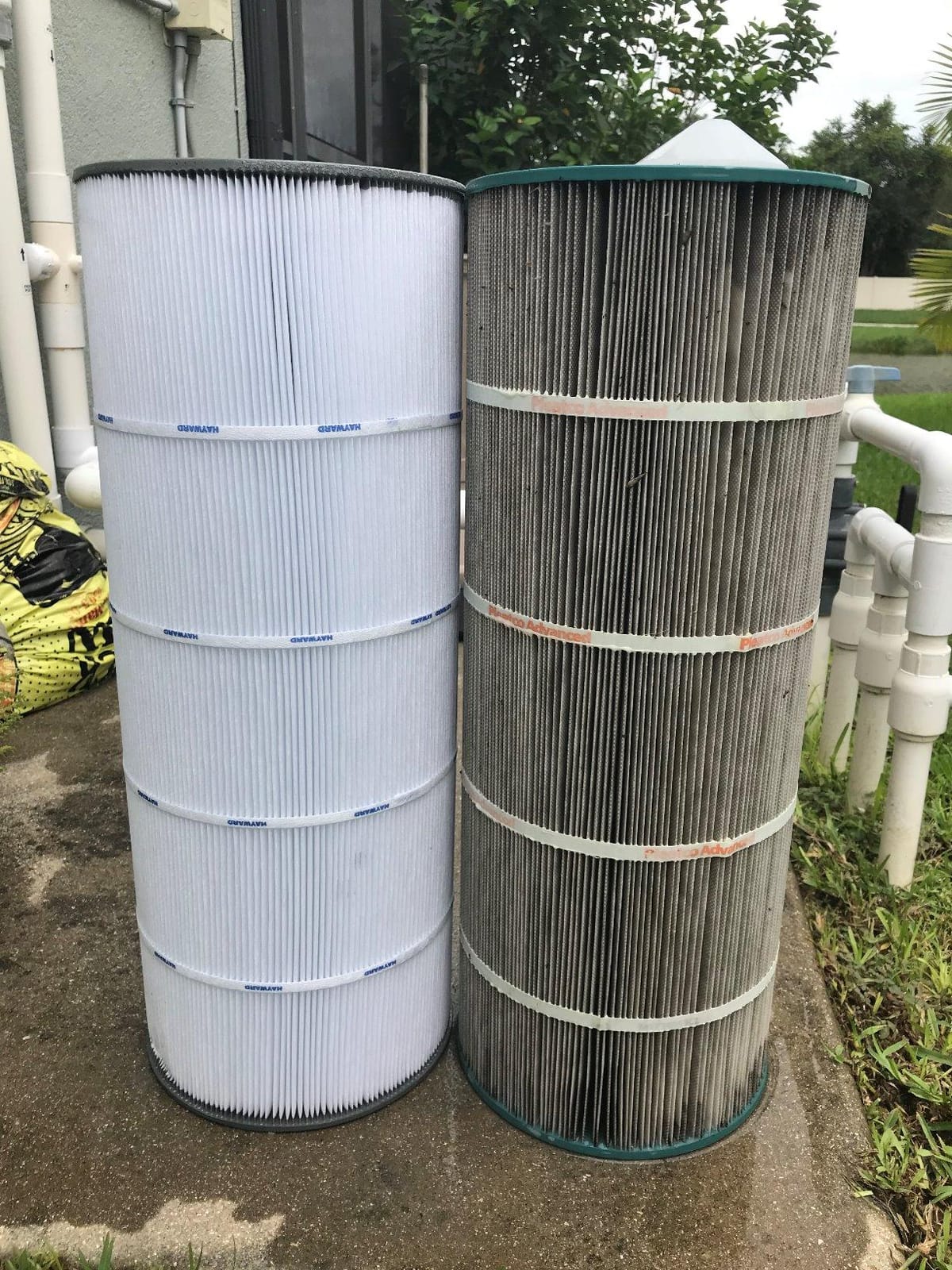
The limitations are honest ones. On some very old housings the slightly smaller opening needs the added ridge trimmed for a clean fit, which is a five-minute job with scissors but worth knowing before you order. And like every pleated element, it holds dirt and requires a hose rinse when the gauge climbs.
Why is the OEM element worth it for an older housing?
Dimensional consistency. The end opening size is what creates the seal with the housing O-ring, and on an older tank that has been heat-cycled for years, a cartridge that is even a fraction too large or too small changes how that seal behaves. The OEM spec is the one the housing was designed around.
Who should skip this cartridge?
Owners of a Star Clear Plus C1200, a SwimClear or a Pentair tank. This element is dimensioned for the C900 canister, and it is a single-element format, so it is not interchangeable with the larger quad-element housings. Check the model stamped on your tank lid before ordering.
7. Hayward CCX1000RE – Best for XStream and Star-Clear C225, C250 and C500
Hayward CCX1000RE Replacement Pool Filter Cartridge Elements, 100-Square-Foot
100 sq ft polyester
Extruded core
9 x 9 x 17 inches
Pros
- Reinforced polyester gives high filtration area for a small element
- Extruded core supports high flow and lower energy use
- Covers XStream
- Star-Clear and HCF housings
- Reusable through multiple rinse cycles
Cons
- Listed as a replacement part so you must already own the housing
- 100 sq ft means more frequent cleaning on dirty water
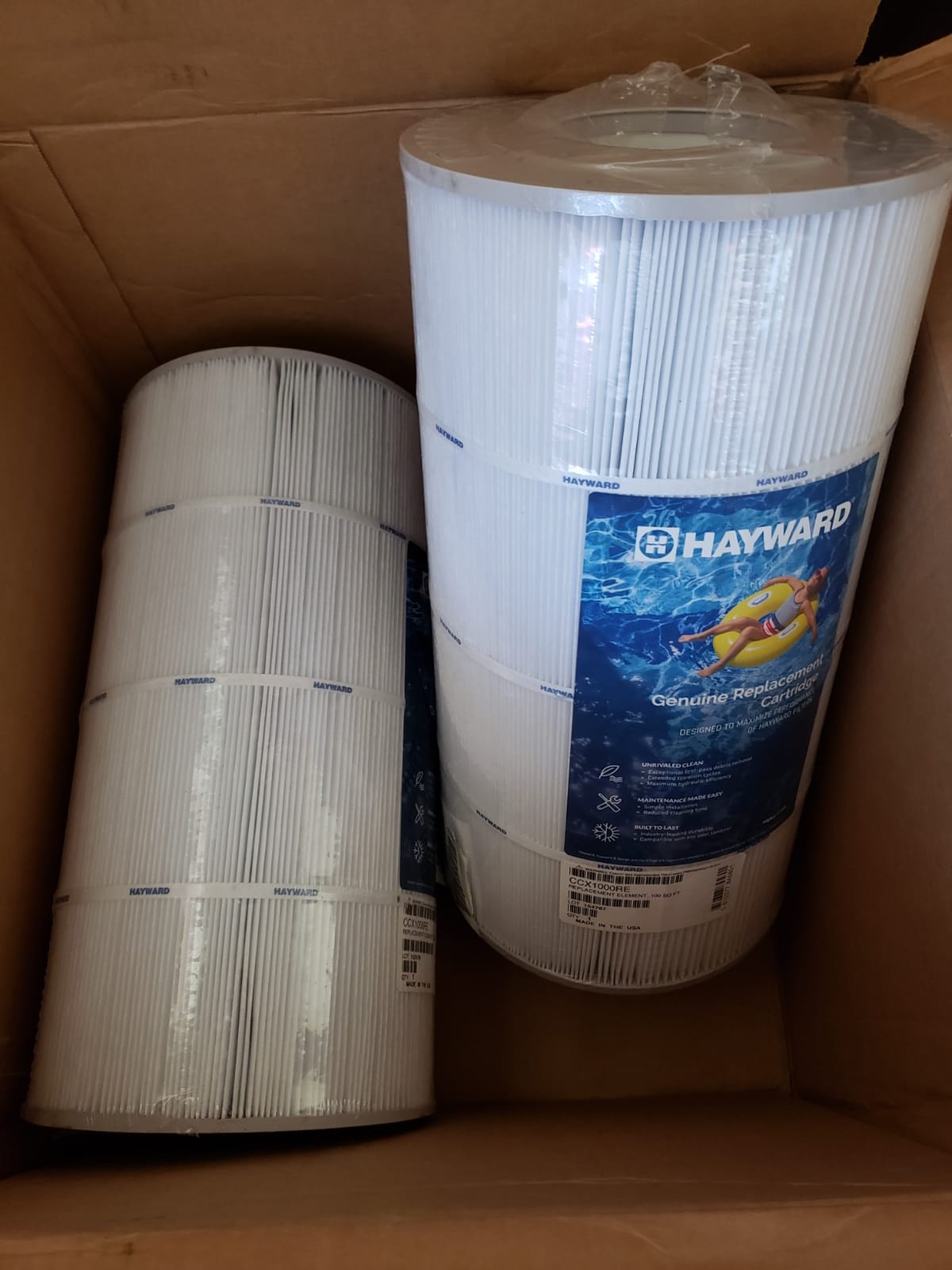
This one covers a housing list that gets missed in most roundups. It fits the XStream models including CC10092S, CC10092SFT, CC10092STL, CC15093S, CC150932S, CC15093SFT, CC15093STL and CC10093STUFFT, and it also fits the Star-Clear and HCF C225, C250 and C500. If your tank sits on the sideline of the Hayward line, this is the part you probably need.
At 100 sq ft of reinforced polyester in a 9 x 9 x 17 inch body, the area-to-volume ratio is efficient, and the extruded core is designed to keep flow high so the pump does not have to work as hard. The material is described as reinforced polyester, which resists the pleat deformation that ends the life of lower-grade elements.
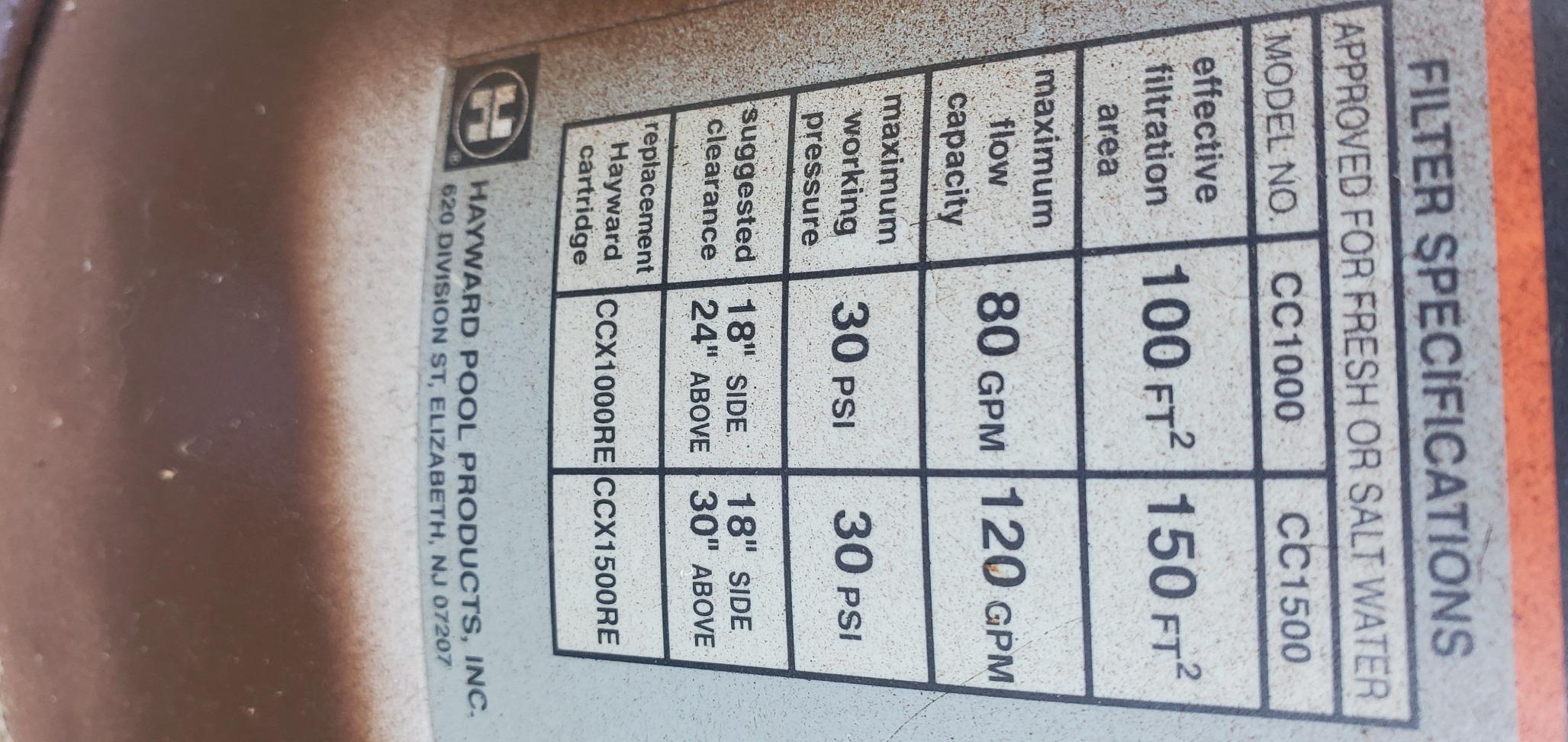
The main caveat is the filtration area. One hundred square feet is on the small side for a large in-ground pool, and owners on dirtier water report cleaning on a shorter cycle than the manufacturer would like. If your pool is heavily planted or sits under trees, a larger 425 sq ft option further down is a better fit for the same housing family style.
Feedback centers on correct sizing, solid construction and straightforward rinsing, which is what you want from a part you install every few years and expect to forget about.
How does a 100 sq ft element compare to a 425 sq ft one?
The 425 sq ft cartridge has more than four times the surface area, so it holds far more debris before the pressure gauge moves. In practice that means cleaning a few times a season instead of every few weeks. If your pool volume is modest or your water stays clear on its own, 100 sq ft is perfectly workable.
Who should skip this cartridge?
Owners of large pools or high-debris sites, and anyone who does not already own a compatible Hayward housing. It is strictly a replacement element with no tank, unions or lid included, so it does nothing on its own in a bare equipment pad.
8. Grefilt C4030 – Best for 425 Sq Ft of Filtration Area
C4030 Pool Filter Cartridges Replaces Hayward SwimClear C4030, CX880XRE
425 sq ft
5 oz trilobal fabric
30 micron
25.5 x 7 inch element
Pros
- Largest single-element filtration area in this roundup
- 5 oz thickened fabric with ABS end caps and support core
- 30 micron trilobal media resists clogging
- Buyers report improved flow and quieter pump operation
Cons
- Verify fit against existing filter dimensions before purchase
- Long-term durability is not yet established on this listing
This is the pick for anyone who wants the big in-ground filtration area without buying a genuine Hayward part number. At 425 sq ft in a single 25.5 inch by 7 inch element, it covers a large in-ground pool, and the media is 5 oz thickened trilobal fabric rather than the 4 oz standard, with high-strength ABS end caps and an integrated support core. Heavier fabric is what resists pleat collapse and keeps cleaning intervals long.
It replaces the Hayward SwimClear C4030, C4025 and C4020, and also covers Pleatco PA106, Hayward CX880XRE and Unicel C-7488. That compatibility is what makes it useful as a stopgap when your original element is no longer available at a sensible cost.
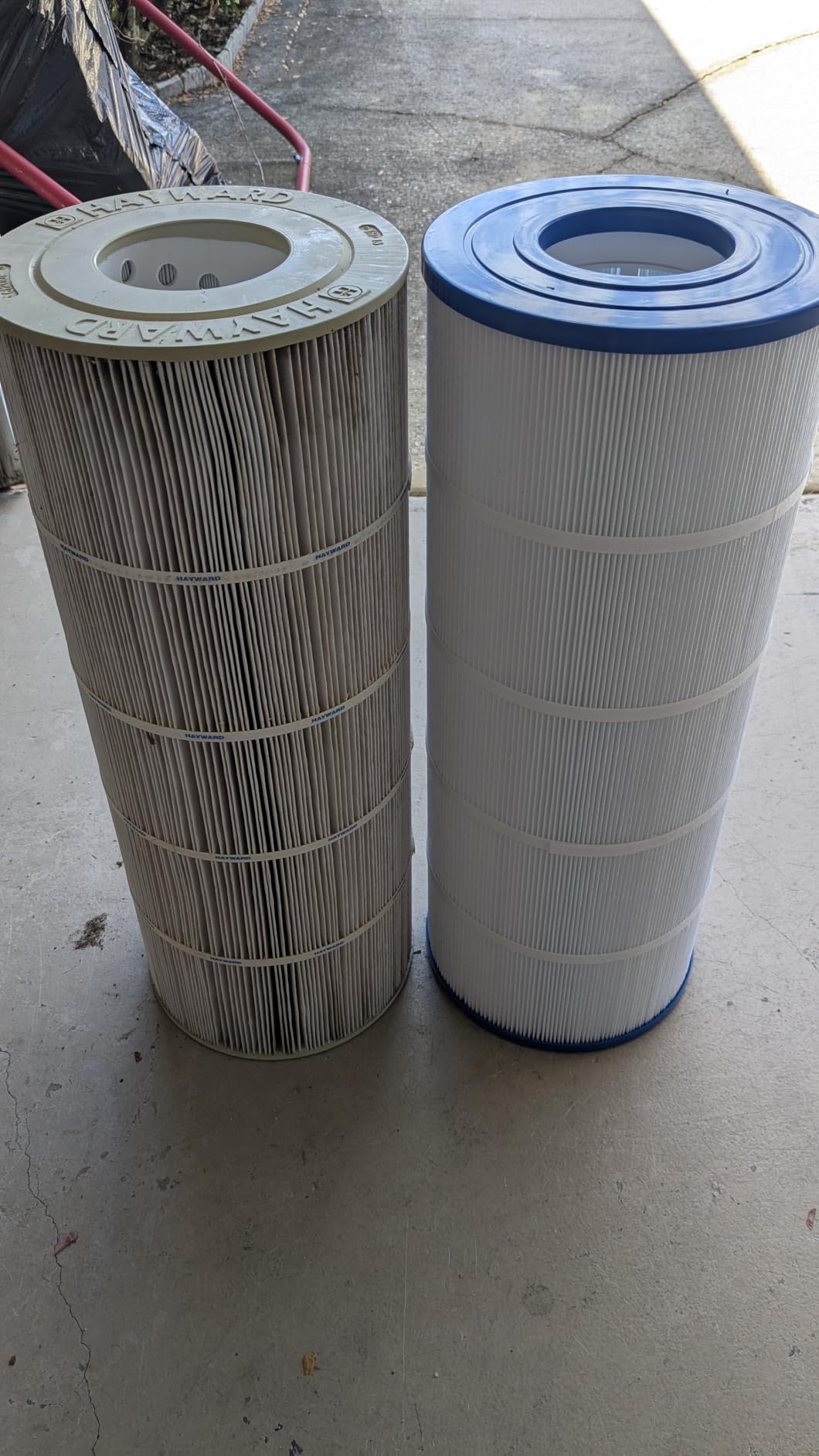
Owners across the Hayward-equivalent sizes report performance matching the OEM cartridge, a noticeable drop in pump noise and clearer water within days. The trilobal structure is described as having 40 percent more branches than standard media, which is marketing language for more surface area per square inch of element.
Two honest caveats. The listing itself instructs buyers to verify fit against existing filter dimensions, which is the right advice for any aftermarket part. And with 351 reviews, the long-term record is still short, so the multi-year durability claims here are thinner than for the Hayward and Pleatco parts.
What does 425 sq ft of filtration area buy me?
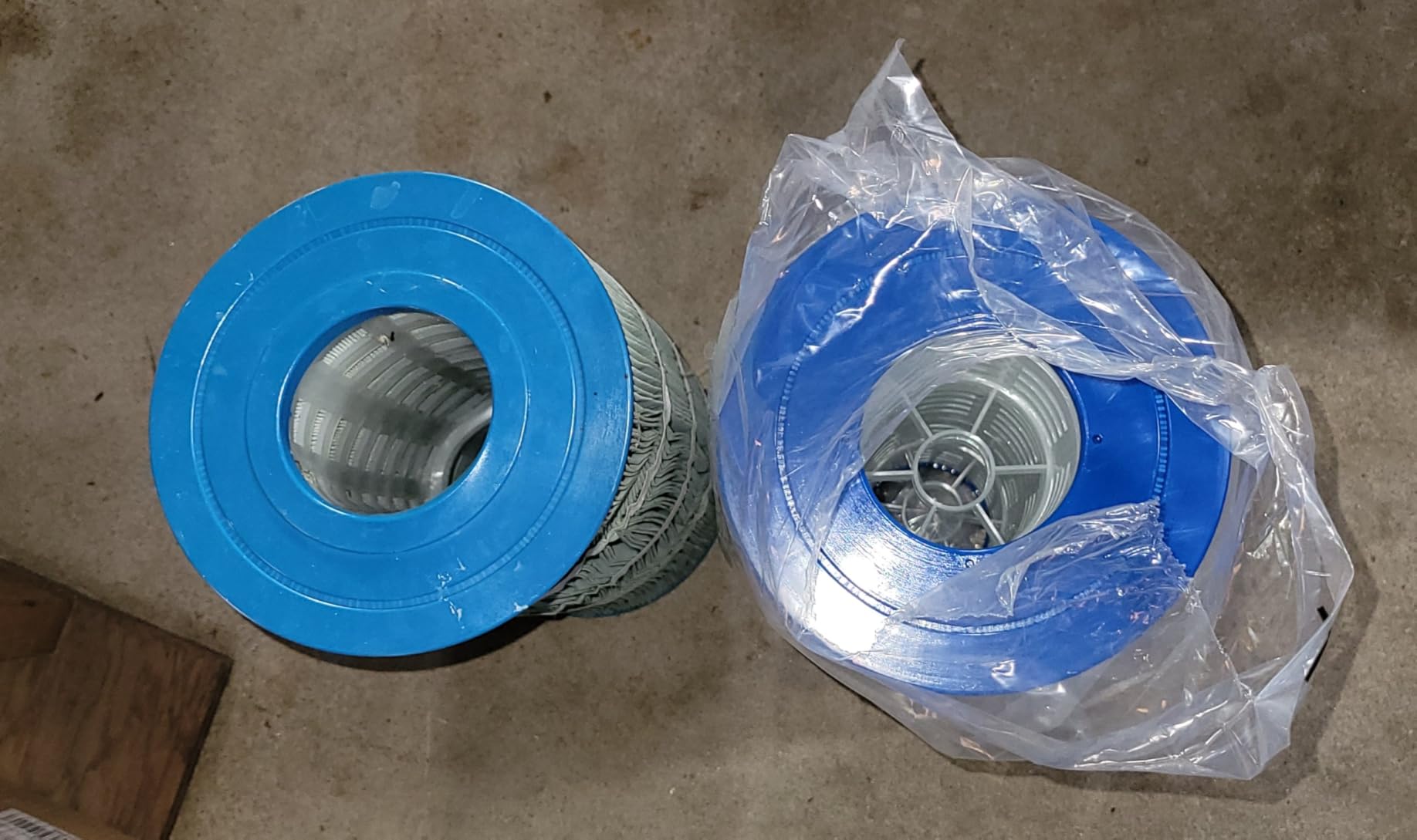
Time between cleanings. A 425 sq ft element on a standard mid-size in-ground pool usually runs four to eight weeks between hose rinses, where a 100 sq ft element on the same pool might need attention every two to three weeks. It also spreads the dirt load more evenly across the pleats, so each cleaning releases more of what was captured.
Who should skip this cartridge?
Owners who want a proven multi-year track record, and anyone whose housing is not in the Hayward C40-series family. The smaller pool of owner reviews is the reason for caution here, not the construction, which matches what the OEM parts use.
9. POOLPURE C-7375 – Best for Spa and Hot Tub Filters
POOLPURE C-7375 Spa Filter Replaces PCD75N, Unicel C-7375, Filbur FC-3964
75 sq ft
14.75 x 7 inch element
Replaces PCD75N
50 micron
Pros
- Correct fit for common spa housings including Caldera Salina
- Reports good clarity and flow at spa temperatures
- Lasts around a year with regular cleaning
- Two-pack option allows rotating a spare
Cons
- Intake tube port is a tight fit on installation
- Spa filter types are numerous so dimensions must be cross-checked
If the filter you are replacing is a PCD75N, this is the aftermarket equivalent, and it also covers Unicel C-7375, Filbur FC-3964, 1019301, AK-60032, APCC7500 and 17543. At 75 sq ft of trilobal fabric in a 14.75 inch by 7 inch body with a 2 and 11/16 inch bottom opening, it sits in the same class of element as the factory part rather than trying to be a larger upgrade.
Spa owners report clarity and flow that match the more expensive factory cartridge, and a service life of around a year when the element is cleaned regularly. The two-pack version is the smarter buy for anyone who does not want to stop and order while the tub is sitting dirty.
Installation is the one real friction point. The bottom port that fits over the intake tube can be very tight to seat, and spa filter types are numerous enough that a misread model number is easy. Measure the old cartridge before you order rather than trusting a listing title.
Is a 75 sq ft spa cartridge enough?
For a residential spa, yes. The tub holds a small volume of water and runs a high circulation rate, so the cartridge is servicing a manageable amount of water. What it needs is frequent cleaning rather than more surface area, which is why a weekly rinse matters more than an upgrade.
Who should skip this cartridge?
Pool owners and anyone whose spa filter is not in the PCD75N or C-7375 dimensional family. Because spa cartridges are small and numerous, buying on brand name alone is how people end up with a cartridge that will not seat over the intake tube.
10. VEVOR 200 Sq Ft Cartridge Filter System – Best for a Complete Replacement System
VEVOR 2026 Pro Pool Cartridge Filter System 200 sqft, Pool Filter for Inground & Above Ground Pools, Compatible W/Pumps 3HP~4HP | Up to 9827 GPH Max Flow, Pool Filters for Pools Up to 39625 Gallons
Complete housing and element
Up to 200 sq ft
Up to 9827 GPH
37 pounds
Pros
- Large capacity clears a full-size pool without backwashing
- Arrives assembled with standard 2 inch unions and thick gaskets
- PP plus fiberglass shell with 5.2mm wall thickness
- Pressure gauge and automatic relief valve included
Cons
- Pressure gauge is reported as arriving filled with fluid and hard to read
- Cartridge is not interchangeable with the tanks it replaces
- One reviewer reported the bleeder valve shearing and leaking
This is the only complete system in the roundup, and that changes the decision entirely. You get the housing, the element, the unions, the pressure gauge and the relief valve in one unit, which is the whole point if you are replacing a failed sand filter and do not want a multiport valve plumbed in. The cartridge holds up to 200 sq ft of media and the housing is rated up to 9827 GPH.
Buyers treat it as a sand filter alternative and the reviews reflect that framing. Praise concentrates on capacity, straightforward installation and size relative to pricier systems, and the shell is a polypropylene and fiberglass composite with 5.2mm wall thickness, which is a substantial tank for a residential installation.
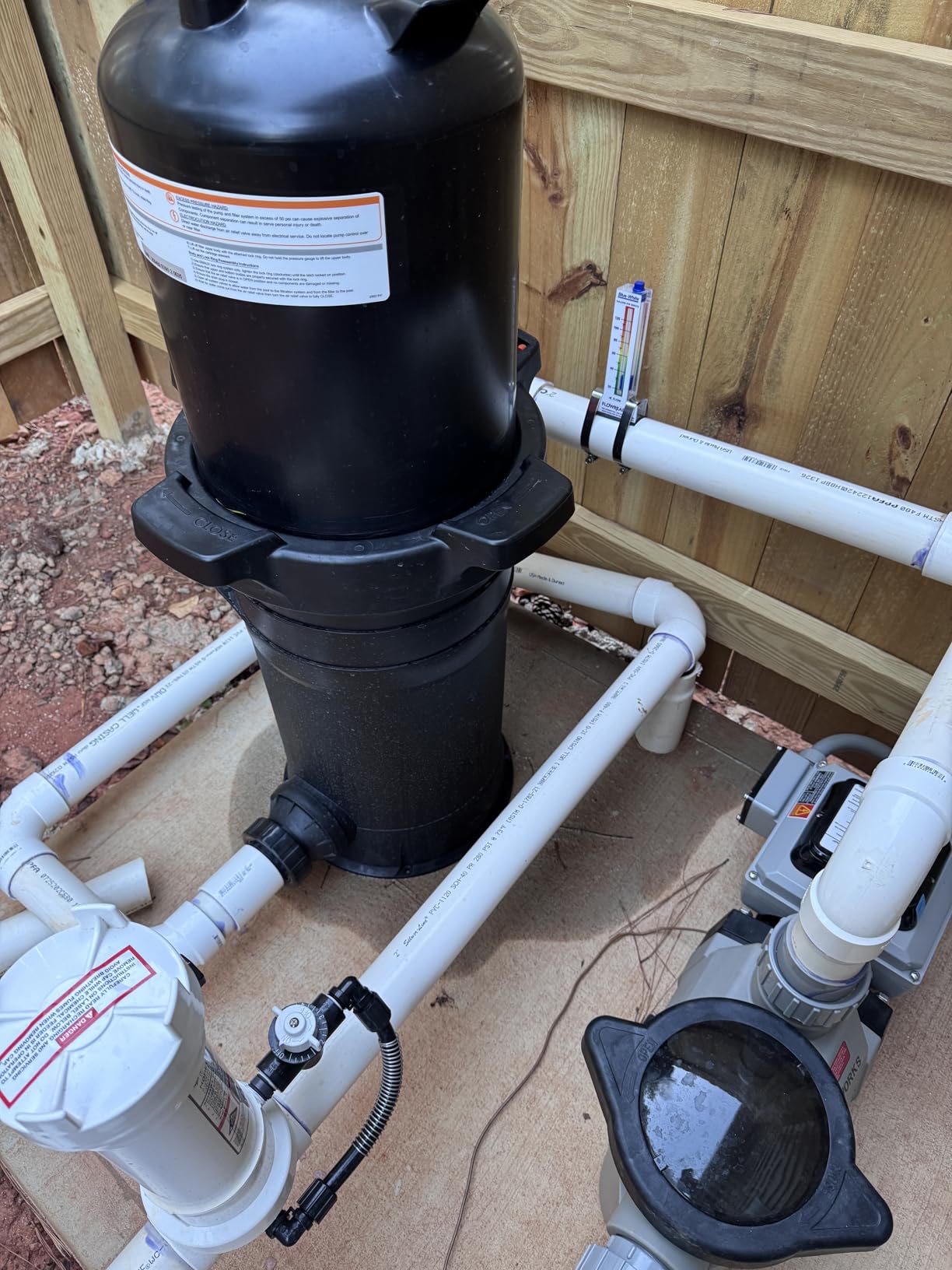
The 4.0 rating is the lowest in this roundup, and the complaints cluster in one place. The pressure gauge reportedly arrives filled with fluid and is hard to read, which matters on a cartridge system because the gauge is your main cleaning signal. One reviewer also reported the bleeder valve shearing off and leaking after about three months, and the cartridge dimensions are not interchangeable with the tanks it is meant to replace.
Cleaning and replacement are typically needed every two to three months on this system, which is a more demanding cycle than a large in-ground element, and the manufacturer states a 50 micron filtration rating. Plan on a higher replacement cadence and budget for a replacement element from day one.
Is a complete cartridge system cheaper to run than a sand filter?
Over several seasons it usually works out better, because a cartridge system does not discharge treated water when you clean it. Sand filters backwash and rinse, and every cycle sends water to the drain. A cartridge system uses a garden hose instead, so the saving is water and the trade is your time every two to three months.
Who should skip this system?
Owners with a working housing who only need an element, and anyone who wants a pressure gauge they can trust. At a 4.0 rating, this is also the one pick in the roundup where I would read the negative reviews before buying rather than after.
How to Choose a Pool Cartridge Filter
Six decisions determine whether a cartridge filter works well for your pool. Work through them in order and the model choice takes care of itself.
1. Decide tank or element first. If your equipment pad already has a housing with a working lid and unions, you need a cartridge element and nothing else. If the housing is cracked, missing or still a sand filter, you need a complete system, and you need to plan for replumbing because a cartridge filter has no multiport valve to reuse.
2. Size by total filtration area, not by the pool size on the box. The rule of thumb is roughly one square foot of filtration area per 1,000 gallons as a minimum, and 1.5 sq ft per 1,000 gallons if you want a genuinely relaxed cleaning schedule. On that basis: up to 15,000 gallons wants at least 90 sq ft and ideally 150; 15,000 to 20,000 gallons wants 150 to 225 sq ft; 20,000 to 25,000 gallons wants 225 to 300 sq ft; and 25,000 to 30,000 gallons wants 300 to 425 sq ft. Above-ground and soft-sided pools sit in a much smaller band, with 120 to 200 sq ft appropriate for anything above about 8,000 gallons.
3. Match the pump flow rate. A cartridge filter slows water down, and a pump that was sized for a sand filter will push more pressure through a cartridge. For a single-speed pump, stay at or below the housing design flow rate. With a variable speed pump, run the lower speed for filtration and step up only for vacuuming or draining, which is also the single biggest energy saving available to a cartridge filter owner.
4. Count elements, not square feet alone. Single-element tanks use one large cartridge. Quad tanks split the same total area across four smaller ones, which means the lid opens to four elements, the tank stays compact on a tight equipment pad, and the pleats are narrower so they capture finer particles. If you have limited space or you want finer filtration, quad designs win.
5. Look at pleat spacing and media weight. Wide pleat spacing is the variable that matters most on debris-heavy pools, because the gaps stay open instead of matting shut. Media weight of 4 oz is the common standard and 5 oz is heavy duty. This is the second-order specification that only one or two competitors in this space bother to explain, and it is worth more to you than a micron number on the box.
6. Read the micron claim skeptically. A 30 micron rating on a cartridge is honest. A 50 micron rating is a coarse capture figure that says more about marketing than about clarity. The useful question is not the micron number but whether the pleats are open, the media is thick and the element covers enough area for your pool volume. Never dose flocculant into a cartridge filter; use clarifier only. For more background on how media choices differ, our guide to polarizing filters covers the same kind of spec-versus-marketing gap in a different category.
On saltwater and SWG pools, pay attention to the gasket and union materials. A tank with a glass-filled polypropylene body and a dielectric O-ring at the lid seal holds up better to salt exposure than a thin plastic tank, and any filter you choose should be salt-rated if you are on a SWG system.
How to Clean a Cartridge Filter and Read the Pressure Gauge
Cleaning is the whole maintenance story for a cartridge system, and it is simpler than a sand filter. Five steps, no backwashing, no multiport valve.
1. Read the gauge before you do anything else. Note the PSI with the pump running and clean water. That number is your baseline, and every future decision is made against it.
2. Clean when the gauge reads 8 to 10 PSI above baseline. Not on a calendar. Gauge-based cleaning is the difference between cleaning six times a season and cleaning every few days, and it is the single most useful habit in cartridge ownership.
3. Turn off the pump, release the air from the lid, and lift the element out. Take a photo before you rinse. Knowing the pleat orientation and the position of any bands makes reassembly faster and reduces the chance of a crooked seat.
4. Rinse from the top down with a garden hose at about a 45 degree angle. Work around the pleats in one direction so debris releases instead of driving deeper into the media. A filter-cleaner soak is worth doing if the element has oils or sunscreen baked in.
5. Let it dry fully, inspect the pleats, and reseat. Never refit a damp element. Dry elements go back in with a proper seal, and a clean dry element stores well as a spare for next time.
What kills a cartridge is worth stating plainly. A pressure washer blasts pleats apart and is the single most common cause of early failure. Sunscreen, body oil and moisturizer from a hot tub bake into the media and are the reason spa elements need a filter cleaner rather than just a hose. And deferring replacement past the point where the pleats have started to deform removes all option but a new cartridge.
For the wider picture on how filtration stages fit together, see our picks for lens filters and pop filters, which break down the same tradeoffs between capture quality and maintenance for camera gear.
OEM to Aftermarket Pool Cartridge Cross-Reference
This is the chart owners actually ask for. The OEM part number on your old element tells you which aftermarket cartridge in this roundup replaces it.
Hayward CX1200RE, HAY823C, Unicel C-8412, Filbur FC-1293, Porpoise PP-B2, Aladdin 22002, AK-7005 – POOLPURE C1200, 120 sq ft, 4 oz fabric.
Hayward SwimClear C4030, C4025, C4020, Hayward CX880XRE, Pleatco PA106, Unicel C-7488 – Grefilt C4030, 425 sq ft, 5 oz trilobal fabric.
Pentair Clean and Clear Plus 420 – Pleatco PCC105-PAK4, molded Free Flow core.
Hayward C900 – Hayward CX900RE, genuine OEM element.
Hayward XStream CC10092S and CC15093S families, Star-Clear and HCF C225, C250, C500 – Hayward CCX1000RE, 100 sq ft.
PCD75N, CD75N, PCD75-N, Unicel C-7375, Filbur FC-3964, 1019301, AK-60032, APCC7500, 17543 – POOLPURE C-7375, 75 sq ft spa cartridge.
Intex 59900E and 29000E, type A, type C and type III pumps from 530 to 2,000 GPH – U.S. Pool Supply FCA-4, pack of four.
Intex filter pumps 28603EG, 28637EG, 28635EG – Intex 29002E Type A, two pack.
Bestway, Lay-Z-Spa, Coleman and SaluSpa Type VI housings – Volca Spares Type VI, 4.1 x 3.1 inch.
Forum threads about the OEM-versus-aftermarket question come down to measurement. If your old element measures 23.25 inches long with an 8.9 inch diameter, it is the C1200 class. Get one dimension, do not get three, and you will not be guessing.
Frequently Asked Questions
How often should a cartridge pool filter be cleaned?
Clean when the pressure gauge reads 8 to 10 PSI above your clean baseline, not on a fixed calendar. On a correctly sized cartridge filter for a mid-size in-ground pool, that usually works out to every four to eight weeks. On an undersized filter or a pool under heavy leaf load, you may be cleaning every one to two weeks. Always note the gauge reading with clean water first, because that baseline is what every later decision depends on.
How long does a pool cartridge filter last?
Two to five years is a realistic range when the element is rinsed regularly and never pressure washed. Owners on reddit.com/r/pools regularly report multi-year service life on Pleatco, Unicel and Filbur cartridges, and failure within a few months when elements are allowed to bake with sunscreen, oil and debris. Above-ground Type A elements are the exception: those are designed around a two-week change and are effectively consumed in a season or two.
Which brand of pool filter cartridge replacement is the best?
Pleatco, Unicel and Filbur are the three established aftermarket names, and forum consensus favors them over unbranded cartridges for media quality and longevity. Pleatco stands out for molded core designs and broad OEM cross-references, while Unicel and Filbur cover the same Hayward and Pentair part numbers at similar build quality. Hayward OEM elements remain the safest choice when you are not certain of the part number.
Which pool filter is better, sand or cartridge?
Cartridge is the better default for most residential in-ground pools because it filters down to finer particle sizes, never discharges treated water, and needs no multiport valve. Sand carries a lower purchase price and backwashes itself, but it is coarser, wastes water at every cleaning and is far harder on a variable speed pump. A DE pool sits between the two on clarity and above both on maintenance effort.
Is 20 psi too high for a pool filter?
Twenty PSI is high but not immediately damaging if it is your normal operating reading. The meaningful number is the change from baseline, so a filter running at 20 PSI constantly is fine while a filter that jumps from 8 to 20 PSI needs cleaning now. If the gauge keeps climbing after a clean element goes back in, check for a bypassed or unseated O-ring rather than rinsing again.
Are some pool filter cartridges better than others?
Yes, and the difference shows up in media weight, core design and pleat construction rather than the micron number on the box. Four ounce polyester is the common standard, 5 oz is heavy duty, and a molded or extruded core pushes more water through the same element than a drilled pipe core. A 50 micron marketing claim tells you very little, since a well-made cartridge with 4 oz media typically captures far finer particle than that figure suggests.
Final Verdict on the Best Pool Cartridge Filters in 2026
The Intex 29002E Type A takes the top spot for the widest compatibility in the roundup, with more than 54k reviews backing the fit across three pump models. For in-ground owners, the Pleatco PCC105-PAK4 is the upgrade worth making: the Free Flow core drops housing pressure and a pack of four supports rotation between clean elements. The POOLPURE C1200 is the value pick for Hayward Star Clear Plus owners, and the Grefilt C4030 is where 425 sq ft of filtration area comes without an OEM part number.
Use the Hayward CX900RE and CCX1000RE when you are certain of your housing model, the U.S. Pool Supply four-pack when one cartridge needs to cover several above-ground pump brands, and the POOLPURE C-7375 or Volca Spares Type VI for spas. The VEVOR system is the one complete replacement here, and it is worth reading the low-rating reviews before committing.
Measure your housing, count your gallons, and buy for total filtration area rather than the pool size printed on the box. Then start tracking your clean-water pressure reading today, because that number is what makes every future cleaning decision easy.